


Three years into the artificial intelligence boom, the question investors ask has changed. In 2023 it was “is this real?” In 2026 it is “how much of it is already in the price?”
- Why AI Is Still a Long-Term Theme, Not a Trade
- How to Judge an AI Stock (Before You Look at Any Ticker)
- Layer 1: AI Infrastructure Stocks
- Nvidia (NASDAQ: NVDA)
- Broadcom (NASDAQ: AVGO)
- Micron Technology (NASDAQ: MU)
- Taiwan Semiconductor (NYSE: TSM) and the picks-and-shovels tier
- Layer 2: Platform Stocks — Lower Risk AI Exposure
- Layer 3: Higher-Risk Pure Plays
- Don’t Want to Pick? Use an ETF
- The Case for Caution
- How to Actually Build a Position
- FAQs
- Conclusion
That is a harder question, and it is the right one. The companies powering AI are no longer speculative stories — they are among the most profitable businesses on earth, printing cash at a scale that makes the dot-com comparisons feel lazy. But their share prices have run hard, expectations are enormous, and the gap between a great company and a great investment has rarely been wider.
Best AI Stocks to Buy for Long-Term Growth this guide looks at the AI stocks that hold up best under a five- to ten-year lens, why each one earns its place, and what could go wrong. Prices and figures reflect early August 2026 and will move.
Why AI Is Still a Long-Term Theme, Not a Trade
Start with the spending, because that is what turns a technology story into an earnings story.
Global semiconductor sales set a record of roughly $120.6 billion in May 2026 — up more than 104% year on year and the fifteenth consecutive monthly record. That is not a sentiment indicator. That is chips being bought, shipped and installed.
Behind it sits hyperscaler capital expenditure. Estimates for total AI-related spending by major technology firms in 2026 cluster around $700 billion and up, and Nvidia’s own management has publicly framed the opportunity as $3 trillion to $4 trillion of AI infrastructure investment by the end of the decade. Grand View Research puts the global AI market on a compound annual growth rate above 30% through 2033.
Forecasts like these deserve scepticism — they are produced by people with an interest in the answer. But the near-term version is verifiable in quarterly filings, and those filings keep beating.
The honest caveat: growth is decelerating from an extraordinary base. Several research houses expect hyperscaler capex growth to slow into the high teens or low twenties in percentage terms during 2026, down from well over 50% in 2025. Slower growth is still growth. It is just growth that no longer justifies paying any price.
How to Judge an AI Stock (Before You Look at Any Ticker)
Most “top AI stocks” lists are a pile of names with no organising idea. It helps to think in three layers, because each layer carries a different risk profile.
Layer 1 — Infrastructure. Chips, memory, networking, power and cooling. Revenue is directly tied to AI build-out, visibility is strong, and the numbers are already enormous. The risk is cyclicality: when the build-out pauses, these fall hardest.
Layer 2 — Platforms. Cloud and software giants that monetise AI across a diversified business. Lower AI purity, lower risk, funded from operating cash flow rather than debt.
Layer 3 — Applications and pure plays. The highest theoretical upside and the highest chance of permanent capital loss. Customer concentration, unproven margins and rich multiples are common here.
A long-term portfolio usually wants weight in layers one and two, with layer three sized so that being wrong is survivable.
Three questions worth asking about any AI name:
- Does the revenue exist today, or is it a 2029 slide? Cash flow now beats a total addressable market later.
- Who pays the bills? If two or three customers drive most of the revenue, that is not a moat — it is a dependency.
- What breaks the thesis? If you cannot answer, you do not own a thesis. You own a hope.
Layer 1: AI Infrastructure Stocks
Nvidia (NASDAQ: NVDA)
Still the centre of gravity. Nvidia’s fiscal Q1 2027 results, reported in May 2026, showed revenue of $81.6 billion, up roughly 85% year on year, with data centre revenue at $75.2 billion. The detail that gets overlooked is networking — up almost 200% year on year to $14.8 billion — which shows Nvidia is selling the whole rack, not just the GPU. Guidance pointed to about $91 billion for the following quarter at a 75% gross margin.
The moat is CUDA. Roughly 80–90% of AI training workloads run on Nvidia silicon, and a generation of engineers writes code optimised for it. Switching costs like that do not evaporate in a quarter.
Shares traded around $219 in early August 2026, up roughly 18% year to date, on a P/E near 30 — cheaper than several peers. The next earnings date, 26 August 2026, is a genuine catalyst, though history is instructive: the market has largely stopped rewarding Nvidia beats with big post-earnings jumps, and the stock has slipped after several recent reports despite strong numbers.
Risk: China exposure, customer concentration among a handful of hyperscalers, and the reality that the law of large numbers eventually applies to everyone.
Broadcom (NASDAQ: AVGO)
The custom-silicon alternative, and arguably the more interesting story right now. Broadcom designs application-specific chips for hyperscalers who want to reduce their dependence on general-purpose GPUs, and it supplies the Ethernet switching that connects those clusters together.
Recent AI semiconductor revenue grew about 143% year on year, and management has guided to roughly $16 billion in AI chip revenue for the current quarter — more than 200% growth — on total revenue near $29 billion. CEO Hock Tan has publicly targeted over $100 billion in annual AI sales by 2027.

The VMware software business adds recurring revenue that smooths the earnings cycle, which pure-play chipmakers cannot match. Notably, the stock sat roughly 20% below its all-time high in early August 2026 despite that acceleration — the kind of gap that long-term buyers pay attention to.
Risk: A forward multiple well above Nvidia’s, meaningful debt from acquisitions, and heavy reliance on a small number of hyperscaler customers. Q3 results land 8 September 2026.
Micron Technology (NASDAQ: MU)
The memory play, and the one that has surprised most people. Fiscal Q3 2026 revenue came in at $41.46 billion — up roughly 346% year on year and nearly 18% ahead of consensus — with guidance pointing to a $50 billion quarter. High-bandwidth memory (HBM4) is shipping in volume for leading accelerator platforms.
Every AI chip needs memory sitting next to it, and HBM supply has been the genuine bottleneck.
Risk: Memory is the most brutally cyclical corner of semiconductors. Pricing has historically collapsed as fast as it has spiked. Investors who lived through 2018 and 2022 will size this position accordingly.
Taiwan Semiconductor (NYSE: TSM) and the picks-and-shovels tier
TSMC manufactures the leading-edge silicon for nearly everyone in this article, which makes it a way to own the trend without picking the winning design. Beyond chips, the physical layer has become its own trade: Vertiv Holdings (NYSE: VRT), which supplies data centre power and thermal management, was trading around $278 in early August 2026 after a Q2 report showing $3.27 billion in revenue, with the stock up over 70% year to date.
Risk for TSM specifically: geopolitical concentration in Taiwan is a real, unhedgeable tail risk. Position sizing is the only honest answer to it.
Layer 2: Platform Stocks — Lower Risk AI Exposure
Alphabet (NASDAQ: GOOGL)
Twelve months ago the consensus was that AI would kill Google Search. Instead, Gemini climbed the model leaderboards, AI Overviews and AI Mode drove more queries, and Google Cloud became the fastest-growing enterprise cloud among the megacaps.
Revenue growth around 22% year on year with a 36% operating margin, and a forward P/E near 29, makes Alphabet unusually reasonable for what it owns: its own models, its own TPU silicon, its own distribution, and roughly three-quarters of its internal code now AI-assisted.
Risk: Advertising is cyclical, and antitrust remains a live overhang.
Microsoft (NASDAQ: MSFT)
Azure plus Copilot embedded across Office, GitHub and LinkedIn makes Microsoft the default enterprise AI vendor. Growth is steadier and less spectacular than the chip names, which is the point — it is the position that lets you sleep during a semiconductor drawdown.
Amazon (NASDAQ: AMZN) and Meta (NASDAQ: META)
Amazon reports it cannot meet demand for AWS capacity, which tells you where the constraint sits. Meta is spending aggressively on ad-ranking and recommendation models, and its capex growth is among the highest in the group — but its most recent quarter disappointed the market, a useful reminder that heavy AI spending and near-term earnings do not always point the same direction.
Layer 3: Higher-Risk Pure Plays
CoreWeave (NASDAQ: CRWV) is close to a pure-play AI cloud, with revenue rising from about $5.1 billion in 2025 to an expected $10 billion-plus in 2026. It is also deeply unprofitable, heavily indebted, and Microsoft accounted for roughly two-thirds of its 2025 revenue. That is not a criticism — it is a description of the trade. Nearly all of its revenue depends on AI demand continuing exactly as forecast.
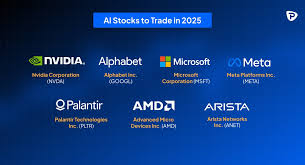
AMD (NASDAQ: AMD) is the credible second source in AI accelerators, with every point of share gained coming straight out of Nvidia’s hide. Execution risk is the whole thesis.
Names like these belong in the part of a portfolio you could lose without changing your life.
Don’t Want to Pick? Use an ETF
For most long-term investors, a broad technology or AI-focused ETF — or simply a low-cost S&P 500 fund — captures the theme with far less single-stock risk. Note the trade-off: the top ten S&P 500 companies now represent roughly 35% of the index, so a “diversified” index fund is already a substantial AI bet, whether you intended it or not.
The Case for Caution
Any list of the best AI stocks to buy for long-term growth is incomplete without the bear case, and it is not trivial.
Market concentration has passed dot-com levels — around 35% of the S&P 500 in ten companies, against roughly 25% at the 2000 peak. Bank of America’s bubble risk indicator has scored the semiconductor index near the top of its range. The S&P 500’s price-to-sales ratio has climbed well above its long-run average. Jamie Dimon and Ray Dalio have both flagged concerns publicly, and a mid-2026 sell-off showed how quickly the same names that led the rally can lead the decline.
The strongest counterargument is quality of earnings. Nvidia trades in the region of 30 times forward earnings. Cisco traded at over 400 times earnings in March 2000. Today’s leaders fund their data centres from operating cash flow rather than debt or dilution — with some notable exceptions in the pure-play tier, which is precisely where the leverage risk has migrated.
The real question is not whether AI is transformative. It is whether the transformation is already priced in. Reasonable investors disagree, which is exactly why it is still a market.
Read For Mor Info:
Circle Stock Analysis Before Earnings: Buy or Sell?
BTC Defends $62.5K While Bears Test Market Strength
MSTR Stock mNAV Framework Retains 1.0x Accretion Target
Bitcoin ETF Outflows Return: Is a Bigger Crash Coming?
How to Actually Build a Position
- Average in rather than going all at once. With volatility this high, a fixed monthly amount removes the need to be right about timing.
- Size positions so a 40% drawdown is uncomfortable, not catastrophic. Nvidia’s own CEO described the mid-2026 sell-off as a chance to buy at a discount. Anyone fully invested at the top could not act on that.
- Hold a core and a satellite. Platform names as the core, infrastructure as the growth engine, pure plays as a small satellite.
- Rebalance annually. After a run like this, a 5% position quietly becomes 20%.
- Decide your sell rule before you buy. Falling hyperscaler capex guidance, collapsing gross margins or a lost anchor customer are thesis-breakers. Price alone is not.
FAQs
Which is the best AI stock to buy for the long term? There is no single answer that fits every investor. Nvidia has the strongest ecosystem moat, Broadcom the fastest current AI revenue growth, and Alphabet arguably the best combination of AI exposure and reasonable valuation. Which suits you depends on your time horizon and risk tolerance.
Are AI stocks in a bubble in 2026? Valuations are stretched by most historical measures, and concentration exceeds dot-com levels. However, today’s leaders generate substantial real profits, unlike most 1999 internet companies. The likelier outcome is sharp, painful corrections within a longer uptrend rather than a single collapse — but nobody knows this in advance.
Is it too late to buy AI stocks? Being three years into a build-out that management teams describe in trillion-dollar terms is not the same as being at the end of it. It does mean the easy gains are gone and entry price now matters much more than it did in 2023.
How much of a portfolio should be in AI stocks? That depends entirely on your age, income stability and other holdings. Remember that a standard index fund already carries heavy AI exposure, so many investors are more concentrated than they realise.
What are the safest AI stocks? Diversified platform companies — Microsoft, Alphabet, Amazon — carry lower single-theme risk than pure-play infrastructure names, because AI is one revenue driver among several.
Conclusion
The best AI stocks to buy for long-term growth in 2026 are, for the most part, the companies already earning serious money from the build-out: Nvidia and Broadcom in silicon, Micron and TSMC in the supply chain, Alphabet and Microsoft in platforms. The upside case rests on capital expenditure that is documented in filings rather than promised in press releases.
The downside case rests on valuations that leave very little room for disappointment — and on the possibility that the enormous sums being spent do not generate returns fast enough to justify them.
Both can be true. That is why position sizing, a long horizon and a written thesis matter more here than stock picking does.
Disclaimer: This article is for informational purposes only and is not investment advice, a recommendation, or an offer to buy or sell any security. All figures reflect publicly reported data as of early August 2026 and are subject to change. Investing in equities carries risk, including loss of principal. Do your own research and consider speaking with a licensed financial adviser before making investment decisions.