

Key Insights
- NYSE is developing a tokenized securities trading platform.
- The exchange aims to provide investors with a full tokenized trading experience starting this year, pending regulatory approval.
- Traditional exchanges are increasingly moving toward tokenization to enable 24/7 trading and instant settlement.
A New Chapter for the NYSE
The New York Stock Exchange (NYSE), one of the world’s most iconic financial institutions, has announced a major strategic shift: it is developing a blockchain-based platform for tokenized stocks and exchange-traded funds (ETFs). This marks a significant milestone in the ongoing integration of traditional finance (TradFi) and decentralized finance (DeFi) principles.
- Key Insights
- A New Chapter for the NYSE
- What Does Tokenization Mean for Stocks and ETFs?
- NYSE’s Tokenized Trading Platform: What to Expect
- Regulatory Approval: A Critical Requirement
- When Will the Platform Launch?
- Traditional Exchanges Are Racing Toward Tokenization
- Why 24/7 Trading Matters
- Institutional Support: ICE, Banks, and Clearinghouses
- Industry Support for Tokenization
- Regulatory Progress: SEC Support for Pilot Programs
- The Future of Tokenized Trading: What It Could Mean for Investors
- Improved Market Accessibility
- Lower Barriers to Entry
- Faster Settlement
- Increased Transparency
- Greater Efficiency
- Challenges and Risks
- FAQ’s
- What is the NYSE tokenization platform?
- What benefits does tokenization bring to investors?
- When will the NYSE tokenization platform launch?
- Is the platform already approved by regulators?
- What role does blockchain play in the NYSE platform?
- How is NYSE different from Nasdaq in tokenization?
- Which companies are supporting NYSE’s tokenization strategy?
- Conclusion
The announcement came on Monday, revealing that the platform will rely on blockchain technology to enable on-chain settlement of tokenized securities. In essence, the NYSE is moving to digitize and modernize the core mechanics of securities trading by leveraging distributed ledger technology (DLT).
The move positions the NYSE alongside other major financial institutions that are exploring tokenization, including Nasdaq, the Depository Trust & Clearing Corporation (DTCC), and several major banks and asset managers.
What Does Tokenization Mean for Stocks and ETFs?
Tokenization is the process of converting rights to an asset—such as shares of stock or units of an ETF—into digital tokens that can be traded on a blockchain. These tokens can represent either:
- Fungible shares that are equivalent to traditionally issued securities, or
- Tokens issued natively as digital securities, with their own unique blockchain-native properties.
Tokenization can unlock several advantages:
- 24/7 trading
- Fractional ownership
- Instant settlement
- Reduced operational complexity
- Improved transparency and auditability
The NYSE’s platform aims to deliver all these benefits while maintaining compliance with existing regulations and ensuring investor protection.
NYSE’s Tokenized Trading Platform: What to Expect
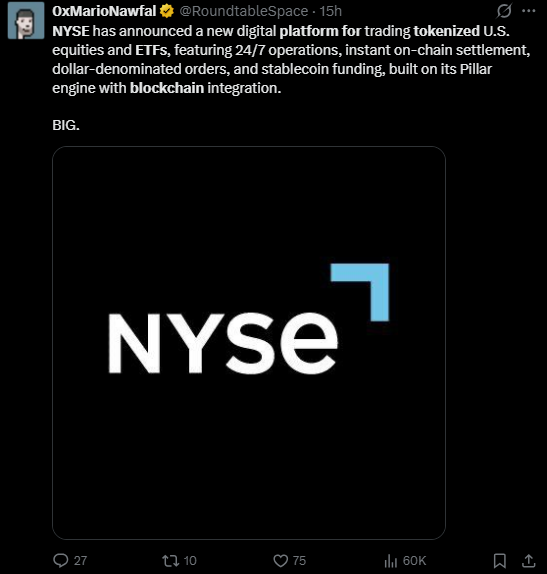
The NYSE’s announcement outlines a platform that will provide a full tokenized trading experience. The key features include:
24/7 Trading
Traditional stock exchanges operate on fixed schedules. In contrast, blockchain markets operate continuously. By tokenizing securities, the NYSE aims to offer trading beyond traditional hours—potentially around the clock.
Fractional Securities
Tokenization enables investors to buy fractions of shares, which could dramatically expand access to high-priced stocks and ETFs. This could be particularly beneficial for retail investors who want exposure to expensive assets but cannot afford full shares.
Instant Settlement
One of the most transformative aspects of tokenization is the potential for near-instant settlement. Instead of the standard T+2 settlement timeline (two business days), tokenized trading could settle transactions in minutes or seconds, improving liquidity and reducing counterparty risk.
Stablecoin-Based Funds
The platform may also integrate stablecoin-based funding mechanisms, allowing investors to use stablecoins as a settlement asset. This could enable faster, more efficient fund transfers.
Multi-Chain Support
The NYSE has stated that the platform will support multiple blockchain networks for custody and settlement. This flexibility is crucial given the fragmented landscape of blockchain ecosystems.
Regulatory Approval: A Critical Requirement
The NYSE has made it clear that the platform is subject to regulatory approvals. The company will seek approval from relevant regulators, including the U.S. Securities and Exchange Commission (SEC).
The platform is part of the broader strategy of the NYSE’s parent company, Intercontinental Exchange (ICE). ICE is already working with major banks and financial institutions to support tokenization efforts.
The company has established collaborations with Citibank and BNY Mellon, which are involved in supporting tokenized deposits across ICE’s six clearinghouses.
ICE’s Vision: From Trading Floor to Blockchain
ICE Vice President Michael Blaugrund highlighted the NYSE’s evolution, describing it as a journey from:
- Trading floor
- Electronic order book
- Blockchain-based trading
Blaugrund emphasized that this development reflects the natural progression of financial markets adapting to new technology and investor needs.
When Will the Platform Launch?
The NYSE has not provided a specific launch date. However, reports suggest the platform could launch as early as this year, pending regulatory approval.
The lack of a confirmed timeline suggests that the NYSE is prioritizing compliance and readiness over speed. Given the complexity of tokenized securities and the need for regulatory clarity, this cautious approach is consistent with industry best practices.
Traditional Exchanges Are Racing Toward Tokenization
The NYSE’s move is part of a broader trend among traditional exchanges to embrace tokenization and modernize their infrastructure.
Tokenization offers the ability to:
- Enable 24/7 trading
- Reduce settlement times
- Improve liquidity
- Increase access for retail investors
- Lower operational costs
Nasdaq’s Tokenization Efforts
Nasdaq, the NYSE’s primary competitor, has also been active in tokenization. The exchange sought SEC approval last year to allow trading of tokenized stocks on its public exchange.
Nasdaq’s efforts show that the industry is moving quickly toward a new paradigm where traditional and digital markets converge.
NYSE’s 22-Hour Trading Push
In addition to its tokenization platform, the NYSE has also been working to extend trading hours. The exchange plans to offer 22-hour trading on weekdays at its NYSE Arca venue.
The NYSE received preliminary approval for this expanded trading window in February 2025, reflecting the broader industry push toward greater accessibility.
Why 24/7 Trading Matters
Investor behavior is changing. Modern investors are accustomed to real-time access and instant transactions. The demand for continuous trading is driven by:
- Global markets and investors in different time zones
- Increased retail participation
- The rise of algorithmic and high-frequency trading
- The need for faster execution and settlement
- The desire for more flexible access to markets
Michael Blaugrund explained in an interview with Bloomberg that the new platform aims to improve accessibility for investors, especially retail users who want to trade on weekends.
He stated:
“It allows for new types of investor accessibility, and will create new opportunities for retail to participate in the stablecoin-funded markets that have attracted their attention.”
This statement aligns with broader market sentiment that tokenization can democratize access to financial markets and enable more participation from retail investors.
Institutional Support: ICE, Banks, and Clearinghouses
The NYSE’s parent company ICE has already laid the groundwork for tokenization. It is working with major banks and clearinghouses to support tokenized deposits.
Citibank and BNY Mellon
ICE has partnered with Citibank and BNY Mellon, two major financial institutions that provide custodial and settlement services for traditional markets.
These partnerships are essential for the success of tokenization because they provide:
- Custody solutions for tokenized assets
- Institutional-grade security
- Integration with existing financial infrastructure
- Regulatory compliance and oversight
Clearinghouses and Tokenized Deposits
ICE supports tokenized deposits across its six clearinghouses. This is an important step toward enabling tokenized securities trading because clearinghouses are a critical part of the settlement process.
By integrating tokenized deposits, ICE is positioning its infrastructure to support digital securities and streamline settlement.
Industry Support for Tokenization
Tokenization has gained support from several industry leaders, including BlackRock CEO Larry Fink, who has stated that tokenization is the next frontier in finance.
Fink believes that tokenization can:
- Increase efficiency
- Lower costs
- Improve access
- Expand liquidity
- Enhance transparency
These benefits align with the NYSE’s stated goals for its tokenization platform.
Regulatory Progress: SEC Support for Pilot Programs
The SEC has shown signs of support for tokenization through pilot programs. In December, the regulator issued a no-action letter regarding the Depository Trust Company (DTC) tokenization pilot.
The DTC is a subsidiary of the Depository Trust & Clearing Corporation (DTCC), which is a key player in the settlement and clearing of securities in the U.S.
The no-action letter indicates that the SEC is open to exploring tokenization in a controlled environment. This regulatory progress is critical for the broader adoption of tokenized securities.
The Future of Tokenized Trading: What It Could Mean for Investors
If the NYSE’s tokenization platform succeeds, it could have profound implications for investors:
Improved Market Accessibility
Tokenization can allow investors to trade outside traditional market hours, making global markets more accessible.
Lower Barriers to Entry
Fractional ownership allows investors with limited capital to participate in high-priced stocks and ETFs.
Faster Settlement
Instant settlement can reduce counterparty risk and improve liquidity.
Increased Transparency
Blockchain technology provides a transparent ledger of transactions, improving auditability and reducing fraud.
Greater Efficiency
Tokenization can reduce operational complexity and lower costs for market participants.
Challenges and Risks
Despite its potential, tokenization faces several challenges:
Regulatory Uncertainty
Tokenized securities require clear regulatory frameworks to ensure investor protection and market integrity.
Technology and Security
Blockchain systems must be secure and scalable enough to handle institutional trading volumes.
Market Adoption
Market participants must adopt new infrastructure and processes, which can take time.
Liquidity and Market Depth
Tokenized markets must attract sufficient liquidity to provide competitive pricing and efficient execution.
Read More: CFTC Chair Predicts Golden Age for U.S. Financial Markets
FAQ’s
What is the NYSE tokenization platform?
The NYSE tokenization platform is a blockchain-based system designed to enable trading, settlement, and custody of tokenized stocks and ETFs.
What benefits does tokenization bring to investors?
Tokenization enables 24/7 trading, fractional ownership, instant settlement, and more accessible markets for retail and institutional investors.
When will the NYSE tokenization platform launch?
The NYSE has not provided a specific launch date, but reports suggest it could launch as early as this year, pending regulatory approval.
Is the platform already approved by regulators?
No. The platform is subject to regulatory approval, and the NYSE is currently engaging with regulators to obtain necessary permissions.
What role does blockchain play in the NYSE platform?
Blockchain enables on-chain settlement, secure custody, transparent transaction records, and multi-chain support for trading tokenized securities.
How is NYSE different from Nasdaq in tokenization?
Nasdaq has also pursued tokenized stock trading, but the NYSE’s platform focuses on full tokenized trading experience, including stablecoin-based settlement and multi-chain support.
Which companies are supporting NYSE’s tokenization strategy?
NYSE parent company ICE is collaborating with major banks like Citibank and BNY Mellon, and leveraging ICE’s clearinghouse infrastructure to support tokenized deposits.
Conclusion
The NYSE’s move to build a blockchain platform for tokenized stocks and ETFs marks a pivotal moment in the evolution of traditional finance. It reflects a broader industry shift toward tokenization and digital transformation.
If successfully implemented, the platform could usher in a new era of 24/7 trading, instant settlement, and greater market accessibility. The NYSE’s initiative also signals that traditional exchanges are prepared to compete in the digital age.
However, the success of tokenization will depend on regulatory approval, technological readiness, and market adoption. The coming months will be critical as the NYSE continues to engage regulators and build the infrastructure needed to support tokenized securities.