


Arthur Hayes sells Ethereum — and the crypto market noticed within minutes. On October 24, 2026, the BitMEX co-founder confirmed that he had closed the entire directional book of Maelstrom, his family office, selling 6,400 ETH and six altcoins in a selloff that on-chain tracker Lookonchain first tallied at $22.28 million.
- Arthur Hayes Sells Ethereum: The $22.28M Breakdown
- Why Arthur Hayes Sold Ethereum: Macro and Geopolitical Risk
- Arthur Hayes Maelstrom Selloff Timeline
- From Long to Exit: Hayes Reverses His October 15 Call
- What Arthur Hayes Kept After the Selloff
- How Ethereum Price Reacted to the Arthur Hayes Selloff
- Arthur Hayes Sells Ethereum: What It Means for ETH Holders
- Risks and Signals to Watch After the Maelstrom Exit
- Frequently Asked Questions
- How much Ethereum did Arthur Hayes sell?
- Why did Arthur Hayes sell his crypto?
- Did Arthur Hayes sell Bitcoin too?
- How much did Arthur Hayes sell in total?
- Did Arthur Hayes make a profit on the sale?
- Conclusion
Hayes did not hide his reasoning. In a post on X on October 24, he wrote that he had dumped the positions, taken profits on Ethereum, Ethena and Uniswap, and decided to sit on the sidelines until conditions improve. His short summary of the outlook — that crypto has to “go down to go up” — spread across the market within hours, and it arrived at a fragile moment: the Ethereum price slide below $2,400 after the hot September CPI report had already shaken confidence, United States spot Ethereum ETFs were losing money for a third straight week, and traders were waiting on the Federal Reserve meeting scheduled for October 27–28.
This article breaks down exactly what Arthur Hayes sold, why he sold it, what he kept, and what the exit could mean for Ethereum holders. Every figure below comes from on-chain tracking reported by Lookonchain and independent coverage from BeInCrypto, Stocktwits, Cryptopolitan and Bitcoin.com, with the disagreements between trackers stated openly rather than smoothed over.
In this article:
- Arthur Hayes Sells Ethereum: The $22.28M Breakdown
- Why Arthur Hayes Sold Ethereum: Macro and Geopolitical Risk
- Arthur Hayes Maelstrom Selloff Timeline
- From Long to Exit: Hayes Reverses His October 15 Call
- What Arthur Hayes Kept After the Selloff
- How Ethereum Price Reacted to the Arthur Hayes Selloff
- Arthur Hayes Sells Ethereum: What It Means for ETH Holders
- Risks and Signals to Watch After the Maelstrom Exit
- Frequently Asked Questions
- Conclusion
Read more: UNI price prediction after CME futures went live
Arthur Hayes Sells Ethereum: The $22.28M Breakdown
When Arthur Hayes sells Ethereum, the headline number only tells part of the story. Lookonchain tracked seven tokens leaving wallets linked to Hayes in a 40-minute window in the early hours of October 24, 2026, between 1:34 a.m. and 2:14 a.m. Eastern Time. Hayes posted his confirmation at 2:18 a.m. Eastern Time, minutes after the last transfer.
Ethereum dominated the sale. The 6,400 ETH was valued at approximately $15.2 million, or about $2,375 per coin, which represented roughly 68% of the $22.28 million total. The remaining six altcoins made up the other third, led by Ethena and Uniswap.
| Token | Amount sold | Approximate value | Share of total |
|---|---|---|---|
| Ethereum (ETH) | 6,400 | $15.2 million | ~68% |
| Ethena (ENA) | 14,000,000 | $2.76 million | ~12% |
| Uniswap (UNI) | 323,000 | $2.24 million | ~10% |
| Ether.fi (ETHFI) | 1,890,000 | $1.23 million | ~6% |
| Aerodrome Finance (AERO) | 546,609 | $398,000 | ~2% |
| Pendle (PENDLE) | 120,000 | $244,000 | ~1% |
| Zama (ZAMA) | 3,000,000 | $214,000 | ~1% |
The destination of each transfer was also visible on-chain. The 14 million ENA went to a Binance deposit address, the UNI and ZAMA went to market maker Wintermute, the ETHFI went to a FalconX deposit, and the AERO moved on the Base network to Binance. Minutes after receiving the tokens, a Wintermute wallet returned 2,425,850 USDC to Hayes, worth about $2.43 million, which trackers identified as likely proceeds from the UNI and ZAMA sales.
One caution applies to every figure in this table. The wallets were identified as Hayes-linked by Lookonchain and other trackers, and Hayes himself confirmed the exit, but the wallet attribution was not independently verified by every outlet that covered the story. The amounts and values above are the trackers’ estimates, calculated using prices at the time of the transfers.
The total itself is disputed. Lookonchain first tallied $22.28 million, then raised its estimate to $28.8 million on October 25, while CryptoSlate reported a figure near $26 million. Etherscan records reviewed by Cryptopolitan showed an even larger Ethereum figure: another address associated with Hayes sent 8,000 ETH in four transactions, including 3,200 ETH to a Galaxy Digital deposit. This article uses the $22.28 million Lookonchain tally as its headline figure because it is the most widely cited, and flags the higher estimates wherever the total matters.
Why Arthur Hayes Sold Ethereum: Macro and Geopolitical Risk
Arthur Hayes sells Ethereum for reasons he stated plainly, and the statement is worth quoting in full because it leaves little room for interpretation. In his October 24 post on X, Hayes wrote: “I dumped it all. The Maelstrom directional book, took profits on $ETH, $ENA, $UNI and other altcoins. I think we gotta go down to go up. It looks a bit dicey out there in macro and geopolitical land. Going to sit on the sidelines and wait for the all clear signal.”
Three points stand out. First, Hayes framed the move as profit-taking, not panic: he said he took profits on Ethereum, Ethena and Uniswap, suggesting the sales locked in gains on earlier positions. Second, he expects lower prices before any recovery — the plain meaning of “go down to go up.” Third, he set a clear condition for returning: an “all clear” signal on the macro and geopolitical outlook, with no timetable given. The message is blunt, and that bluntness is the point: when Arthur Hayes sells Ethereum, he says so publicly and in plain language.
The backdrop supported his caution. Brent crude had settled at $116.72 per barrel on Friday, October 23, its highest level since late April, after attacks in Saudi Arabia raised concerns about regional energy supply. Elevated energy prices keep inflation concerns alive and complicate the outlook for monetary policy, an unfavourable backdrop for high-beta assets such as crypto. Traders were also waiting for the Federal Reserve meeting on October 27–28, and Ethereum developers had just postponed the Glamsterdam upgrade on the Hoodi test network, removing a near-term catalyst. He has long argued that dollar liquidity and United States Treasury operations set the direction for crypto markets, so stepping aside when those conditions turn uncertain fits his playbook.
Arthur Hayes Maelstrom Selloff Timeline
The speed of the exit is part of the story. Nine days separated Hayes urging traders to go long from Hayes closing his own book, and the on-chain moves and the public confirmation happened within a single hour on Saturday morning. The timeline below shows how fast Arthur Hayes sells Ethereum positions once his view changes.
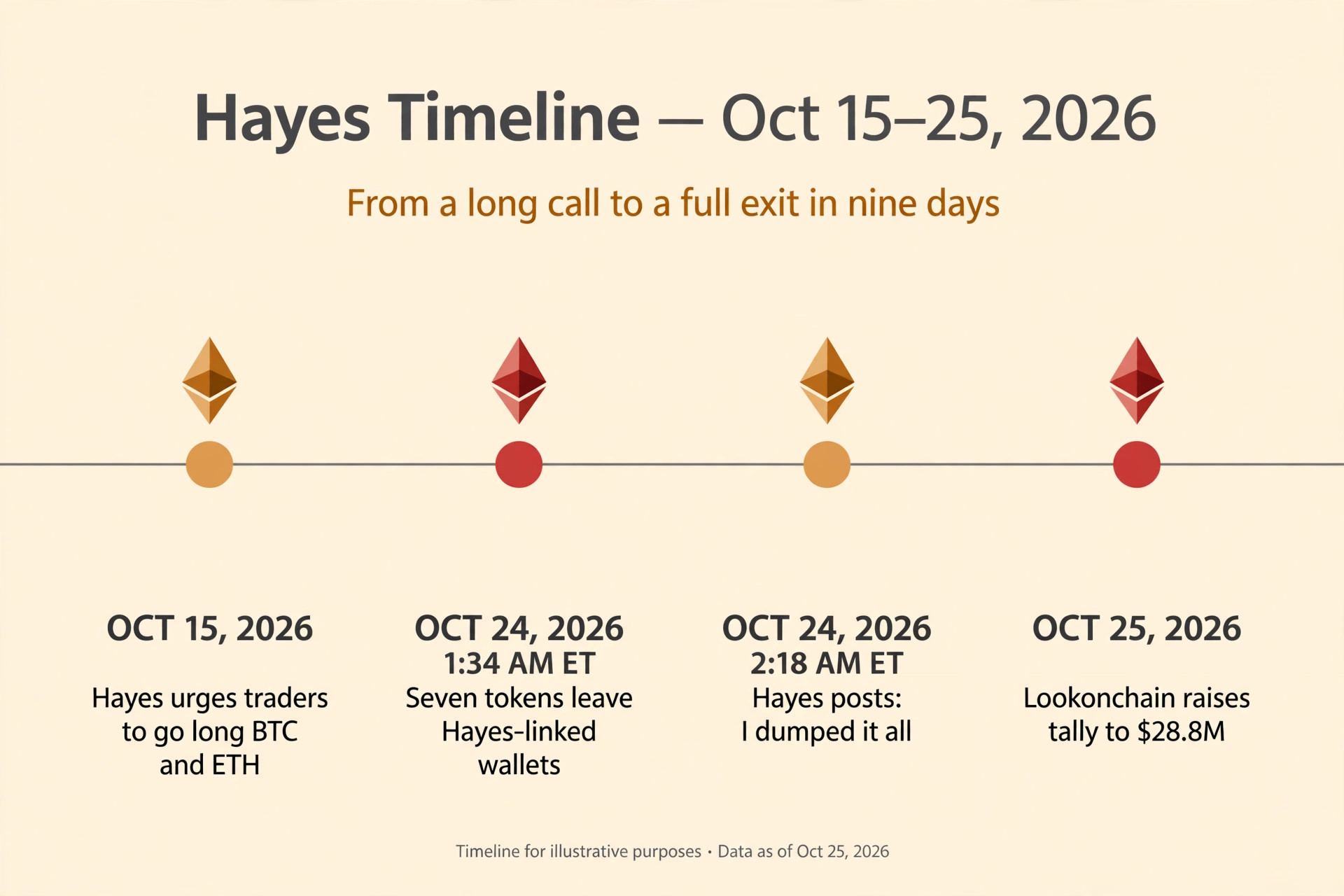
On October 15, Hayes urged traders to go long Bitcoin and Ethereum and trade an eventual bailout, a bullish call that set the tone for the second half of the month. On October 24, between 1:34 a.m. and 2:14 a.m. Eastern Time, seven tokens left Hayes-linked wallets in a 40-minute window. At 2:18 a.m. Eastern Time, Hayes posted his confirmation on X. On October 25, Lookonchain raised its tally of the sales to $28.8 million, up from the $22.28 million first reported.
The timeline shows the exit was planned, not improvised. Tokens moved to exchanges and market makers in an orderly sequence — Binance, Wintermute and FalconX — before Hayes announced the move publicly, consistent with a trader closing positions deliberately rather than reacting to a sudden headline.
From Long to Exit: Hayes Reverses His October 15 Call
The October 24 exit reversed a bullish stance Hayes had held for months. In August 2026, he said Maelstrom had taken maximum risk exposure across several cryptocurrencies, including Bitcoin, Ether, Ethena and Ether.fi. His thesis centred on dollar liquidity and United States Treasury operations: measures supporting the government bond market could create favourable conditions for digital assets, even if corrections occurred along the way.
That context makes the October reversal sharper. Hayes had not been a sceptic warning from the sidelines; he had been fully invested and publicly bullish. The table below summarises how his Ethereum positioning changed across 2026.
| Date | Arthur Hayes Ethereum move | Approximate value |
|---|---|---|
| June 2026 | Sold 6,000 ETH after moving 3,000 ETH from Flowdesk | $10.14 million sale; ~$606,000 estimated loss |
| August 2026 | Maelstrom at maximum risk exposure, including ETH | Position size not disclosed |
| October 15, 2026 | Urged traders to go long Bitcoin and Ethereum | Public call, no trade disclosed |
| October 24, 2026 | Arthur Hayes sells Ethereum: 6,400 ETH plus six altcoins, closing the directional book | $22.28 million first tally |
June set the precedent. Lookonchain linked a wallet associated with Hayes to a transfer of 3,000 ETH from Flowdesk, valued at approximately $5.42 million, and later reported that Hayes sold 6,000 ETH for about $10.14 million — an approximate $606,000 loss against earlier purchases at higher prices. Hayes has adjusted his Ethereum exposure in earlier periods of uncertainty, and the October sale follows the same pattern at a larger scale.
Hayes has changed his mind quickly before. On October 15 he was urging traders to go long; nine days later he was out. That speed is why the market treats his positioning as a signal about the next few weeks rather than a long-term forecast.
What Arthur Hayes Kept After the Selloff
Arthur Hayes sells Ethereum and six altcoins, but the sale did not empty his wallets. After the transfers, the main labelled wallet still retained about 14.45 million ENA, according to on-chain trackers. That retained balance is worth noting because Ethena was the second-largest sale in the exit, yet Hayes kept a larger ENA position than the one he sold.
Just as important is what the trackers did not find. Neither Hayes’s statement nor Lookonchain’s breakdown identified a Bitcoin sale. His October announcement did not explain when Maelstrom began reducing its positions, and he did not disclose the fund’s remaining portfolio, hedges or private investments. The exit covered the directional book — the active trading positions — not necessarily everything Maelstrom holds.
The profit picture is mixed and partly unknowable. The Ethena trade supports his profit-taking claim: in early August he bought 9.05 million ENA for about $773,000, or roughly $0.085 per token, while Lookonchain valued the October 24 ENA sale at about $0.20 per token — though it is unconfirmed whether the tokens sold were the same ones bought in August. His newest bets fared worse: in mid-October he bought Aerodrome, Pendle and Zama tokens for about $889,000 and sold them for about $856,000, a loss of roughly $33,000. His cost for the 6,400 ETH is not public, so no profit or loss can be calculated on the Ethereum sale itself.
How Ethereum Price Reacted to the Arthur Hayes Selloff
When Arthur Hayes sells Ethereum, the price reaction is never caused by one wallet alone, and the weekend of October 24–25 proved the point. Ethereum fell to about $2,282 on Binance during Saturday’s liquidation wave, recovered to close the day near $2,359, then slipped to about $2,330 by Sunday’s close. On Monday, October 26, it traded near $2,300–$2,320, down about 1% over 24 hours and lower on the week, with $2,290–$2,300 acting as immediate support and $2,360–$2,400 the key recovery zone.
The technical picture was already weak before Hayes sold. Ethereum had been rejected at the $2,800 supply zone in September, broken below its ascending channel near $2,400, and was trading about 6.5% below its 20-day moving average near $2,456 and about 10% below its 50-day average near $2,545.
Four pressures overlapped at the same time: forced selling in leveraged futures, steady redemptions from United States spot Ethereum ETFs, the Hayes exit, and the delay to Ethereum’s Glamsterdam upgrade. The ETF numbers explain part of the drag. United States spot Ethereum ETFs recorded about $320.1 million in net outflows from October 12 through October 16, with BlackRock’s ETHA accounting for nearly $299 million of the weekly withdrawals, and roughly $1.13 billion in net outflows over the previous 21 trading days. Total assets across the funds stood near $14.6 billion.
Bitcoin faced the same headwinds, trading near the $80,000 mark on October 26, with the $78,000–$80,000 region as the key demand zone. Oil near $115 per barrel and the coming Federal Reserve decision kept risk appetite subdued, so the Hayes sale landed in a market that was already defensive.
Arthur Hayes Sells Ethereum: What It Means for ETH Holders
The sale is not evidence that Ethereum is finished, and it is not a prediction that prices can only fall. Hayes himself expects a money-printing cycle to follow, according to Stocktwits’ account of his post, so his “go down to go up” view contains a recovery on the other side of the decline. He has previously floated a long-term view of Ethereum reaching $100,000 to $200,000 at the peak of the next cycle — a forecast that shows how differently he treats the next few weeks from the next few years.
What the exit does signal is that a trader with a strong record of reading liquidity conditions sees more downside first. When Arthur Hayes sells Ethereum, the market reads it as a vote that the macro picture will get worse before it gets better, not a judgement on Ethereum’s technology or its long-term adoption.
For Ethereum holders, the practical takeaway is narrower than the headlines suggest. The sale removed about $15.2 million of Ethereum from one family office’s book, small against daily Ethereum trading volume of roughly $9.12 billion and a market capitalisation near $280 billion. The larger risk is the signal effect: other traders watch Hayes, ETF flows are already negative, and the $2,300 support level now decides whether the decline extends toward $2,000. If $2,300 holds and ETF flows turn positive, the exit will look like a well-timed trade by one fund; if $2,300 breaks, it will look like an early warning.
There is also a contrarian reading. Hayes sold near $2,375 per ETH and Ethereum was trading near $2,300 within two days, so the exit has already proved well-timed in the short term. But a trader who moves that fast can return just as fast when his “all clear” condition is met, and watching for that return may matter as much as watching the exit.
Risks and Signals to Watch After the Maelstrom Exit
Whether the Arthur Hayes sells Ethereum moment marks a local bottom or the start of a deeper decline will be decided by the signals below. Readers tracking this story should watch them in order of importance.
- The “all clear” signal: any new public statement from Hayes about returning to directional trading, which would be the clearest sign that his macro concerns have eased.
- The Federal Reserve decision: the October 27–28 meeting and its guidance on rates, which sets the tone for dollar liquidity that Hayes watches most closely.
- Ethereum ETF flows: whether United States spot Ethereum ETFs return to net inflows after roughly $1.13 billion of outflows over 21 trading days.
- The $2,300 support level: a sustained break below $2,290–$2,300 would open the path toward $2,000, while a recovery above $2,360–$2,400 would signal stabilisation.
- On-chain flows: further transfers from Hayes-linked wallets, which would show whether the exit is complete or still under way.
- Macro and energy prices: Brent crude holding near $115 per barrel, which keeps inflation concerns alive and complicates the outlook for rate cuts.
- The Glamsterdam upgrade: a new activation date for the delayed Hoodi testnet upgrade, which would restore a near-term catalyst for Ethereum.
This article is for informational purposes only and does not constitute financial advice. Cryptocurrency investments carry substantial risk and volatility, and prices can fall sharply in short periods. Always do your own research and consult a qualified financial adviser before making any investment decision.
Hayes first became widely known as the co-founder of the BitMEX derivatives exchange, and he now serves as chief investment officer of the Maelstrom family office. Readers who want background on his career can read the profile of BitMEX co-founder Arthur Hayes on Wikipedia.
Frequently Asked Questions
How much Ethereum did Arthur Hayes sell?
Arthur Hayes sells Ethereum in the amount of 6,400 ETH, valued at approximately $15.2 million at about $2,375 per coin. The Ethereum sale represented roughly 68% of the $22.28 million total that Lookonchain first tallied for the exit.
Why did Arthur Hayes sell his crypto?
Hayes said he closed Maelstrom’s directional book because macroeconomic and geopolitical conditions looked “a bit dicey” and he expects crypto to “go down to go up” before recovering. He plans to sit on the sidelines and wait for an “all clear” signal before returning to directional trading.
Did Arthur Hayes sell Bitcoin too?
No Bitcoin sale was identified in the October 24 exit. Neither Hayes’s statement nor Lookonchain’s breakdown mentioned a Bitcoin sale, and the seven tokens tracked were Ethereum, Ethena, Uniswap, Ether.fi, Aerodrome Finance, Pendle and Zama.
How much did Arthur Hayes sell in total?
Lookonchain first tallied the sales at $22.28 million across seven tokens, then raised the estimate to $28.8 million on October 25. Other trackers put the figure near $26 million. The differences come from which linked wallets and price points each tracker counts.
Did Arthur Hayes make a profit on the sale?
Hayes said he took profits on Ethereum, Ethena and Uniswap. His Ethena trade looks profitable on paper — he bought 9.05 million ENA in early August for about $773,000 and sold at about $0.20 per token — but it is unconfirmed whether the tokens sold were the same ones bought in August. His mid-October Aerodrome, Pendle and Zama trades lost about $33,000, and his cost for the 6,400 ETH is not public.
Conclusion
Arthur Hayes sells Ethereum at a moment when the market was already under pressure, and the sale is best read as a liquidity call rather than a verdict on Ethereum itself. The facts are clear: 6,400 ETH and six altcoins left Hayes-linked wallets on October 24, 2026, in a selloff first tallied at $22.28 million, and Hayes confirmed the exit himself, citing macro and geopolitical risk and a plan to wait for an “all clear” signal.
The context makes the move more significant than its size. Hayes reversed a bullish call made nine days earlier, closed a book he had described as maximum risk exposure in August, and did so while Ethereum ETFs were losing money, oil was near $115 per barrel and the Federal Reserve meeting was days away. Ethereum near $2,300 now decides what comes next: hold it, and the exit looks like one fund’s well-timed trade; lose it, and the decline Hayes expects has further to run.
For readers, the disciplined response is to watch the signals rather than copy the trade. The Arthur Hayes sells Ethereum story will be judged by what happens next, not by the $22.28 million already sold. The Federal Reserve decision, the direction of Ethereum ETF flows, the $2,300 support level and any word from Hayes himself will say more about the next move than the sale itself. Hayes has reversed quickly before, and the trader who went from long to out in nine days can return just as fast when conditions change.