

UNI Price Prediction After CME Futures Go Live: Can Uniswap Hold $7?
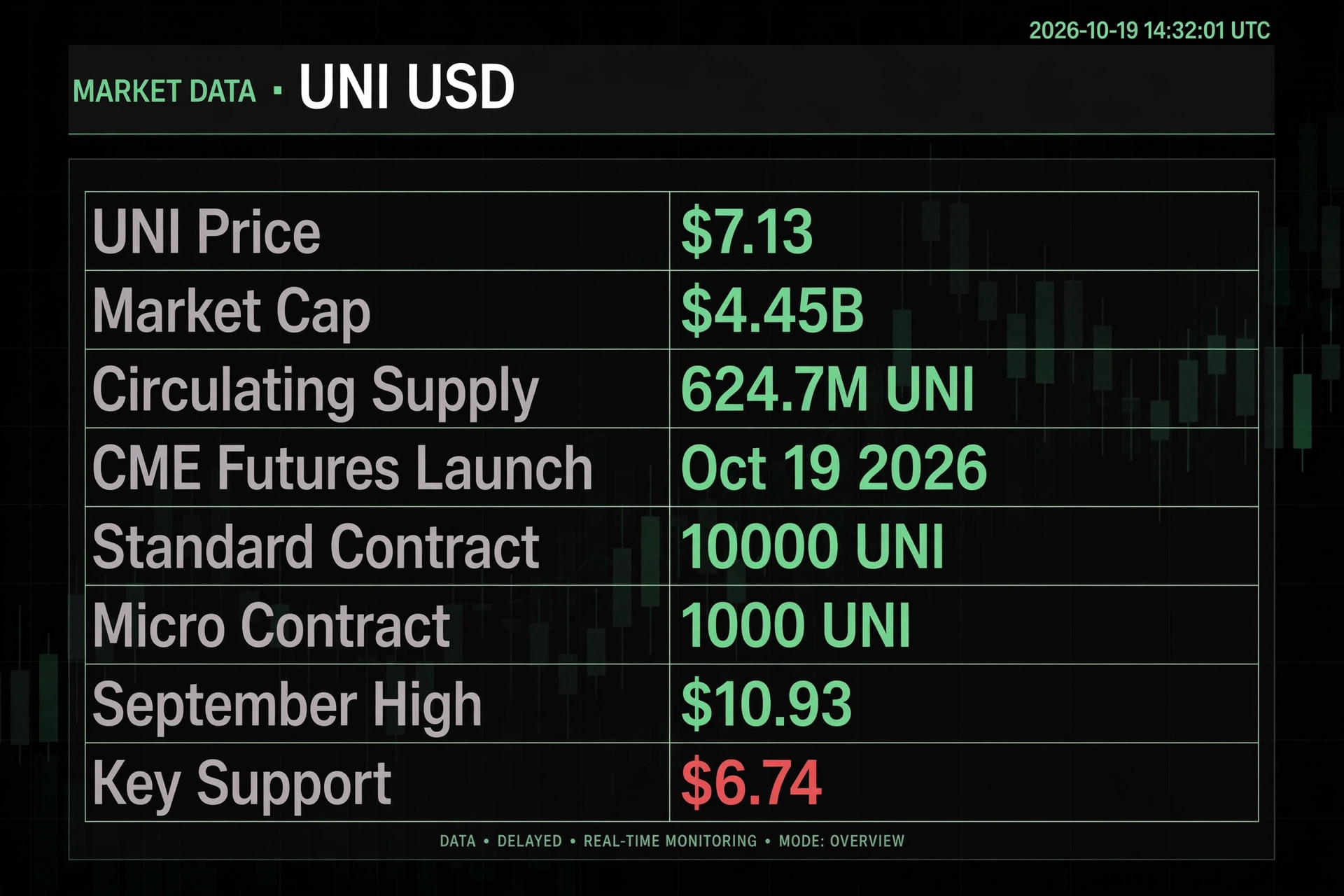
Uniswap’s UNI is trading near $7.13 on October 20, one session after its first futures contracts opened on CME Group. The listing marks the moment the largest decentralized exchange’s governance token entered the regulated derivatives market — and it arrives while UNI is still nursing a two-week correction of roughly 20%.
- CME Uniswap Futures Go Live: What the Contracts Offer
- UNI Price Today: The October Correction by the Numbers
- Binance Inflows Flagged UNI Distribution — and Selling Pressure Is Easing
- The BCH Twin Launch: Why Announcement Hype Faded
- Why a Futures Listing Is Not Automatically Bullish for UNI
- The Spot ETF Angle: Bitwise’s Filing and the April 2027 Test
- The Fee Switch Upgrade: UNI’s Structural Bull Case
- UNI Price Prediction: Key Support and Resistance Levels
- What Could Move UNI Price Next
- Frequently Asked Questions
- When did CME UNI futures go live?
- What is the CME UNI contract size?
- Why did UNI price fall in October?
- What are the key UNI price levels to watch?
- Will there be a spot Uniswap ETF?
- Conclusion
The setup is a study in contrast. UNI peaked near $10.93 in late September, then slipped through early October even as the derivatives debut approached. The slide came during a broader macro-driven crypto selloff — the same inflation shock that produced Ethereum’s $106 million Binance long liquidation in the same inflation-driven selloff — while exchange inflows into Binance signaled that holders were distributing.
Read More: Bitcoin ETF Outflows Hit $261M as Crypto ETFs Lose $391M: Will $80K Hold?
The CME debut changes the market structure around UNI. Whether it changes the price direction is a separate question. This article breaks down the contract specifications, the on-chain flow evidence, the twin Bitcoin Cash launch, the spot ETF angle, and the price levels that matter next.
- CME Uniswap Futures Go Live: What the Contracts Offer
- UNI Price Today: The October Correction by the Numbers
- Binance Inflows Flagged UNI Distribution — and Selling Pressure Is Easing
- The BCH Twin Launch: Why Announcement Hype Faded
- Why a Futures Listing Is Not Automatically Bullish for UNI
- The Spot ETF Angle: Bitwise’s Filing and the April 2027 Test
- The Fee Switch Upgrade: UNI’s Structural Bull Case
- UNI Price Prediction: Key Support and Resistance Levels
- What Could Move UNI Price Next
- Frequently Asked Questions
- Conclusion
CME Uniswap Futures Go Live: What the Contracts Offer
CME Group announced the new contracts on September 22, 2026, and trading opened for the Monday, October 19 trade date. According to industry reporting, the listing took effect under Special Executive Report 9820 after the contracts were self-certified with the U.S. Commodity Futures Trading Commission. Before that, CME’s own product pages had described the launch as conditional on regulatory review — the standard posture for a product between announcement and clearance.
The launch makes UNI the eleventh single-asset cryptocurrency futures product on CME, alongside Bitcoin and Ether and the altcoin contracts added during the exchange’s 2026 expansion. Both contracts are cash-settled against the CME CF Uniswap Dollar Reference Rate, a once-daily index built from eligible UNI dollar trades across constituent venues. No tokens change hands at expiry; the contracts let traders hedge or speculate on UNI’s price without holding the token or managing a wallet.
| Contract detail | UNI futures specification |
|---|---|
| Standard contract size | 10,000 UNI (about $70,000 in notional value at $7) |
| Micro contract size | 1,000 UNI (about $7,000 in notional value at $7) |
| Contract months listed | Monthly October 2026 through March 2027, then quarterly through March 2028 |
| Settlement | Cash-settled against the CME CF Uniswap Dollar Reference Rate |
| Last trading | 4 p.m. London time on the final Friday of the contract month |
| Trading hours | Nearly around the clock, with a two-hour Saturday maintenance window (Central time) and a brief weekday pause |
| Execution options | Eligible for block trades and Basis Trade at Index Close (BTIC) variants |
The sizing matters when turnover figures start appearing: 100 micro-contract trades represent 100,000 UNI of contract units without any transfer of tokens. CME Global Head of Cryptocurrency Products Giovanni Vicioso said in the announcement that “as crypto markets continue to mature, participants require broader, regulated tools to navigate evolving digital asset related price risk.”
The context is a rapid institutionalization of altcoin derivatives. CME’s 2026 altcoin expansion — contracts on Cardano, Chainlink and Stellar among them — had generated more than $1 billion in year-to-date notional value, according to the exchange, while its crypto futures and options overall averaged 279,800 contracts a day ($8.3 billion in notional) in the first half of 2026, with average open interest of $15.4 billion.
UNI Price Today: The October Correction by the Numbers
Across major trackers, UNI changed hands around $7.12–$7.16 on October 20, with the 24-hour range running roughly $7.09–$7.42 and the daily move down about 3%. Market capitalization sat near $4.45 billion, with roughly 624.7 million UNI in circulation — about 62.5% of the token’s 1 billion maximum supply.
| Timeframe | UNI performance (approx.) |
|---|---|
| 24 hours | Down about 3% ($7.09–$7.42 range) |
| 7 days | Down 5–6% |
| 30 days | Down 18–19% |
| 52-week range | $2.38–$10.21 |
| Year to date | Up roughly 30% |
| From all-time high ($44.97, May 2021) | About 84% below |
The drawdown’s shape is well documented. UNI reached about $10.93 on September 23, closing out a two-month rally that had lifted the token more than 121%. It then fell from $9.08 on October 5 to $7.12 on October 8 — roughly a 21.6% drop in three days — and was down about 20.8% between October 5 and October 18. A rebound toward $7.36 on October 19, the launch day, trimmed the damage but did not reverse the downtrend.
Binance Inflows Flagged UNI Distribution — and Selling Pressure Is Easing
Price charts show what happened; exchange flows show who was behind it. CryptoQuant analyst Darkfost reported that UNI had entered a distribution phase during the price retreat, with tokens moving into exchanges — particularly Binance. His analysis showed Binance inflows exceeding $40 million on some days in late September, with the inflow Z-score (a measure of how unusual activity is relative to history) rising above four several times.
That kind of reading signals that selling-related exchange activity stayed elevated through the correction, and it accompanied UNI’s reversal from the September high near $10.90. More recently, the picture has softened: inflows remained active but showed less momentum than the late-September spikes, and Darkfost noted that a continued reduction could coincide with the end of the distribution phase.
The shift was notable enough to headline market coverage on October 17, which described UNI sliding ahead of the CME debut even as Binance selling pressure eased. The honest reading, though, is two-sided. The CryptoQuant chart does not establish a price bottom, and UNI’s decline into October 18 showed downward pressure had continued. For bulls, the confirmation to watch is straightforward: sustained net outflows from Binance, which would signal that the distributing hands are done.
The BCH Twin Launch: Why Announcement Hype Faded
UNI did not launch alone. Bitcoin Cash futures opened on the same day, and the twin listing offers a useful reality check on how derivatives debuts actually play out.
BCH initially reacted strongly to the September 22 announcement: the token surged roughly 25–30% and futures open interest nearly doubled to around $295 million, per Santiment data cited in market coverage. But the excitement faded well before launch day. By October 18, open interest had slid back to roughly 560,000 BCH — close to where it stood before the announcement. UNI’s reaction was quieter from the start; the token saw a more subdued response to the announcement and never held its momentum.
The lesson is that announcement rallies front-run the launch and can exhaust themselves. What matters for UNI now is launch-week reality: the first prints of CME volume and open interest will show whether institutions actually showed up, or whether the listing is a symbolic addition with thin early trading. Caution is warranted on both sides — thin opening sessions are normal for new contracts and do not define long-term demand either.
Why a Futures Listing Is Not Automatically Bullish for UNI
Regulated access and spot demand are different things. The CME contracts are cash-settled, which means no institution needs to buy a single UNI token to trade them. A desk holding UNI can sell futures to hedge a decline in inventory; another participant can express a bearish view without ever touching the spot market. New venues create long and short exposure, and the basis trades and spreads that dominate early futures sessions are often direction-neutral.
None of this negates the milestone. A regulated, nearly 24-hour venue with block-trade capability is the kind of infrastructure that legitimizes an asset for allocators who cannot touch spot crypto or offshore derivatives. But the price impact comes later, and indirectly — through deeper liquidity, tighter spreads, and the occasional structural buyer — not on launch day. Investors who treat a futures listing as a guaranteed catalyst are pricing in a mechanism that does not exist.
The Spot ETF Angle: Bitwise’s Filing and the April 2027 Test
One concrete structural angle is real. Bitwise filed an S-1 for a spot Uniswap ETF in February, naming Coinbase Custody as custodian. Under the generic listing standards the U.S. Securities and Exchange Commission approved in September 2025, a commodity-based exchange-traded product can list without a bespoke rule change if its underlying asset backs a futures contract that has traded for at least six months on a CFTC-regulated designated contract market. If the CME UNI contracts trade continuously from October 2026, that test would be satisfied around April 2027.
That timeline is worth tracking, not trading on. A futures listing is a procedural precondition, not an approval: it neither establishes demand for a spot ETF nor implies that regulators have blessed one. The existence of listed derivatives should not be treated as evidence that a spot product is coming — it simply starts a clock that investors can watch.
The Fee Switch Upgrade: UNI’s Structural Bull Case
Separate from the derivatives story, UNI carries a protocol-level development that many newer investors missed. In December 2025, Uniswap governance approved the “UNIfication” proposal: it activated the long-debated fee switch, directing a protocol fee to UNI governance — 0.05% of pool fees alongside the 0.25% liquidity-provider fee on v2 pools, with selected v3 pools routing a portion of fees depending on tier — and introduced a deflationary mechanism. The package included a one-time burn of 100 million UNI from the treasury plus an ongoing burn funded by protocol fees, including sequencer revenue from the Unichain layer-2 network.
This matters because it created, for the first time, a direct cash-flow linkage between protocol usage and token value. UNI had long been criticized as a governance-only token with no claim on the enormous trading revenue flowing through the protocol; the fee switch begins to answer that. Whether the burn meaningfully offsets the vesting schedule depends on trading volumes and fee accrual over time — the mechanism is real, the magnitude is still unproven — but it is the kind of structural support that futures listings and price charts do not capture.
UNI Price Prediction: Key Support and Resistance Levels
Technically, UNI sits in a defined range after its correction. The recent October lows near $6.74–$6.80 form the floor to watch: a move below that area would put UNI beneath its October base and open the way toward the $6.00–$6.20 zone from earlier in the month. On the upside, $7.00 marks nearby resistance after the recent intraday action, with the 24-hour high near $7.40 as the first real test. Above that, $9.08 — the October 5 reference — and the $10.93 September high define the recovery ladder.
The table below frames the possibilities honestly, as scenarios rather than forecasts.
| Scenario | What would need to happen | Likely UNI price implication |
|---|---|---|
| Bull case | Binance net outflows confirm distribution is over; CME futures show healthy week-one volume and open interest; macro tone improves into the Fed’s late-October meeting | Reclaim of $7.40, then a run at $9.08 |
| Base case | Futures volume starts thin but steady; flows stay mixed; macro remains the dominant driver | Range trade between roughly $6.74 and $7.40 |
| Bear case | Distribution persists; hot macro data deepens risk-off; daily close below $6.74 | Slide toward $6.00–$6.20, with $5.50 as the deeper zone |
What Could Move UNI Price Next
Several near-term catalysts will decide whether UNI stabilizes or extends its decline:
- The first CME volume and open interest prints. These arrive in the days after launch and show whether institutions are engaging with the new contracts.
- Binance flow direction. Sustained net outflows would confirm the distribution phase identified by CryptoQuant is ending.
- The Federal Reserve’s October 27–28 meeting. UNI fell during an inflation-driven selloff, so the tone of U.S. monetary policy remains the macro anchor for the whole crypto market.
- Broader risk appetite. Spot ETF flow tone and equity market direction will set the backdrop; a DeFi governance token rarely rallies alone against a risk-off tape.
- The $6.74–$7.40 range boundaries. A decisive break of either level, especially on strong volume, would likely set the next directional leg.
For background on the asset itself, a primer on the Uniswap protocol covers its automated market maker model, the 2025 v4 upgrade, and UNI’s governance role.
Not financial advice: this article is for informational purposes only and does not constitute financial or investment advice. Cryptocurrency markets are highly volatile, derivatives trading carries the risk of rapid loss, flow and volume figures are revised as final data arrives, and prediction scenarios are illustrations — not guarantees. Always do your own research and consult a qualified financial adviser before making investment decisions.
Frequently Asked Questions
When did CME UNI futures go live?
Trading opened for the Monday, October 19, 2026 trade date, following self-certification of the contracts with the CFTC under Special Executive Report 9820. CME had announced the plan on September 22, 2026.
What is the CME UNI contract size?
The standard contract covers 10,000 UNI — about $70,000 in notional value at a $7 token price — and the micro contract covers 1,000 UNI, or about $7,000. Both are cash-settled against the CME CF Uniswap Dollar Reference Rate.
Why did UNI price fall in October?
UNI fell roughly 20.8% between October 5 and October 18. The drivers were a hot U.S. inflation report that repriced rate expectations across risk assets, and a distribution phase identified by CryptoQuant analyst Darkfost, who tracked elevated UNI inflows into Binance during the retreat.
What are the key UNI price levels to watch?
Support sits at $6.74–$6.80, the October lows — a daily close below that area opens deeper downside. Resistance starts at $7.00–$7.40, with $9.08 (the October 5 reference) and $10.93 (the September high) above.
Will there be a spot Uniswap ETF?
Nothing has been approved. Bitwise filed an S-1 for a spot Uniswap ETF in February 2026. Under the SEC’s generic listing standards, a futures contract trading continuously on a CFTC-regulated venue for six months would satisfy the eligibility test around April 2027 — a precondition, not an approval.
Conclusion
UNI’s first day on CME closed with the token holding near $7.13 — a stabilization, not yet a recovery. The listing is a genuine structural milestone: regulated, nearly round-the-clock derivatives access, real institutional plumbing, and a clock started toward a possible spot ETF eligibility test in April 2027. It sits alongside an equally real protocol-level upgrade in the activated fee switch and token burn.
But none of that erases the near-term tape. UNI is still digesting a 20% correction, Binance flows have not yet confirmed that distribution is over, and the twin BCH launch showed how quickly announcement excitement can fade. The honest base case is a $6.74–$7.40 range until the first CME volume prints, the Binance flow direction, and the Fed’s late-October meeting give the market something new to price. For now, the futures are live — and the proving ground is just beginning.