

Circle USDC Revenue Breakdown: Where the $1.4B From H1 2026 Went
Stablecoin issuers rarely open their books. On October 16, 2026, Circle did exactly that: Chief Commercial Officer Kash Razzaghi published a detailed breakdown of the company’s USDC economics for the first half of the year, revealing approximately $1.4 billion in revenue and showing, almost to the cent, where every dollar went. The headline number surprised even seasoned crypto watchers — but the split underneath it tells the more important story.
- Circle USDC Revenue H1 2026: The $1.4 Billion Split
- Where USDC Revenue Goes: 59 Cents to Distribution Partners
- Coinbase, the Largest USDC Partner
- Binance’s $100M Investment and Five-Year USDC Deal
- The 150-Plus Partner Network
- The 34 Cents Circle Reinvests: Licenses, Banks, and Compliance
- The $819M Bundling Caveat: What Circle Did Not Break Out
- USDC On-Chain Volume: $36 Trillion in Six Months
- Circle Payments Network Enables Free 24/7 USDC Redemptions
- Circle vs New Stablecoin Issuers: The “Distributes Everything, Funds Nothing” Argument
- What Circle’s USDC Numbers Mean for CRCL Stock Investors
- How the Circle USDC Flywheel Model Works
- Stage 1: Partners Grow USDC Balances
- Stage 2: Reserve Income Funds Infrastructure
- Stage 3: A More Useful Dollar Pulls in Developers
- Stage 4: Volume Growth Reinforces Partner Incentives
- Frequently Asked Questions
- How much revenue did Circle earn from USDC in H1 2026?
- Where did Circle’s $1.4 billion in USDC revenue go?
- Which companies are Circle’s biggest USDC distribution partners?
- How much USDC transaction volume was processed in H1 2026?
- Can USDC be redeemed for free?
- When does Circle report Q3 2026 earnings?
- Conclusion
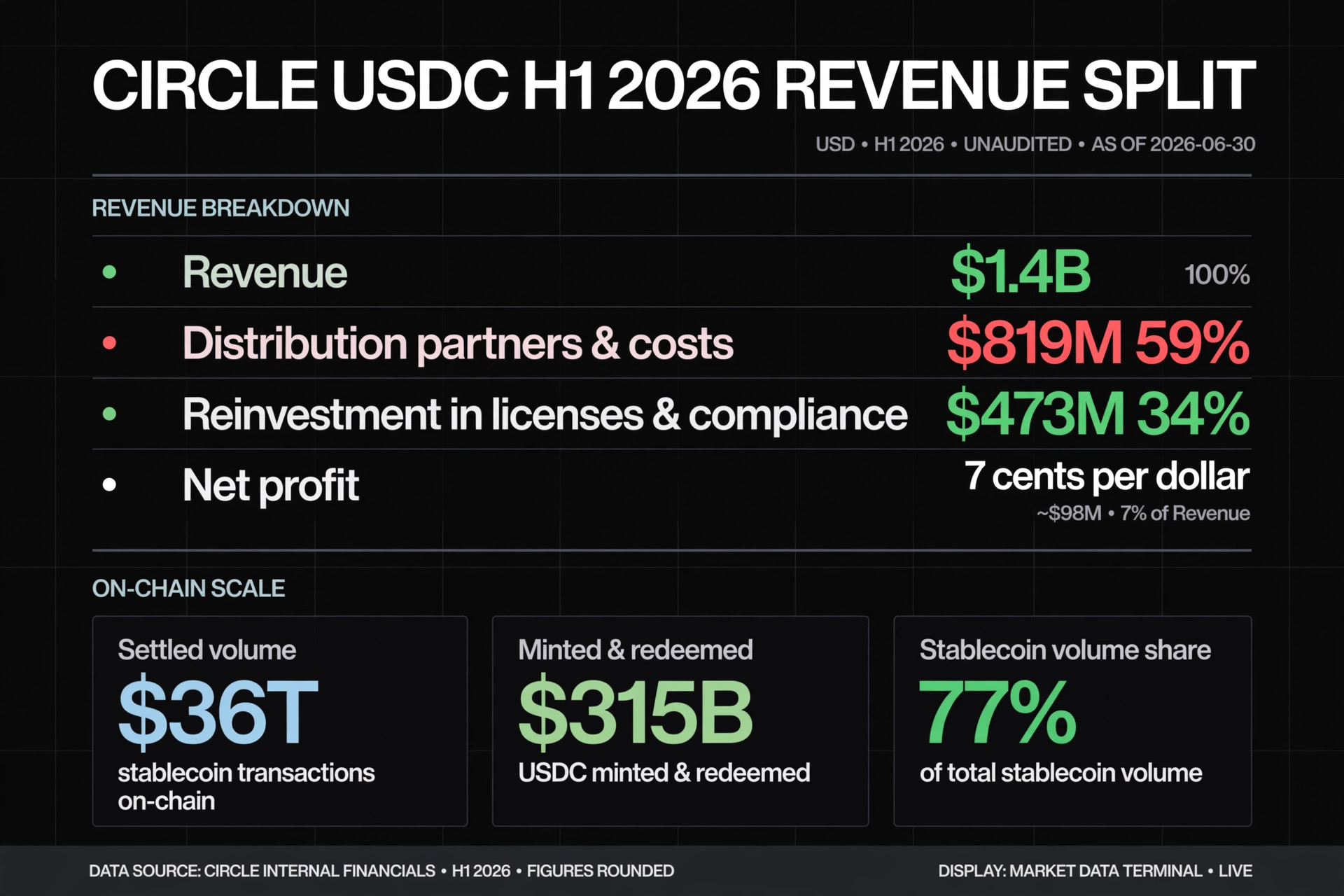
Of that $1.4 billion, roughly $819 million flowed straight back out to USDC distribution partners and transaction costs. Circle kept about 34 cents of every dollar to fund licenses, banks, compliance and product development, and retained only about 7 cents per dollar as net profit. The disclosure landed as institutional crypto positioning whipsaws — crypto ETF flows turned sharply negative in October, draining $391M in a single day — and as Circle pushes back publicly against new stablecoin entrants promising partners a bigger slice of the economics.
- Circle USDC Revenue H1 2026: The $1.4 Billion Split
- Where USDC Revenue Goes: 59 Cents to Distribution Partners
- The 34 Cents Circle Reinvests: Licenses, Banks, and Compliance
- The $819M Bundling Caveat: What Circle Did Not Break Out
- USDC On-Chain Volume: $36 Trillion in Six Months
- Circle Payments Network Enables Free 24/7 USDC Redemptions
- Circle vs New Stablecoin Issuers: The “Distributes Everything, Funds Nothing” Argument
- What Circle’s USDC Numbers Mean for CRCL Stock Investors
- How the Circle USDC Flywheel Model Works
- Frequently Asked Questions
- Conclusion
Circle USDC Revenue H1 2026: The $1.4 Billion Split
Circle reported approximately $1.4 billion in revenue and reserve income for the first half of 2026. The three-way split, published by Razzaghi on Circle’s official blog and confirmed in coverage by The Block, CoinMarketCap and Crypto Briefing, works out as follows:
| Revenue bucket | Amount (H1 2026) | Cents per dollar |
|---|---|---|
| Distribution partners and transaction costs | $819 million | ~59 |
| Reinvested in licenses, banks, compliance, products | $473 million | ~34 |
| Net profit retained | ~$98 million (implied) | ~7 |
| Total revenue and reserve income | ~$1.4 billion | 100 |
The most striking line in the table is the last one. Running the world’s largest regulated dollar stablecoin through the first half of 2026 produced net earnings of about $98 million on $1.4 billion of revenue — a margin that would look thin for a software company, but one that reveals how much of a stablecoin issuer’s income is shared back out with partners.
What “Revenue and Reserve Income” Means
Circle earns almost all of its money from the reserves backing USDC in circulation: the interest and yield those reserves generate is its “reserve income.” Because Circle pays partners a share of that income to distribute USDC, revenue and costs are two sides of the same arrangement — more circulation means more income, and larger partner payouts. That linkage is the key to reading the rest of this breakdown.
Read more: Evernorth’s 473M XRP treasury debut on Nasdaq — Ripple’s expanding institutional footprint shows how fast established crypto players are moving into traditional markets.
Where USDC Revenue Goes: 59 Cents to Distribution Partners
Fifty-nine cents of every dollar Circle earned in the first half of 2026 went to the platforms that make USDC available to users — exchanges, neobanks, fintechs, payment processors and enterprises that hold and grow USDC balances. The mechanism is deliberate: partners that expand USDC circulation earn a share of the reserve income those balances generate, so adoption and payouts scale together.
Coinbase, the Largest USDC Partner
Coinbase is by far the largest single participant in the arrangement. In its second-quarter results, the exchange reported that average USDC held in its products reached a record $20 billion, up 44% year over year. As the single biggest holder of USDC balances, Coinbase commands the single biggest share of the distribution pool — and analysts have long noted that a large portion of Circle’s distribution costs flow to its largest exchange partner.
Binance’s $100M Investment and Five-Year USDC Deal
The newest major partner is Binance. On September 22, 2026, Circle announced that Binance had made a $100 million strategic equity investment in Circle Internet Group and signed a new five-year commercial agreement to promote USDC, with a focus on emerging markets. Circle issued Binance 1,237,011 Class A shares at $80.84 each in a private placement that closed on September 17; Binance agreed not to sell or hedge the shares for up to two years. Circle, in turn, will pay Binance a monthly incentive fee tied to USDC balances held through its wallet service.
The arrangement replaces earlier deals from November 2024 and August 2025, and it gives Circle a powerful new distribution channel in markets where rival dollar stablecoins are deeply entrenched.
The 150-Plus Partner Network
Beyond the two giants, more than 150 other partners — neobanks, fintechs, payment platforms and enterprises — share in USDC’s economics, according to Circle. This broad base is what Razzaghi’s disclosure was defending: the partner payouts are not a cost to be minimized, the company argues, but the incentive structure that grew USDC’s circulation and on-chain volume in the first place.
The 34 Cents Circle Reinvests: Licenses, Banks, and Compliance
After partner payouts, Circle spent about $473 million — 34 cents of every dollar — on running and growing the network: licenses, banking relationships, settlement liquidity, compliance programs, new products and blockchain integrations. The company’s argument is that this spending is what makes USDC usable at institutional scale, and that a stablecoin issuer that gives everything away would have nothing left to fund it.
The Regulatory Footprint
The numbers behind that claim are substantial. Circle says USDC now sits behind more than 55 licenses and registrations, including a US national trust bank charter (OCC) and MiCA compliance in Europe. The company works with over 25 partner banks, runs compliance and sanctions programs across 185 countries, and is deployed natively on more than 35 blockchains. Each license and banking relationship carries maintenance costs that have to be paid whether or not they ever make a headline.
Reserves, BlackRock, and BNY Custody
USDC reserves are held in a government money market fund managed by BlackRock and custodied at BNY Mellon, with monthly attestations published for public review. That institutional-grade reserve structure is part of what Circle is spending on: custody, fund management, attestation and audit arrangements that let a treasurer at a corporation or bank treat USDC as a credible dollar substitute rather than a crypto experiment.
The $819M Bundling Caveat: What Circle Did Not Break Out
Here is the analytical wrinkle every reader of this disclosure should keep in mind: Circle never separated how much of the $819 million went to partners versus how much was consumed by transaction costs — the fees of moving dollars on and off blockchains and banking rails. That bundling matters for interpretation. “59 cents goes to partners” is a very different statement from “59 cents goes to partners plus the plumbing,” and Circle chose the version that makes its partner generosity look largest.
This is not to say the numbers are wrong — three separate research desks restated the same three-way split within hours of publication — but it means the precise partner economics remain partly opaque. When a new entrant claims it can share a “substantial majority” of its economics, the honest comparison is not 59% versus some higher number; it is the unknown net partner share after transaction costs are stripped out. Circle has the data to make that comparison exact. It chose not to publish it.
USDC On-Chain Volume: $36 Trillion in Six Months
The revenue numbers sit on top of a settlement machine. In the first half of 2026, USDC processed more than $36 trillion in on-chain transaction volume. Circle minted and redeemed more than $315 billion of the token over the same period — about $1.7 billion every single day, including weekends and holidays. By June, USDC carried roughly 77% of global stablecoin transaction volume, up from 60% a year earlier.
| USDC scale metric | Figure |
|---|---|
| On-chain transaction volume (H1 2026) | More than $36 trillion |
| USDC minted and redeemed (H1 2026) | More than $315 billion (~$1.7B/day) |
| Share of global stablecoin transaction volume (June) | ~77% (up from 60% a year earlier) |
| USDC in circulation (end Q2 2026) | $73.3 billion (+19% year over year) |
| Quarterly on-chain transaction volume (Q2 2026) | $14.8 trillion (+151% year over year) |
The $14.8 trillion quarterly figure is worth pausing on: a 151% year-over-year jump in quarterly on-chain volume suggests USDC is capturing a growing share of actual payment and settlement flows, not just trading liquidity. Visa and Mastercard both settle in USDC seven days a week, and a growing number of banks now hold the token as a reserve asset.
Circle Payments Network Enables Free 24/7 USDC Redemptions
Alongside the financials, Circle detailed how USDC redemptions work today — a direct rebuttal to rivals who claim redemptions are expensive. Every customer can still redeem USDC for free through standard banking rails, with settlement in up to two business days.
The newer part is speed. Businesses moving payment flows over the Circle Payments Network (CPN) — card networks, processors, remittance firms and fintechs — can now redeem USDC for free in near real time, around the clock. Customers on the Circle Platform can qualify for the same treatment by holding USDC balances or building with products like Arc, Circle Mint and Circle Wallets. To make instant redemption possible, Circle keeps a large pool of cash pre-positioned with its bank partners; that cash earns less than Treasuries would, and the company absorbs the difference rather than charging a fee.
The volumes involved explain why this matters: Circle redeemed $71.8 billion in USDC in Q1 2026 alone — about 90% of the supply in circulation at the time — and combined minting and redemption volume reached $170 billion in Q2, up 105% year over year. At hundreds of billions in redemptions, the pre-positioned liquidity pool is the infrastructure that keeps the peg credible at scale.
Circle vs New Stablecoin Issuers: The “Distributes Everything, Funds Nothing” Argument
The timing of the disclosure was not accidental. Razzaghi framed it as a rebuttal to new stablecoin entrants pitching a “more useful stablecoin” on two promises: passing along a “substantial majority” of their economics and cutting redemption costs. Circle’s counter-argument is that these pitches misrepresent how USDC works today and drastically underestimate what it takes to make a stablecoin useful.
“Without that foundation, a stablecoin is not a digital dollar; it is a token,” Razzaghi wrote, calling rival models that share everything “a stablecoin that distributes everything but funds nothing.” The logic: redemption, compliance and resilience cost money, and an issuer that distributes 100% of reserve income has no revenue left to pay for an OCC charter, 185-country sanctions screening, or a 24/7 liquidity buffer.
Investors should treat both sides’ claims with care. Circle’s argument is self-serving — it is the incumbent defending its margin — but it also points at a real structural question: whether any issuer can simultaneously promise near-total revenue sharing and fund the compliance stack that regulators now expect. The coming quarters, and the outcome of Circle’s regulatory pipeline, will be the test.
What Circle’s USDC Numbers Mean for CRCL Stock Investors
Circle trades on the NYSE under the ticker CRCL, and these economics feed directly into how equity investors should value the stock. For the second quarter of 2026 alone, Circle reported $701 million in revenue and reserve income against $412 million in distribution, transaction and other costs — again roughly 59% flowing back out, suggesting the cost structure is stable, not a one-off.
What could change the picture: Circle reports third-quarter results on November 4, 2026, which will show whether the partner-payout ratio held through the summer. William Blair analysts noted in September that Circle could benefit from a broader crypto recovery, with regulatory rulemaking and tokenized-asset activity supporting the stock into 2027. The Binance partnership — a $100 million aligned shareholder with a two-year lockup — adds another long-duration signal of confidence.
None of this removes the central risk for CRCL shareholders: Circle’s revenue is overwhelmingly tied to short-term interest rates and USDC circulation, and partner payouts scale with both. Lower rates or a migration of balances away from USDC would squeeze the top line before costs could adjust. Anyone evaluating the stock should model the 59-cent distribution ratio as the baseline, not the upside case.
Readers new to the asset itself can review the background on USDC’s reserve model and history on Wikipedia before going deeper into the economics.
How the Circle USDC Flywheel Model Works
Circle describes its model as a flywheel, and the H1 numbers make the mechanism visible. The loop runs in four stages, each funding the next:
Stage 1: Partners Grow USDC Balances
Exchanges, neobanks and fintechs promote USDC because they earn a share of the reserve income their balances generate. Coinbase’s $20 billion in average USDC balances is the clearest example of this incentive working.
Stage 2: Reserve Income Funds Infrastructure
Growing circulation produces more reserve income, and Circle retains about 34 cents per dollar to fund licenses, banking relationships, settlement liquidity and new blockchain integrations — the moat that keeps USDC redeemable and compliant everywhere.
Stage 3: A More Useful Dollar Pulls in Developers
Each new license, chain integration and payment product (CPN, Arc, Circle Mint) makes USDC useful in one more venue, which pulls in the next wave of businesses and developers.
Stage 4: Volume Growth Reinforces Partner Incentives
More usage means more balances, which means larger partner payouts — and the loop restarts. The 77% share of stablecoin transaction volume is the scorecard: the flywheel is currently accelerating, not stalling.
The question for the next disclosure cycle is whether the flywheel can keep spinning at the same speed. Competitors are explicitly targeting the partner-payout layer — the 59-cent bucket — and any serious defection of balances would slow every stage of the loop at once.
Not financial advice: this article is for informational purposes only and does not constitute financial or investment advice. Cryptocurrency and equity markets involve risk, and figures cited are based on company disclosures and third-party reporting that may be revised.
Frequently Asked Questions
How much revenue did Circle earn from USDC in H1 2026?
Circle reported approximately $1.4 billion in revenue and reserve income for the first half of 2026, disclosed in an October 16 blog post by Chief Commercial Officer Kash Razzaghi.
Where did Circle’s $1.4 billion in USDC revenue go?
About $819 million (59 cents per dollar) went to USDC distribution partners and transaction costs, $473 million (34 cents) was reinvested in licenses, banking, compliance and products, and roughly 7 cents per dollar was retained as net profit.
Which companies are Circle’s biggest USDC distribution partners?
Coinbase is the largest, holding a record $20 billion in average USDC balances in Q2 2026 (+44% year over year). Binance became a major partner in September 2026 with a $100 million equity investment and a five-year USDC promotion agreement. More than 150 other partners also share in the economics.
How much USDC transaction volume was processed in H1 2026?
USDC settled more than $36 trillion in on-chain transaction volume in the first half of 2026, and Circle minted and redeemed more than $315 billion — about $1.7 billion per day. By June, USDC carried roughly 77% of global stablecoin transaction volume.
Can USDC be redeemed for free?
Yes. Every Circle customer can redeem USDC for free through standard banking rails (settlement up to two business days). Businesses on the Circle Payments Network and qualifying Circle Platform customers can redeem free in near real time, 24/7.
When does Circle report Q3 2026 earnings?
Circle is scheduled to report its third-quarter 2026 financial results on November 4, 2026.
Conclusion
Circle’s October 16 disclosure did something stablecoin issuers almost never do: it put a price tag on the business model. The $1.4 billion in first-half USDC revenue splits into three legible buckets — 59 cents to the partners who distribute the token, 34 cents to the licenses, banks and compliance programs that keep it redeemable, and about 7 cents of net profit. That is a thinner margin than most investors probably assumed, and a more honest picture of what “running a compliant digital dollar” actually costs.
The disclosure was also a competitive document. By publishing the split, Circle dared new entrants to show their own numbers — and argued that any issuer promising to hand partners the “substantial majority” of its economics must explain who pays for the compliance, liquidity and resilience that make a stablecoin trustworthy at $36-trillion scale. Whether the market accepts that argument will show up in the next data points that matter: USDC circulation, the payout ratio in the November 4 Q3 results, and the trajectory through the Binance partnership. Watch those three numbers — they are the flywheel’s pulse.