

Tesla stock is entering an important period as investors prepare for the company’s third-quarter vehicle delivery report and the expected presentation of its next-generation Roadster. Both events could influence market sentiment, but the actual effect on TSLA will depend on how the results compare with expectations.
- Tesla Q3 Deliveries Could Be a Major Stock Catalyst
- Analyst Estimates Point to a Wide Range
- Tesla Roadster Launch Adds Another Catalyst
- Could Higher Fuel Prices Support EV Demand?
- Tesla Earnings Could Matter More Than Deliveries Alone
- Tesla Stock Technical Levels to Watch
- Three Factors That Could Shape TSLA’s Next Move
- What Investors Should Check Before Making a Decision
- Frequently Asked Questions
- When will Tesla report Q3 2026 deliveries?
- When is the Tesla Roadster expected to be presented?
- What are analysts expecting from Tesla’s Q3 deliveries?
- What Tesla stock levels are important on the chart?
- Can Tesla deliveries predict the stock price?
- Final Thoughts on the Tesla Stock Forecast
The Q3 delivery figures should provide a fresh look at Tesla’s vehicle demand and sales momentum, while the Roadster event could offer more information about the company’s future product strategy. Investors will also be watching revenue, margins, production, inventory and management commentary when Tesla reports its quarterly financial results.
For anyone following the Tesla stock forecast, these developments are worth considering together rather than treating a single announcement as a guaranteed signal for the share price.
Tesla Q3 Deliveries Could Be a Major Stock Catalyst
Tesla’s quarterly delivery report is one of the most closely watched operating updates because it gives investors an early indication of vehicle sales before the complete earnings report is released.
Tesla is expected to report its third-quarter 2026 delivery figures on October 2. Analysts have published different estimates, showing that there is no single consensus around how many vehicles the company will deliver.
Goldman Sachs has projected approximately 435,000 deliveries, while UBS has estimated around 470,000. Barclays has also published an estimate of roughly 475,000 vehicles.
These forecasts should be treated as expectations rather than confirmed results. The eventual number will be more useful when compared with both the previous quarter and the range of current analyst estimates.
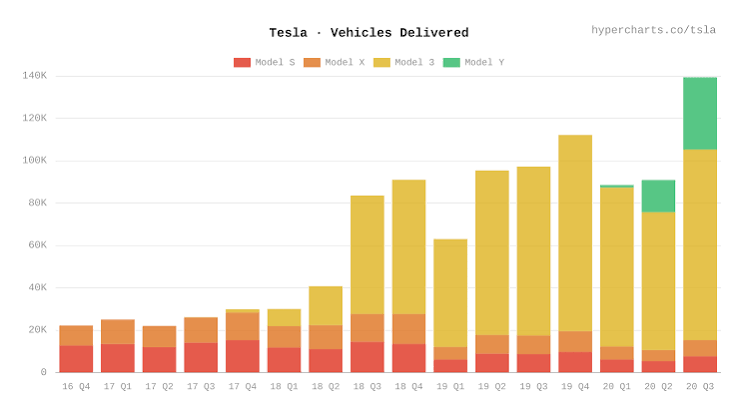
Tesla delivered 480,126 vehicles in the second quarter of 2026. Of that total, 467,762 were Model 3 and Model Y vehicles, while 12,364 came from other models.
The Q3 number will therefore help investors determine whether Tesla maintained its sales momentum during the quarter.
Read more: SpaceX Stock Outlook as Musk Aims for AI Leadership Within Six Months
Why Production and Inventory Matter
Looking only at deliveries can provide an incomplete picture of Tesla’s automotive business.
Production is another important metric because a company can increase deliveries while also building up inventory. Conversely, production that remains closely aligned with deliveries can provide a different picture of demand.
Tesla produced 451,758 vehicles during Q2 while delivering 480,126. That difference is worth remembering when assessing the company’s next delivery report.
Investors can therefore look at several numbers together:
- Total vehicle deliveries
- Total vehicle production
- Model 3 and Model Y deliveries
- Other vehicle deliveries
- Changes in inventory
- Pricing and incentives
This broader view can help distinguish genuine demand growth from sales supported primarily by discounts or temporary incentives.
Analyst Estimates Point to a Wide Range
The difference between published estimates is important for understanding the potential market reaction.
A delivery figure of 450,000 vehicles, for example, would be above Goldman Sachs’ reported estimate but below the estimates cited from UBS and Barclays. That means the same result could be interpreted differently depending on which benchmark an investor uses.
This is one reason a Tesla stock forecast should not rely on a single analyst target.
Investors also need to consider what the market has already priced into TSLA. If traders are already expecting strong deliveries, even a solid result may produce a limited reaction. On the other hand, an unexpected improvement could attract additional buying interest.
The earnings report will eventually provide more context by showing how vehicle sales translated into revenue and profitability.
Tesla Roadster Launch Adds Another Catalyst
The next-generation Tesla Roadster is another major event attracting attention.
Tesla is expected to present the vehicle on October 1, 2026, at an event in Waco, Texas. The Roadster has been part of Tesla’s product story for years, making the latest presentation important for investors who want to know how close the vehicle is to commercial production.
The key issue is not simply whether Tesla shows the car. Investors will want to see concrete information about production timing, pricing, specifications and customer availability.
A product presentation can generate considerable attention, but it does not automatically translate into immediate revenue. The financial impact depends on when production begins, how many vehicles Tesla can manufacture and whether customers actually purchase the vehicle at the announced price.
What Investors Should Watch During the Roadster Event
Several details could be particularly relevant:
Production timeline: A specific manufacturing schedule would provide more information than a general statement about future availability.
Pricing: Investors can compare the latest pricing information with Tesla’s previous Roadster announcements.
Performance specifications: Range, acceleration and other specifications could help define the vehicle’s market position.
Availability: A clearer customer delivery schedule would make the announcement more commercially meaningful.
Technology: Any new technology demonstrated during the event could provide information about Tesla’s product development strategy.
Tesla previously announced a $200,000 starting price for the Roadster and a $250,000 Founders Series. Reports have also indicated that reservations were reopened with an initial $5,000 payment followed by an additional $45,000 payment.
However, earlier announcements and reservation terms should not be treated as confirmation of final production pricing or delivery dates unless Tesla officially confirms those details.
Could Higher Fuel Prices Support EV Demand?
Energy prices can influence consumer interest in electric vehicles because the operating cost of an EV can become relatively more attractive when gasoline and diesel prices rise.
However, the relationship is not straightforward.
Consumers consider many factors when purchasing a vehicle, including the upfront price, financing costs, charging availability, electricity prices, driving requirements and competing models.
Higher gasoline prices may therefore support EV interest over time, but they do not guarantee an immediate increase in Tesla deliveries.
Tesla is also competing in a market where consumers have more electric vehicle choices than in previous years. Other manufacturers are expanding their EV lineups, giving buyers additional alternatives.
For Tesla, maintaining demand may depend not only on the broader shift toward electric transportation but also on pricing, product updates, financing options and the competitiveness of its individual models.
Tesla Earnings Could Matter More Than Deliveries Alone
The delivery report will provide an early indication of Tesla’s quarterly vehicle sales, but the full earnings report will offer a much broader view of the company.
Revenue is affected by more than vehicle volume. Average selling prices, product mix, energy generation and storage, services, foreign exchange movements and other factors can all influence Tesla’s financial results.
This means strong deliveries do not automatically guarantee stronger earnings.
For example, if Tesla increases deliveries by offering significant discounts, the higher sales volume could come with pressure on automotive margins. Investors therefore need to examine revenue and profitability alongside the delivery number.
Tesla’s cash flow and operating expenses can also provide useful information about the company’s financial position and investment requirements.
Tesla Stock Technical Levels to Watch
Technical analysis can provide another perspective for traders following TSLA.
The chart levels identified in the supplied analysis place attention around the $383 and $394 areas on the upside, with approximately $353 acting as an important support reference.
The chart also showed a potential double-top formation near the $383 area. In technical analysis, a double top occurs when a stock tests a similar high more than once but struggles to break through it.
The area between the two highs can become important because traders may watch for a break below the intervening support level.
What a Break Below Support Could Mean
The $353 area was identified as the neckline or support reference for the potential pattern.
If the stock were to break decisively below that level, technical traders could interpret it as confirmation of increased selling pressure. The original chart analysis also identified the $300 area as a possible lower support reference.
That does not mean TSLA must fall to $300.
Technical levels are not guarantees. Company announcements, earnings, market conditions and investor sentiment can all cause a stock to move differently from a historical chart pattern.
What Could Invalidate the Bearish Pattern?
A sustained move above the $383 area could weaken the double-top interpretation described in the supplied analysis.
A move through resistance toward the $394 area would give traders another level to monitor. However, an intraday move above resistance is not necessarily the same as a confirmed breakout.
Volume and subsequent price action can provide additional context when evaluating whether a move has lasting momentum.
Three Factors That Could Shape TSLA’s Next Move
Rather than relying on one event, investors can monitor three broad areas.
1. Actual Q3 Deliveries
The first question is whether Tesla’s reported deliveries exceed, meet or fall below the range of analyst expectations.
The number should also be compared with production and inventory data.
2. Roadster Details
The Roadster presentation could influence sentiment if Tesla provides meaningful updates about pricing, production and availability.
The commercial significance will depend on what Tesla can actually deliver rather than the attention generated by the event itself.
3. Financial Results
The subsequent earnings report will show whether vehicle sales translated into revenue and profitability.
Margins, cash flow, operating expenses and management guidance could ultimately matter more to long-term investors than the delivery headline alone.
What Investors Should Check Before Making a Decision
Anyone researching a Tesla stock forecast should avoid relying on a single price target or chart pattern.
Instead, consider:
- Actual Q3 delivery results
- Current analyst expectations
- Production compared with deliveries
- Inventory trends
- Vehicle pricing and incentives
- Roadster production information
- Quarterly revenue
- Automotive margins
- Cash flow
- Broader market conditions
- TSLA’s technical price levels
This approach provides a more complete picture of the factors that could influence Tesla shares.
Frequently Asked Questions
When will Tesla report Q3 2026 deliveries?
Tesla is expected to release its third-quarter 2026 vehicle delivery figures on October 2, 2026.
When is the Tesla Roadster expected to be presented?
The next-generation Roadster is expected to be presented on October 1, 2026, at an event in Waco, Texas.
What are analysts expecting from Tesla’s Q3 deliveries?
Published September estimates cited in the supplied research ranged from approximately 435,000 vehicles to 475,000 vehicles, depending on the analyst.
What Tesla stock levels are important on the chart?
The supplied technical analysis identified approximately $353 as support and $383 to $394 as important resistance areas.
Can Tesla deliveries predict the stock price?
Not by themselves. Deliveries are one operating indicator. Investors also need to consider pricing, margins, earnings, cash flow, production, inventory and broader market conditions.
Final Thoughts on the Tesla Stock Forecast
Tesla enters October with several developments that could influence investor attention. The Q3 delivery report will provide fresh evidence about vehicle demand, while the Roadster presentation could clarify Tesla’s plans for one of its most closely watched upcoming products.
The most useful approach is to look beyond a single headline. Delivery volume needs to be considered alongside production, inventory and pricing, while the Roadster announcement needs to be evaluated based on confirmed production and commercial details.
Technical levels can add another perspective for traders, but they should not replace fundamental analysis. For anyone following the Tesla stock forecast, the combination of confirmed company data, analyst expectations, financial results and market conditions provides a more complete framework for understanding TSLA’s next phase.