


Israeli Prime Minister Benjamin Netanyahu has asked officials to prepare a blockchain plan that could keep Israel’s economy moving if international banking sanctions ever cut the country off from the global financial system. The announcement, made in a television interview on October 23, 2026, turned a niche crypto topic into one of the most debated economic stories of the week — and drew an unusually blunt public rejection from Israel’s own central bank.
- What Netanyahu Actually Said in the Channel 10 Interview
- The Sanctions Threat Behind the Netanyahu Blockchain Plan
- How Banking Sanctions Could Hit Israel’s Economy
- Can Blockchain Bypass Banking Sanctions?
- Bank of Israel Rejects the Crypto Bypass Idea
- Israel Crypto Sanctions: Lessons From Iran, Russia and Venezuela
- 109 Economists Warn of Damage to Israel’s Economy
- US Military Aid: The $38 Billion Question
- Netanyahu Blockchain Plan: Key Facts at a Glance
- What the Netanyahu Blockchain Plan Means for Crypto Markets
- What Happens Next: Three Scenarios
- Frequently Asked Questions
- What is the Netanyahu blockchain plan?
- Did Netanyahu say Israel will use Bitcoin?
- Can crypto actually bypass banking sanctions?
- What did the Bank of Israel say about the plan?
- When will the UK settlement goods ban take effect?
- Conclusion
The idea is simple to describe and hard to execute: use blockchain networks and digital currencies to move value outside the correspondent-banking channels that sanctions would target. Whether that can work at the scale of a national economy is a different question, and the early answers from economists and regulators are skeptical.
The proposal also arrives at a moment when regulated digital dollars are already moving serious money. As we reported, regulated dollar stablecoins processed more than $36 trillion in on-chain volume in the first half of 2026, with USDC alone handling $315 billion in minting and redemptions over the same period. That scale is exactly why a head of government would look at crypto rails in a crisis — and also why the limits of those rails matter so much.
- What Netanyahu Actually Said in the Channel 10 Interview
- The Sanctions Threat Behind the Netanyahu Blockchain Plan
- How Banking Sanctions Could Hit Israel’s Economy
- Can Blockchain Bypass Banking Sanctions?
- Bank of Israel Rejects the Crypto Bypass Idea
- Israel Crypto Sanctions: Lessons From Iran, Russia and Venezuela
- 109 Economists Warn of Damage to Israel’s Economy
- US Military Aid: The $38 Billion Question
- Netanyahu Blockchain Plan: Key Facts at a Glance
- What the Netanyahu Blockchain Plan Means for Crypto Markets
- What Happens Next: Three Scenarios
- Frequently Asked Questions
- Conclusion
What Netanyahu Actually Said in the Channel 10 Interview
Netanyahu made the remarks on Friday, October 23, 2026, in an interview with Roi Katz on Israel’s Channel 10 business channel. Asked whether blockchain technology could offer a way of dealing with economic sanctions against Israel, he confirmed that his government was examining the technology and had already requested a plan.
His framing was blunt. He told viewers that Israel needed to prepare an “alternative economic system” in case restrictions hit the country’s banking system, and that there are currencies capable of bypassing such restrictions. When Katz pressed him on whether he meant cryptocurrency, Netanyahu agreed and said blockchain was another possibility under consideration.
The prime minister also tied the proposal to a wider warning about American support. He said Israelis should prepare for a future without the tens of billions of dollars in United States military assistance he had secured twice before, arguing that Washington has changed and that the aid will eventually end. He gave no date for that change, and he named no specific cryptocurrency, stablecoin or blockchain network as part of the proposed response. No launch date, budget or supervisory framework was announced.
Read more: Bybit Dubai VARA license approval for spot trading — how regulators are drawing the line between licensed crypto trading and products that stay outside the licensed perimeter.
The Sanctions Threat Behind the Netanyahu Blockchain Plan
Netanyahu’s remarks followed a concrete escalation in September 2026. On September 8, British Foreign Secretary Ed Miliband told the House of Commons that the United Kingdom would ban imports of all goods produced in Israeli settlements in the occupied West Bank, and would act against companies and individuals providing services — including financing, construction, infrastructure and real estate — that support settlement expansion. The measures were announced alongside a joint statement with 12 countries, and France and Canada committed to introducing similar restrictions of their own.
Two details matter for understanding the scale of the threat. First, the British measures target settlement goods and settlement-linked services, not Israel’s banking system as a whole, and trade with Israel itself is to continue. Second, the import ban is scheduled to take effect within six to nine months of the announcement, which gives the timeline a slow fuse rather than an immediate trigger.
Israel responded with countermeasures of its own, including closing the British consulate in Jerusalem. The economic stakes of any wider escalation are large: the European Union is Israel’s largest trading partner, accounting for 31.7 percent of Israel’s total trade in goods in 2025, worth €43.3 billion (about $50.4 billion), according to European Commission data.
How Banking Sanctions Could Hit Israel’s Economy
Banking sanctions would work very differently from a goods ban. Modern trade runs on correspondent banking: Israeli banks hold accounts with large international banks, and those relationships clear payments for imports, exports, salaries and investment. If foreign banks were barred from dealing with Israeli institutions, the plumbing of everyday commerce would clog — even for transactions that have nothing to do with settlements.
Can Blockchain Bypass Banking Sanctions?
On paper, the technology has real features that look useful in a sanctions scenario. Blockchain networks record transactions on shared digital ledgers, and some support transfers of digital assets without using the correspondent-banking infrastructure that traditional payments rely on. A stablecoin pegged to the US dollar can, in principle, move value across borders in minutes, at any hour, without a bank in the middle. That gap is the central question the Netanyahu blockchain plan must answer.
- On-ramps and off-ramps are regulated. Turning crypto into goods, salaries or local currency still requires exchanges, banks and payment firms — and those firms comply with sanctions lists, screen transactions and freeze flagged funds. Chain-analysis tools make large flows visible.
- Scale is a problem. Even the largest stablecoins settle a fraction of what a national economy trades in a week. Moving a country’s import bill through crypto markets would overwhelm available liquidity and move prices against the buyer.
- Volatility and counterparty risk remain. Unbacked cryptocurrencies swing sharply in value, and stablecoins depend on the reserves and banking relationships of their issuers — the same banking system a sanctions regime would target.
- Legality is not optional. Cryptocurrency services remain subject to financial laws and restrictions, and using them to evade sanctions can itself create criminal liability for the parties involved.
None of this means blockchain is useless in a crisis. It means the technology is better suited to small, targeted transfers than to replacing a national banking system.
Bank of Israel Rejects the Crypto Bypass Idea
The most striking institutional response came from Israel’s central bank. The Bank of Israel publicly rejected the proposal, stating that cryptocurrencies “cannot be used as a route for bypassing sanctions,” according to a Financial Times report cited by crypto outlets on October 25, 2026.
The central bank’s position carries weight because it supervises Israel’s banks and payment systems. Its message was, in effect, that the institution responsible for financial stability does not believe the workaround would work — and that planning around it would be a mistake. That public disagreement between a prime minister and his central bank is rare, and it signals how seriously the proposal is being taken inside Israel’s economic establishment.
Market participants were watching closely as well. Bank and market figures told Israeli media they feared a sell-off when the Tel Aviv Stock Exchange reopened on Monday. The remarks came days before Israel’s elections, scheduled for Tuesday, October 27, 2026.
Israel Crypto Sanctions: Lessons From Iran, Russia and Venezuela
History offers a useful test of the idea, because several countries have already tried it. As Haaretz noted in its coverage of the interview, only countries facing severe economic sanctions — such as Iran, North Korea, Russia and Venezuela — currently make use of crypto as a workaround solution. Their experience is instructive, and it is not encouraging.
Iran has used Bitcoin mining and crypto payments to earn hard currency outside the banking system, but the volumes involved are small relative to its oil trade. Russia has explored crypto for cross-border settlement since its exclusion from parts of the global banking system, yet most of its trade still runs through conventional channels. Venezuela’s state-backed Petro cryptocurrency, launched with similar ambitions, collapsed into irrelevance.
The pattern across all three cases is consistent: crypto can move some value around the edges of a sanctions regime, but it has never replaced the banking system for a national economy.
109 Economists Warn of Damage to Israel’s Economy
The backlash from Israel’s business community was swift. On October 25, 2026, a group of 109 economists, business leaders, high-tech entrepreneurs and former senior public officials issued a strongly worded statement expressing “deep anxiety and concern” over the prime minister’s remarks, warning of irreversible damage to Israel’s economy if international sanctions are imposed.
The signatories argued that restrictions on Israel’s banking system would lead to soaring unemployment, the disappearance of foreign investment and the paralysis of the high-tech sector. They also warned of severe consequences for daily life, including the inability to use credit cards, the loss of access to online shopping platforms such as Amazon and AliExpress, and difficulties for the healthcare system in purchasing medicines and medical equipment.
Their harshest criticism was aimed at the proposed solution itself. The letter said the prime minister was leading Israel toward international economic isolation and offering a solution commonly used by criminal organizations that would be of no help. Opposition leader Yair Lapid said Netanyahu had admitted in his own words that, if his government were reelected, US military aid would end and Israel would face sanctions that would devastate its economy. The Netanyahu blockchain plan drew the sharpest criticism in the letter.
US Military Aid: The $38 Billion Question
The second half of Netanyahu’s interview may matter more than the blockchain proposal itself. The United States and Israel signed a ten-year security assistance agreement in 2016, covering fiscal years 2019 through 2028, worth $38 billion — including $33 billion in military financing and $5 billion for missile defense programs. Netanyahu told Israelis that the tens of billions he secured twice before should not form the basis of long-term defense planning, because the United States has changed and the assistance will eventually end.
He also said the government had allocated an additional 400 billion shekels for defense spending over the coming years, and discussed greater domestic defense production. The message was consistent: Israel should prepare to stand more on its own, financially and militarily. The Netanyahu blockchain plan sits inside that wider shift toward self-reliance.
Netanyahu Blockchain Plan: Key Facts at a Glance
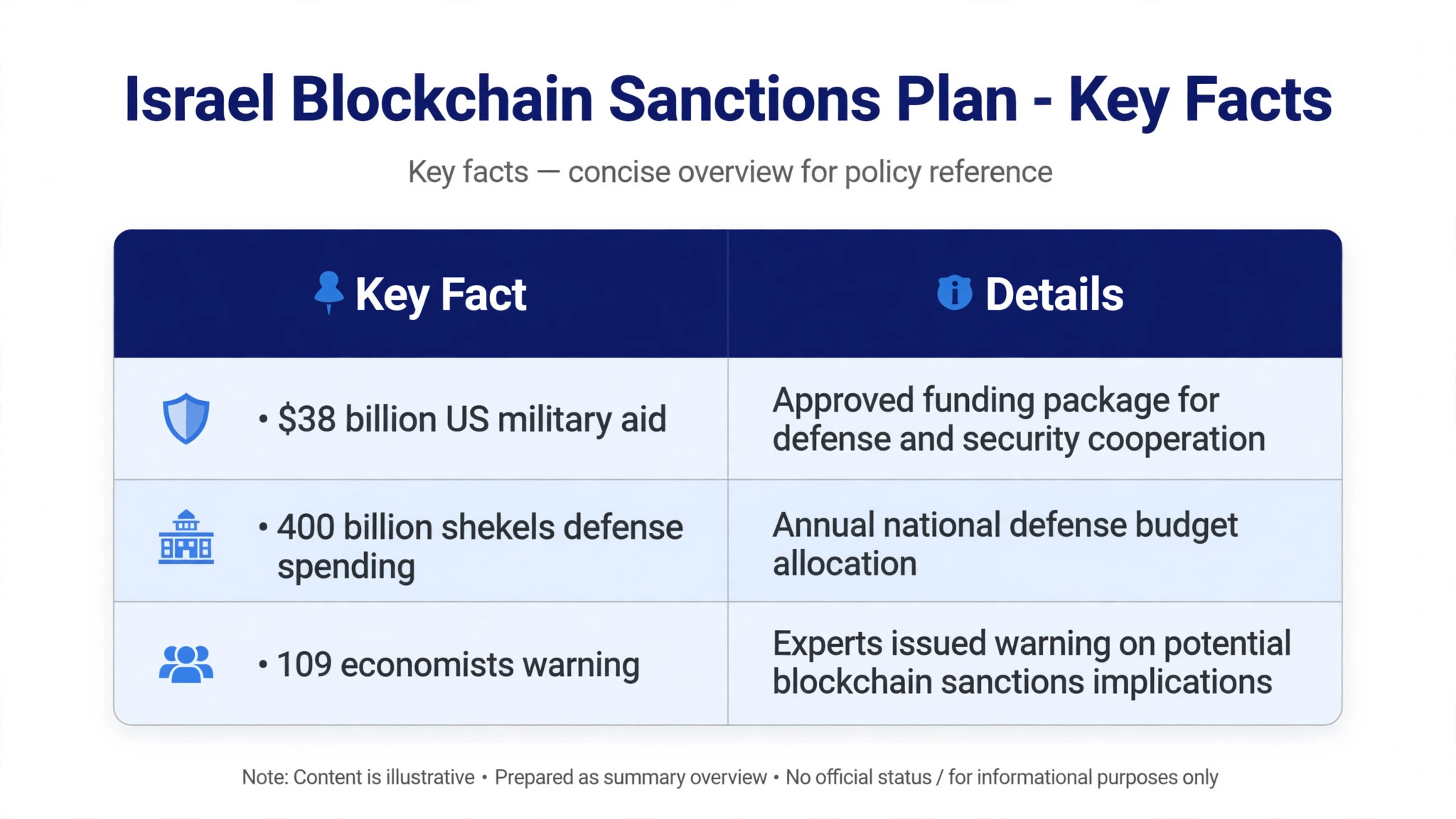
The table below gathers the verified figures behind this story in one place. Every number here is drawn from the reporting cited in this article.
| Fact | Detail |
|---|---|
| Blockchain plan requested | October 23, 2026, in a Channel 10 interview |
| UK settlement goods ban announced | September 8, 2026, by Foreign Secretary Ed Miliband |
| UK ban takes effect | Within 6 to 9 months of announcement |
| Countries backing settlement trade restrictions | UK, France and Canada committed; 12-country joint statement |
| US military aid agreement (2016) | $38 billion for fiscal years 2019–2028 |
| Military financing within the agreement | $33 billion |
| Missile defense within the agreement | $5 billion |
| Additional defense spending announced | 400 billion shekels |
| Economists and business leaders warning | 109 signatories, October 25, 2026 |
| EU share of Israel’s goods trade (2025) | 31.7 percent, worth €43.3 billion (about $50.4 billion) |
What the Netanyahu Blockchain Plan Means for Crypto Markets
For crypto investors, the story matters less as a price catalyst and more as a signal about how governments now think about digital assets. A head of government publicly treating cryptocurrency as a potential instrument of national economic policy — even as a contingency — is a marker of how far the asset class has travelled from its fringe origins. The Netanyahu blockchain plan is the clearest example yet of that shift.
Bitcoin was trading near $84,000 when the story broke, with the wider market under pressure after a week of heavy ETF outflows. Nothing in the reporting suggests the interview moved crypto prices on its own, and traders should be cautious about drawing a causal line between political headlines and market moves.
Stablecoins sit at the center of that scrutiny. They are the most plausible vehicle for any state-level crypto payments plan, because they carry dollar value without dollar banking rails — but the same feature makes them the first thing regulators examine, and major issuers run extensive sanctions-screening programs for exactly that reason.
What Happens Next: Three Scenarios
The story is still moving, and the range of outcomes is wide. Three scenarios cover what could plausibly happen to the Netanyahu blockchain plan from here.
| Scenario | What would trigger it | Likely outcome |
|---|---|---|
| Plan stays a contingency | No new sanctions beyond the UK measures; elections change the government | The blockchain plan is shelved or quietly studied; crypto markets barely notice |
| Escalation without banking sanctions | More countries join the settlement goods bans; EU pressure grows | Political pressure rises, but banking rails stay open; the plan remains theoretical |
| Banking restrictions arrive | Sanctions expand to Israeli banks or payment networks | Severe economic disruption; any crypto workaround would face the scale and compliance limits described above |
The most likely near-term path is the first: a plan that exists on paper while the politics play out. But the story has already changed one thing permanently — the idea of a state using crypto to route around sanctions is now attached to a mainstream, US-allied government, and that framing will shape regulatory debates well beyond Israel.
For readers new to the underlying technology, blockchain technology is explained in detail on Wikipedia, including how distributed ledgers record transactions without a central authority and how different networks handle payments in different ways.
This article is for informational purposes only and does not constitute financial advice. Cryptocurrency markets are volatile and high-risk, and political developments can change quickly. Always do your own research and consult a qualified adviser before making any investment decision.
Frequently Asked Questions
What is the Netanyahu blockchain plan?
In an October 23, 2026 interview on Israel’s Channel 10, Prime Minister Benjamin Netanyahu said he had asked officials to prepare a plan using blockchain technology and digital currencies as part of an “alternative economic system” in case banking sanctions are imposed on Israel. No specific cryptocurrency was named, and no launch date, budget or framework has been announced.
Did Netanyahu say Israel will use Bitcoin?
No. He did not identify Bitcoin, a stablecoin or any other digital asset as part of the proposal. He confirmed that blockchain was one option under examination, alongside other alternative financial arrangements that were not specified.
Can crypto actually bypass banking sanctions?
Only to a limited extent. Blockchain networks can move value without correspondent banks, but converting crypto into goods, salaries or local currency still requires regulated exchanges and payment firms that comply with sanctions. Past attempts by Iran, Russia and Venezuela show crypto can move some value at the margins, but it has never replaced a national banking system. That is the core doubt hanging over the Netanyahu blockchain plan.
What did the Bank of Israel say about the plan?
The Bank of Israel publicly rejected the idea, stating that cryptocurrencies “cannot be used as a route for bypassing sanctions.” As the supervisor of Israel’s banks and payment systems, the central bank’s view carries significant weight in the debate.
When will the UK settlement goods ban take effect?
The British government said the import ban on settlement goods and the related services restrictions would take effect within six to nine months of the September 8, 2026 announcement — meaning sometime between early and mid-2027.
Conclusion
The Netanyahu blockchain plan is best understood as a warning wrapped in a proposal. The warning — that Israel may face banking sanctions and fading American aid — is the part of the interview that rattled markets, economists and the central bank. The proposal — a blockchain-based alternative economy — is untested at national scale, rejected by the Bank of Israel, and contradicted by the experience of every sanctioned country that has tried it.
What the episode does prove is that cryptocurrency has entered the language of national economic strategy. Whether it can deliver on that promise in a crisis is a separate question, and the honest answer, for now, is that no one has shown it can. Investors should watch the sanctions timeline, the election result and the Bank of Israel’s next moves for what comes next.