

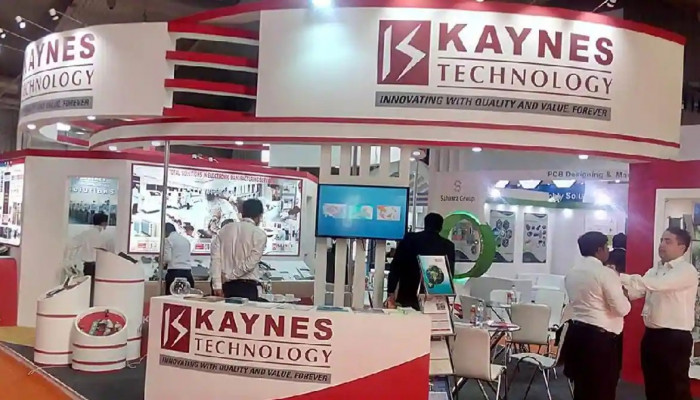
Kaynes Technology has become one of the most closely watched electronics manufacturing and semiconductor-related stocks in India. The company’s expansion into electronics manufacturing services, printed circuit boards and semiconductor assembly has created a compelling long-term story.
- What Does Kaynes Technology Do?
- Kaynes Technology Investment: Quick Verdict
- Kaynes Technology FY26 Financial Performance
- Why Did Kaynes Technology Shares Fall?
- Strong Order Book Supports Future Revenue
- Semiconductor and OSAT Growth Opportunity
- PCB Manufacturing as a Second Growth Engine
- The Biggest Concern: Operating Cash Flow
- Is Kaynes Technology Overvalued?
- Kaynes Technology Fundamental Analysis
- Kaynes Technology Q1 FY27 Results
- Kaynes Technology Share Price Target 2026
- Is Kaynes Technology a Good Long-Term Investment?
- Kaynes Technology: Buy, Hold or Avoid?
- Frequently Asked Questions
- Is Kaynes Technology a good investment?
- What is the Kaynes Technology share price?
- Why is Kaynes Technology share falling?
- What is Kaynes Technology’s order book?
- Does Kaynes Technology manufacture semiconductors?
- When will Kaynes Technology announce Q1 FY27 results?
- Is Kaynes Technology suitable for beginners?
- Conclusion
However, a good business does not automatically become a good investment at every price.
The latest Kaynes Technology investment case contains both strong growth opportunities and serious financial risks. Revenue, EBITDA and the order book expanded during FY26, but working-capital requirements increased sharply. The March quarter also disappointed investors because profit declined despite higher revenue.
At approximately ₹3,875 on August 4, 2026, Kaynes Technology was trading almost 50% below its 52-week high of ₹7,705. The correction has made the valuation less extreme than it was near the peak, although the stock still carries a premium based on its existing earnings.
The balanced conclusion is that Kaynes Technology remains an attractive long-term business story, but investors should wait for clearer evidence of cash-flow improvement and consistent execution before treating it as a low-risk investment.
What Does Kaynes Technology Do?
Kaynes Technology India Limited is an integrated electronics manufacturing and design company listed under the NSE symbol KAYNES and BSE code 543664.
The company provides conceptual design, product engineering, integrated manufacturing and life-cycle support. Its customers operate across automotive, electric vehicles, industrial equipment, aerospace, strategic electronics, medical devices, railways, the Internet of Things and information technology.
Kaynes is not limited to assembling simple consumer electronics. It focuses on high-mix and higher-value products that may require specialized manufacturing, engineering, testing and regulatory certifications.
Its business can broadly be understood through the following activities:
- Printed circuit board assembly
- Box-build and integrated manufacturing
- Original design manufacturing
- Product engineering and IoT solutions
- Semiconductor assembly and testing
- Advanced printed circuit board manufacturing
The company’s expansion into OSAT and PCB manufacturing is important because it could move Kaynes deeper into the electronics value chain.
Kaynes Technology Investment: Quick Verdict
For investors seeking a direct answer, the current position can be summarized as follows:
| Investor Type | Possible Approach |
|---|---|
| Conservative investor | Wait for cash-flow and working-capital improvement |
| Existing long-term shareholder | Hold while monitoring quarterly execution |
| High-risk growth investor | Consider gradual accumulation rather than a lump-sum purchase |
| Short-term trader | Watch Q1 FY27 results and management guidance |
| Income investor | Not ideal because the stock is mainly a growth investment |
Kaynes Technology is not an obviously cheap value stock. The investment thesis depends on the company achieving strong future growth from core EMS, OSAT, PCB and design-led products.
Kaynes Technology FY26 Financial Performance
Kaynes reported consolidated FY26 revenue of ₹36.26 billion, equivalent to approximately ₹3,626 crore. Revenue increased 33.2% compared with FY25.
EBITDA grew 39.8% to approximately ₹574 crore, while the EBITDA margin improved from 15.1% to 15.8%. Full-year profit after tax increased 24% to approximately ₹364 crore.
FY26 Financial Summary
| Metric | FY25 | FY26 | Growth |
|---|---|---|---|
| Revenue | ₹2,722 crore | ₹3,626 crore | 33.2% |
| EBITDA | ₹411 crore | ₹574 crore | 39.8% |
| EBITDA margin | 15.1% | 15.8% | 70-basis-point increase |
| Profit after tax | ₹293 crore | ₹364 crore | 24.0% |
| PAT margin | 10.8% | 10.0% | 80-basis-point decline |
| Order book | ₹6,597 crore | ₹8,366 crore | Approximately 27% increase |
The full-year growth appears impressive. EBITDA increased faster than revenue, indicating better operating profitability before depreciation, interest and tax.
However, the PAT margin declined even though the EBITDA margin improved. Higher depreciation, finance costs and tax expenses prevented all of the operating growth from reaching net profit.
Why Did Kaynes Technology Shares Fall?
Kaynes Technology’s Q4 FY26 results exposed several weaknesses behind the strong full-year numbers.
Q4 revenue increased 26.2% year over year to approximately ₹1,243 crore. EBITDA rose 15.4% to around ₹194 crore, but profit after tax declined 21.5% to approximately ₹91 crore.
The quarterly EBITDA margin fell from 17.1% to 15.6%, while the PAT margin declined from 11.8% to 7.3%.
The market had expected stronger execution. After the results, Kaynes shares fell sharply as brokerages raised concerns about missed guidance, working-capital requirements, cash burn and project delays.
Management said that geopolitical disruption, customer deferments, supply-chain delays and changes in product timing affected near-term revenue recognition. It maintained that the underlying orders remained valid and that demand had not structurally weakened.
Investors now need to determine whether the weakness was temporary or evidence that the company’s growth plans are becoming more difficult to execute.
Strong Order Book Supports Future Revenue
One of the biggest arguments supporting a Kaynes Technology long-term investment is its order book.
The company reported an order book of approximately ₹8,366 crore at the end of FY26, compared with around ₹6,597 crore one year earlier. This represents more than twice the company’s FY26 revenue and provides reasonable visibility for future production.
The customer base is also spread across several industries, including industrial equipment, automotive, railways, medical devices, aerospace and IoT.
According to the company’s FY26 presentation, its five largest customers represented 46% of revenue. The top 10 represented 60%. This is still meaningful concentration, but the business is not dependent on only one or two customers.
An order book is not the same as realized revenue, however. Production schedules, approvals, component availability and customer readiness determine when orders are executed.
The key question is therefore not only whether Kaynes wins orders, but whether it can convert them into revenue and operating cash flow on time.
Semiconductor and OSAT Growth Opportunity
Kaynes has expanded into OSAT, or outsourced semiconductor assembly and testing.
OSAT companies package, assemble and test semiconductor chips after the wafer-manufacturing stage. This activity is essential before chips can be used in automotive systems, industrial equipment, consumer devices and other electronic products.
Kaynes inaugurated its semiconductor facility in Sanand, Gujarat, in March 2026. The company said the first OSAT unit had started commercial operations and was scaling production.
Management reported OSAT revenue visibility exceeding ₹2,500 crore over five years. It also stated that customers had indicated additional demand for the company’s planned PCB capacity.
External consensus estimates cited by S&P Global suggested that OSAT and PCB activities could become meaningful contributors over the coming years. However, both businesses are still early in their commercial development, so investors should treat long-term forecasts as estimates rather than guaranteed outcomes.
Why OSAT Could Help Kaynes
A successful semiconductor operation could:
- Increase the company’s addressable market
- Deepen relationships with electronics customers
- Improve its position in India’s manufacturing supply chain
- Create higher-value revenue opportunities
- Provide integration between chip packaging, PCBs and electronics assembly
The opportunity is substantial, but the required investment is also high. New semiconductor operations may take time to achieve optimal utilization and profitability.
PCB Manufacturing as a Second Growth Engine
Kaynes is also building advanced PCB manufacturing capabilities.
Printed circuit boards connect and support the electronic components found inside industrial systems, vehicles, medical equipment, smartphones and other devices.
Management stated that its HDI PCB manufacturing unit was approaching operational readiness. It expects PCB manufacturing to support greater backward integration and improve its ability to offer complete electronics solutions.
This strategy could make Kaynes more valuable to customers because the company would control more parts of the manufacturing process.
At the same time, PCB manufacturing is capital-intensive. The investment case depends on whether demand is converted into profitable production without creating excessive debt or working-capital pressure.
The Biggest Concern: Operating Cash Flow
Revenue and accounting profit do not tell the entire story.
Kaynes reported operating profit before working-capital changes of approximately ₹672 crore in FY26. However, a major increase in trade receivables and inventory caused net cash flow from operating activities to fall to negative ₹600 crore.
Trade receivables increased from approximately ₹575 crore in FY25 to ₹1,528 crore in FY26. Inventory rose from approximately ₹814 crore to ₹1,103 crore.
This means a significant amount of reported revenue had not yet been collected as cash by the end of the year.
Net working-capital days increased from 87 days to 125 days. Management explained that smart-meter procurement contributed to the higher consolidated working-capital cycle. It also said working-capital days in the core EMS business had improved from 83 days in FY24 to 53 days in FY26.
Both explanations can be true: the underlying EMS operation may have improved while newer activities increased the group’s total cash requirement.
Nevertheless, investors should not ignore negative operating cash flow. The company needs to demonstrate that receivables can be collected and that growth will eventually generate cash rather than continually consume it.
Is Kaynes Technology Overvalued?
At the August 4, 2026 closing price of around ₹3,875, Kaynes Technology had an estimated market capitalization of approximately ₹26,000 crore.
Compared with FY26 profit after tax of approximately ₹364 crore, that produces a rough price-to-earnings valuation of around 71 times FY26 earnings. This is an approximate calculation and may differ from financial platforms because of changes in share count and the method used to calculate trailing earnings.
A valuation of that level indicates that the market still expects substantial future growth.
The stock could justify a premium valuation if:
- Revenue continues growing rapidly
- OSAT and PCB operations scale successfully
- Margins remain healthy
- Operating cash flow improves
- Return on capital recovers
- Management meets its guidance consistently
The valuation could contract if earnings growth slows or capital-intensive expansion fails to generate the expected returns.
Kaynes Technology Fundamental Analysis
Strengths
Diversified business exposure: Kaynes serves industrial, automotive, railway, medical, aerospace and strategic-electronics customers.
Strong revenue growth: FY26 revenue increased 33.2%, while EBITDA rose 39.8%.
Healthy order visibility: The company ended FY26 with an order book exceeding ₹8,300 crore.
Higher-value manufacturing: Kaynes operates in design-led and specialized electronics rather than relying entirely on low-margin assembly.
Semiconductor opportunity: OSAT and PCB investments give the company access to rapidly developing areas of India’s electronics ecosystem.
Weaknesses
Negative operating cash flow: FY26 operations consumed cash despite positive accounting profit.
Rising receivables: A substantial increase in receivables raises questions about collection cycles.
Execution risk: The company missed market expectations and faced project-timing delays.
Capital intensity: OSAT and PCB plants require large investments before generating stable returns.
Premium valuation: A high earnings multiple leaves less room for weak quarterly performance.
Kaynes Technology Q1 FY27 Results
Kaynes Technology’s board is scheduled to consider the financial results for the quarter ended June 30, 2026, on August 7, 2026.
This upcoming result may be more important than normal because investors will look for evidence that the Q4 weakness was temporary.
Important numbers to monitor include:
- Revenue growth in the core EMS business
- EBITDA and PAT margins
- Trade-receivable growth
- Operating cash flow
- Net working-capital days
- OSAT revenue and production ramp-up
- PCB commissioning timeline
- Updated order-book value
- FY27 revenue guidance
- Capital expenditure and funding requirements
Strong revenue without better cash conversion may not be enough to restore investor confidence.
Kaynes Technology Share Price Target 2026
A reliable share-price target cannot be created by simply adding a percentage to the current price.
The stock’s fair value depends on future earnings, execution, cash conversion and the valuation multiple that investors are willing to pay.
Instead of using one fixed Kaynes Technology share-price target, investors can consider three scenarios:
Bull Case
The bull case requires strong EMS growth, successful OSAT commercialization, on-time PCB execution, stable margins and improving operating cash flow.
Under this scenario, the company could regain a premium market valuation.
Base Case
In the base case, revenue continues growing but working capital remains elevated. OSAT and PCB operations scale gradually rather than immediately.
The stock could remain volatile while the market waits for evidence of sustainable free cash flow.
Bear Case
The bear case includes further guidance misses, delayed projects, lower margins, rising receivables or additional financing requirements.
In that situation, the market may reduce the valuation multiple even if revenue continues growing.
Is Kaynes Technology a Good Long-Term Investment?
Kaynes Technology may be suitable for long-term investors who believe India will expand its role in electronics and semiconductor manufacturing.
The company has a credible operating business, diversified customers, a large order book and exposure to several structural-growth industries.
However, its long-term success will depend on execution rather than industry potential alone.
Investors should look for three improvements:
- Positive and sustainable operating cash flow
- Lower consolidated working-capital days
- More consistent delivery against management guidance
Until those improvements appear, Kaynes should be treated as a higher-risk growth stock rather than a predictable compounder.
Kaynes Technology: Buy, Hold or Avoid?
Based on the information available before Q1 FY27 results, Kaynes Technology appears closer to a cautious hold or gradual accumulation candidate than a strong lump-sum buy.
Existing shareholders may consider holding if they have a long investment horizon and their position is not excessively large.
New investors may benefit from waiting for the August 7 results or building a position in small stages. This approach reduces the risk of purchasing immediately before an earnings-driven price movement.
Investors seeking stable cash flow, low valuation or regular dividends may find other companies more suitable.
Frequently Asked Questions
Is Kaynes Technology a good investment?
Kaynes Technology offers strong long-term growth potential through EMS, semiconductor assembly and PCB manufacturing. However, negative operating cash flow, rising working capital and a premium valuation make it a higher-risk investment.
What is the Kaynes Technology share price?
Kaynes Technology closed near ₹3,875 on August 4, 2026. Share prices change every trading day, so readers should verify the latest quote before investing.
Why is Kaynes Technology share falling?
The stock has faced pressure because of missed expectations, execution delays, weaker Q4 profit, elevated working capital and negative operating cash flow.
What is Kaynes Technology’s order book?
The company reported an order book of approximately ₹8,366 crore at the end of FY26, compared with around ₹6,597 crore one year earlier.
Does Kaynes Technology manufacture semiconductors?
Kaynes operates an OSAT facility that provides semiconductor assembly, packaging and testing. Its Sanand facility began commercial operations during FY26.
When will Kaynes Technology announce Q1 FY27 results?
The company is scheduled to consider its Q1 FY27 financial results on August 7, 2026.
Is Kaynes Technology suitable for beginners?
The stock may not be ideal for highly conservative beginners because it carries valuation, execution and cash-flow risks. Beginners should understand position sizing and diversification before investing.
Conclusion
The Kaynes Technology investment story is supported by rapid revenue growth, a large order book and expansion into OSAT and advanced PCB manufacturing.
Nevertheless, the company’s FY26 cash-flow position prevents the stock from being considered a straightforward buy. Negative operating cash flow, higher receivables, increased working-capital days and inconsistent quarterly execution are significant concerns.