


SpaceX Stock Price Prediction: Can SPCX Reclaim $175 After October 20 Q3 Earnings?
SpaceX stock (SPCX) heads into its October 20 third-quarter earnings report on the back foot. Shares closed at $146.03 on October 16, down 17.2% from the $175 October high set just ten days earlier, as investors weighed the company’s accelerating artificial intelligence capital spending against a balance sheet preparing to take on tens of billions in new debt. The decline has pushed SPCX below several key technical levels, even though the underlying business keeps growing at a near-doubling pace. The October 20 report will decide whether the stock stabilizes near $146 or slides toward the next major support at $132.
- SpaceX Stock Q3 Earnings Preview: What the October 20 Report Must Prove
- SpaceX Revenue Breakdown: Starlink Carries the Load in Q3
- The $40 Billion Nvidia Chip Bet Hanging Over SpaceX Stock
- SpaceX Spectrum Strategy: The $8 Billion Grain Deal and the Wireless Ambition
- SpaceX Stock Technical Analysis: Key Levels Between $132 and $175
- SpaceX Stock Scenarios: Bull Case vs Bear Case After Earnings
- Risks That Could Keep SpaceX Stock Under Pressure
- Will SpaceX Stock Rebound After Q3 Earnings?
- Frequently Asked Questions
- When does SpaceX report Q3 2026 earnings?
- Why did SpaceX stock fall 17.2% in October?
- What is the $40 billion Nvidia deal?
- Is SpaceX becoming a wireless carrier?
- What are the key SpaceX stock price levels to watch?
- Conclusion
The tension in SpaceX stock is easy to describe: revenue is growing fast, but the cost of that growth is rising faster. The company is preparing to borrow about $40 billion to buy AI chips from Nvidia, has committed roughly $8 billion for wireless spectrum, and spent more than $18 billion on capital expenditure in a single quarter. Our Nvidia stock forecast on the $500B AI financing deal explores the capital side of the same AI infrastructure cycle driving this spending.
- SpaceX Stock Q3 Earnings Preview: What the October 20 Report Must Prove
- SpaceX Revenue Breakdown: Starlink Carries the Load in Q3
- The $40 Billion Nvidia Chip Bet Hanging Over SpaceX Stock
- SpaceX Spectrum Strategy: The $8 Billion Grain Deal and the Wireless Ambition
- SpaceX Stock Technical Analysis: Key Levels Between $132 and $175
- SpaceX Stock Scenarios: Bull Case vs Bear Case After Earnings
- Risks That Could Keep SpaceX Stock Under Pressure
- Will SpaceX Stock Rebound After Q3 Earnings?
- Frequently Asked Questions
- Conclusion
SpaceX Stock Q3 Earnings Preview: What the October 20 Report Must Prove
The October 20 report is SpaceX’s second quarterly disclosure as a public company after its record $86 billion IPO in June 2026, and it arrives with investor patience wearing thin. With a market capitalization near $2 trillion, SPCX trades well below the $300 price target Morgan Stanley reiterated in September — a gap reflecting genuine uncertainty about the returns on the company’s enormous capital program.
The last report set a high bar, and the next one must show that growth is becoming more capital-efficient, not just faster. The four questions that matter: whether AI revenue is scaling fast enough to justify the chip spending, whether capital expenditure is stabilizing, whether Starlink subscriber growth is holding, and what new details emerge on the Nvidia financing and the wireless rollout.
Q2 2026 by the Numbers
SpaceX’s second-quarter results — its first ever as a public company — showed revenue of about $7.81 billion, up 92% year over year, with adjusted EBITDA near $3.54 billion and a net loss that narrowed to $541 million from roughly $1.01 billion. The segment breakdown reveals three very different businesses:
| Segment | Q2 2026 revenue | Operating result | Role |
|---|---|---|---|
| Connectivity (Starlink) | $4.29 billion (+66%) | +$1.66 billion | Only profitable segment; funds the rest |
| AI (models, platform, infrastructure) | $2.56 billion (+247%) | -$1.26 billion | Fastest growth; heaviest capital consumer |
| Space (launch services) | $962 million (+29%) | -$542 million | Stable franchise; long NASA contracts |
One business earns while the other two invest. Total capital expenditure hit $18.37 billion in the quarter — more than double revenue — with about $15.83 billion directed at AI infrastructure. The company ended the quarter with roughly $100 billion in cash and a $47.5 billion backlog, which provides real but not unlimited funding capacity.
What Analysts Expect for Q3
Expectations heading into the report, as reflected in recent market coverage, center on revenue near $13 billion, with the most optimistic estimate close to $15.2 billion — implying growth remains near a doubling pace. That is an extraordinary rate for a company this size, and any sign of deceleration would likely be punished.
The headline number is only half the test. The AI segment absorbed about 86% of second-quarter capital spending while losing roughly 49 cents at the operating level on every dollar of revenue. Progress in narrowing that loss — or credible guidance that spending is converting into contracted revenue — may matter more for SpaceX stock than the total revenue figure.
Read more: how hot CPI data shook risk assets across markets — the inflation-driven risk-off backdrop pressuring growth stocks alongside crypto.
SpaceX Revenue Breakdown: Starlink Carries the Load in Q3
Any serious SpaceX stock forecast starts with Starlink, the satellite connectivity business that functions as the company’s profit engine. The segment generated $4.29 billion in second-quarter revenue with $1.66 billion in operating income — an operating margin near 39% — and remains the only part of the company producing more cash than it consumes.
Subscriber growth is the core of the bullish case. Starlink reached 12 million subscribers at the end of Q2, roughly double a year earlier, with 1.7 million net additions in the quarter. Consumer connectivity revenue rose 44% to $2.49 billion, while enterprise and government revenue more than doubled to $1.81 billion — a favorable mix shift, since institutional contracts tend to be stickier and higher-value.
The trade-off is pricing power. Average revenue per user fell to $66 per month from $85 a year earlier as SpaceX expanded into lower-cost international markets, and final approvals for Starlink service in India remain pending. The question for October 20 is whether subscriber additions are strong enough to offset the ARPU decline. If Starlink growth stalls, the funding mechanism for the AI and launch businesses weakens — and the SpaceX stock price would reflect it quickly.
The AI segment is where the growth and the spending both live. Revenue of $2.56 billion represented 247% year-over-year growth, and reported agreements include Google paying about $920 million a month for SpaceX computing capacity, with market coverage also pointing to AI-compute arrangements with firms including Anthropic and Reflection AI. The segment’s challenge is conversion: turning contracted demand into operating profit before the capital bill overwhelms the balance sheet.
The launch business, at $962 million in quarterly revenue, is the smallest and steadiest of the three. NASA added a $946 million Commercial Crew modification in September, lifting the total contract value to $5.92 billion through 2030 — a reminder that the launch franchise still carries long-duration, high-visibility revenue even as market attention has shifted to AI and wireless.
The $40 Billion Nvidia Chip Bet Hanging Over SpaceX Stock
The largest overhang on SpaceX stock is the reported plan to raise about $40 billion in debt to buy AI chips from Nvidia. First reported by the Financial Times on October 7 and subsequently confirmed in outline by Bloomberg, the financing would consist of roughly $10 billion in bank loans and $30 billion in investment-grade bonds, led by Apollo Global Management with Pimco among the lenders in discussions. The deal is expected to close in 2027 and would rank among the largest financing packages ever assembled for AI infrastructure.
The market’s initial reaction was negative: SpaceX shares fell in extended and premarket trading, and credit investors began demanding higher yields on existing company bonds. The concern is arithmetic. In the first half of 2026, SpaceX recorded about $28.5 billion in property, plant, and equipment purchases — up 309% from a year earlier — a figure running 8.2 times its operating cash flow. Adding $40 billion of debt tests the limits of even a $2 trillion balance sheet, particularly with a BBB credit rating two notches above junk.
The strategic logic is straightforward. Elon Musk has said SpaceX will build its AI data centers exclusively on Nvidia hardware, citing the Vera Rubin architecture as the strongest available option. The company is making the same wager as the rest of the AI industry — that computing demand grows into today’s capital spending — at a scale few peers are attempting. Morgan Stanley estimates the AI sector will need $1.5 trillion in external financing by 2028, which puts SpaceX’s raise in context: large, but part of an industry-wide shift from equity-funded to debt-funded AI buildouts.
Two related developments add to the leverage picture. In August, SpaceX agreed to acquire AI coding firm Cursor for $60 billion in an all-stock deal involving 389.3 million new shares, expanding the AI segment while diluting holders. And a reported 328.4 million restricted shares became transfer-eligible on October 9 after the IPO lock-up. The October 20 earnings call is the natural venue for management to address all three: financing terms, dilution, and the supply overhang.
SpaceX Spectrum Strategy: The $8 Billion Grain Deal and the Wireless Ambition
While the Nvidia financing dominated credit-market attention, SpaceX’s second big strategic move — becoming a wireless carrier — may matter more for the long-term SpaceX stock forecast. On October 8, the company agreed to acquire Grain Management’s entire nationwide portfolio of low-band 800 MHz spectrum, up to 14 megahertz of paired frequencies, for about $8 billion in cash, according to Wall Street Journal reporting. The deal needs FCC approval to close.
The market reaction was dramatic. The next trading day, Verizon fell nearly 9%, AT&T dropped almost 10%, and T-Mobile plunged more than 13%, erasing close to $39 billion in combined market value — nearly five times what SpaceX paid. Low-band spectrum is the missing piece for satellite-to-phone service: 800 MHz frequencies travel farther and penetrate buildings far better than higher bands, solving the indoor-coverage problem that has limited direct-to-cell service. Most existing smartphones already support the band, so no new hardware is required. Musk called it “the last critical piece of the spectrum puzzle needed for SpaceX to provide complete phone coverage in America.”
The deal builds on earlier moves: a separate $17 billion agreement to buy AWS-4 and H-block spectrum from EchoStar in 2025, and an October 6 FCC authorization to deploy 15,000 satellites that connect directly to phones. On the August earnings call, President Gwynne Shotwell said SpaceX expects to win “quite a few” customers from the three big carriers. Cell tower stocks rose 6.5% to 13.3% on the news, as investors bet Starlink’s wireless ambitions would drive demand for towers and small cells.
Skeptics urge caution. A Reuters analysis on October 16 argued the deal falls short of an immediate threat to telecom giants: analysts at TD Cowen and Evercore ISI noted the acquired spectrum is a fraction of Tier-1 carrier capacity, and spectrum alone does not replicate terrestrial network performance without ground infrastructure or wholesale MVNO agreements — buildouts that take years and heavy spending. For the SpaceX stock forecast, the honest framing is optionality with a long fuse: a credible path to a wireless business exists, but the revenue is years away while the costs are immediate.
| Deal | Asset | Reported value | Status |
|---|---|---|---|
| Grain Management (Oct 2026) | Nationwide 800 MHz low-band, up to 14 MHz paired | ~$8 billion cash | FCC approval pending |
| EchoStar (2025) | AWS-4 and H-block spectrum | ~$17 billion | In FCC review |
SpaceX Stock Technical Analysis: Key Levels Between $132 and $175
The price action tells its own story. The four-hour chart shows SPCX forming a small shooting star candlestick on October 6 — a classic reversal signal — before rolling over into a decline that carried the stock below the 38.2% Fibonacci retracement level and beneath the 25-period exponential moving average. The Relative Strength Index kept falling and is nearing oversold territory, confirming that genuine selling pressure, not consolidation, is driving the move.
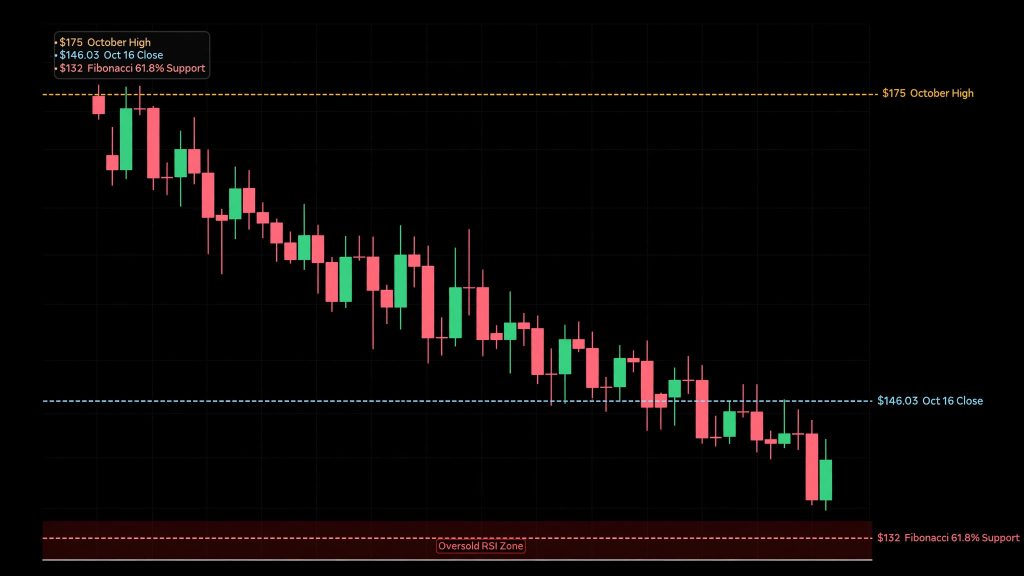
The $146.03 October 16 close sits in no-man’s land: below the broken 38.2% level but above the deeper 61.8% retracement near $132, now the next major support. The most likely near-term path is a drift toward $132, where Fibonacci support plus an RSI approaching 30 could set up a bounce. The October 20 earnings report is the obvious catalyst to accelerate or reverse that move.
Support: $146.03, Then the $132 Fibonacci Level
If selling persists into earnings, $132 is the level that matters. A test of the 61.8% retracement with deeply oversold momentum would create the conditions technicians look for in a selling climax. A hold there keeps the broader uptrend structure intact and sets up a recovery leg; a decisive daily close below $132 would open a deeper correction and invalidate the bullish Fibonacci framework.
Resistance: The $175 October High
On the upside, $175 is both the October high and the level SPCX must reclaim to repair the technical damage. A convincing earnings beat — especially one showing AI revenue scaling and capex discipline — could drive a move back through the broken 38.2% level and the 25-period EMA, with $175 as the natural objective. Until then, rallies should be treated as corrective.
| Level | Price | Significance |
|---|---|---|
| Resistance | $175 | October high; reclaim target for any rebound |
| Current | $146.03 | Oct 16 close; below 38.2% retracement and 25 EMA |
| Support | $132 | 61.8% Fibonacci retracement; expected bounce zone near RSI 30 |
SpaceX Stock Scenarios: Bull Case vs Bear Case After Earnings
With the report days away, scenarios are more useful than single price targets. The table below lays out three paths for SpaceX stock after October 20, each tied to observable triggers rather than vague sentiment.
| Scenario | What would need to happen | Likely SpaceX stock implication |
|---|---|---|
| Bull case | Q3 revenue beats; AI segment losses narrow; credible capex discipline and favorable Nvidia financing terms | Reclaim of the 25 EMA and a run toward the $175 October high |
| Base case | Revenue roughly in line; capex elevated but funded; spectrum and financing timelines confirmed without surprises | Stabilization between $132 and $155 while the market waits for proof of returns |
| Bear case | Revenue miss or soft guidance; capex accelerates; financing terms disappoint or credit spreads widen | Break of $132 support, opening a deeper correction |
The base case is the most probable and least discussed. SpaceX does not need a blowout quarter to stabilize; it needs the report to remove uncertainty. Confirmation that the $40 billion financing is proceeding on expected terms, that the Grain spectrum deal is on track for FCC approval, and that Starlink subscriber growth is intact would give the market enough to work with — even with the AI segment still loss-making.
Risks That Could Keep SpaceX Stock Under Pressure
A balanced SpaceX stock forecast must acknowledge the downside. The risks below are the ones most likely to extend the decline if October 20 fails to address them:
- Capital intensity vs. cash generation: first-half 2026 capital spending ran 8.2 times operating cash flow — a ratio that cannot persist without slowing the buildout or raising more capital.
- Credit market sensitivity: with a BBB rating and $40 billion of new debt planned, any widening in credit spreads directly raises the cost of the AI strategy; bond investors already demand higher yields on existing SpaceX debt.
- AI demand cycle risk: Gartner has warned that neocloud and data center companies may need billions in impairments if AI infrastructure returns disappoint — SpaceX would not be immune to an industry-wide AI capex reassessment.
- Regulatory execution: the Grain spectrum deal and the wireless rollout require FCC approvals, and the EchoStar transaction is already in what EchoStar calls an unusually restrictive review.
- Wireless buildout costs: TD Cowen and Evercore ISI caution that turning spectrum into a competitive wireless service needs ground infrastructure or MVNO agreements that take years and heavy spending to assemble.
- Share supply: the $60 billion Cursor acquisition added 389.3 million new shares, and a reported 328.4 million restricted shares became transfer-eligible on October 9.
- Valuation: at roughly $2 trillion in market capitalization, the stock prices in flawless execution across AI, wireless, and space simultaneously — any stumble in one pillar invites reassessment of all three.
Will SpaceX Stock Rebound After Q3 Earnings?
The October 20 report is a genuine two-way event, and the current price reflects that uncertainty fairly. SpaceX stock fell 17.2% in ten days not because the business is deteriorating — revenue is growing at a near-doubling pace and Starlink remains a genuine profit engine — but because the market is repricing the cost and risk of everything the company is building at once.
What would change the calculus is evidence, not promises: AI revenue converting capital spending into contracted demand, the $40 billion Nvidia financing closing on investment-grade terms, and a realistic FCC-approved path for the wireless strategy. The company has the assets, cash, and backlog to fund its ambitions; it now needs to show investors the returns. If the report delivers, the oversold setup into $132 support favors a sharp rebound toward $175; if it disappoints, $132 may only pause the decline. Either way, October 20 is the most important day for SpaceX stock since the June IPO. For background on the company’s founding and operations, see the SpaceX company profile on Wikipedia.
This article is for informational purposes only and does not constitute financial advice. Stock prices can experience substantial volatility and capital losses. Figures cited reflect publicly reported data and market coverage available before publication. Investors should conduct independent research and consult a qualified financial adviser before making investment decisions.
Frequently Asked Questions
When does SpaceX report Q3 2026 earnings?
SpaceX is scheduled to publish third-quarter 2026 results on October 20, 2026 — its second quarterly report since the $86 billion IPO in June 2026.
Why did SpaceX stock fall 17.2% in October?
SPCX declined from its $175 October high to $146.03 on October 16 as investors reassessed AI capital spending and borrowing plans: the reported $40 billion Nvidia chip financing, capex running far above operating cash flow, and broader fears about returns on AI infrastructure investment.
What is the $40 billion Nvidia deal?
Per Financial Times and Bloomberg reporting, SpaceX is in talks to raise about $40 billion — roughly $10 billion in bank loans and $30 billion in investment-grade bonds led by Apollo — to buy AI chips from Nvidia. The deal is expected to close in 2027 and remains under negotiation.
Is SpaceX becoming a wireless carrier?
It is moving that way. SpaceX agreed to buy Grain Management’s nationwide 800 MHz spectrum portfolio for about $8 billion in cash, pending FCC approval. Combined with existing spectrum and 15,000 authorized direct-to-phone satellites, it aims to compete with AT&T, Verizon, and T-Mobile — though analysts caution a competitive ground network will take years to build.
What are the key SpaceX stock price levels to watch?
Resistance is the $175 October high; the $146.03 October 16 close is the current battleground below the 38.2% Fibonacci retracement and 25-period EMA; key support is the 61.8% Fibonacci level near $132, where oversold momentum could set up a bounce.
Conclusion
SpaceX stock enters the October 20 earnings report caught between two narratives: a business growing at a near-doubling pace on Starlink’s strength, and a capital program — $40 billion in planned Nvidia chip debt, an $8 billion spectrum acquisition, $18 billion-plus quarterly capex — testing investor confidence. The 17.2% decline to $146.03 created an oversold setup into $132 support, but charts alone will not decide the next move.
The report must show AI revenue scaling toward the spending, confirm the financing and spectrum timelines, and prove Starlink’s subscriber engine still funds the ambition. Deliver that, and the path back to $175 opens; disappoint, and $132 may only pause the decline. The deeper question is unchanged: whether SpaceX can convert the largest capital buildout in its history into durable, profitable franchises in AI computing and wireless. October 20 is the next major checkpoint.