

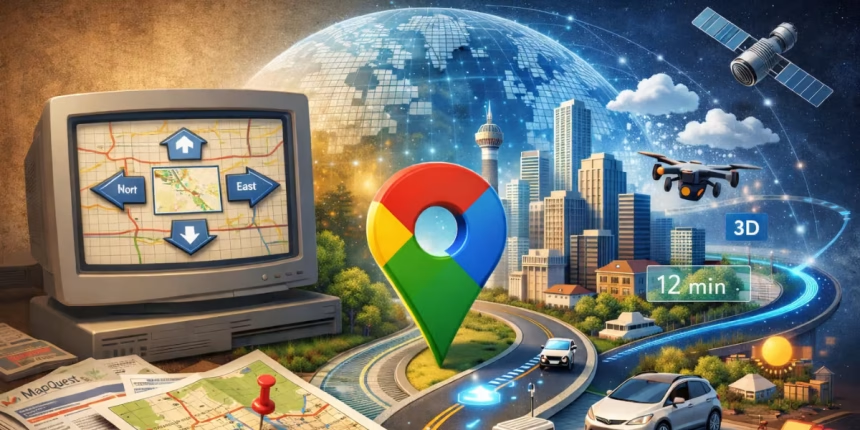
Today, February 8, 2026, marks 21 years since a modest blog post unveiled a new way to navigate the world. If Google Maps were a person, it could finally buy a drink in the United States. But in reality, it’s been “consuming” the planet’s data for two decades, evolving from a clever tech demo into the invisible framework underpinning our daily lives.
To appreciate the scale of this transformation, we need to revisit 2005 and compare it to the astonishing world of 2026.
2005: The Death of “Click North”
For anyone who remembers online maps before 2005, it was a painful experience. MapQuest ruled the roost. You entered an address and received a static image. Want to see what lay slightly to the left? You clicked a “West” arrow, waited five seconds for the page to reload, and were rewarded with… a new static image. Slow, clunky, and firmly stuck in the “Page-Reload Paradigm.”
Then came February 8, 2005. Google launched a product built on technology acquired from the small Australian startup Where 2 Technologies. Two innovations blew our minds:
- Dynamic Tiling: The map was divided into thousands of tiny 256×256 pixel squares.
- AJAX: Tiles loaded asynchronously in the background.
The result? The “Slippy Map.” You could drag the map with your mouse in real time. No page reloads. No waiting. Pure magic. Suddenly, the web became a dynamic, interactive canvas.
The Mashup Revolution
Google Maps wasn’t just impressive—it was irresistible. Within weeks, developer Paul Rademacher reverse-engineered the code and combined it with Craigslist housing data to create HousingMaps.com, the world’s first major “mashup.”
Instead of shutting him down, Google hired Rademacher. By June 2005, the official Google Maps API was launched, sending a clear message:
Here’s our infrastructure. Build your business on top of it.
This sparked the era of Neogeography, where anyone could map data and create location-based services on a scale never seen before.
Google Maps & the “Big Bang” of Disruption
Fast forward to October 2009. Google shifted Maps from a utility to a strategic weapon. By offering free turn-by-turn navigation on Android, Google destroyed the premium navigation hardware market overnight. Garmin and TomTom, once dominant, saw their products and stock values plummet. Google had successfully “commoditized the complement,” giving away maps to sell phones—and ads.
2026: The Operating System of Reality
Today, Google Maps is far more than a way to find coffee. It has become a digital twin of our planet, the invisible layer that orchestrates the flow of people, goods, and services worldwide. Consider this:
Every delivery startup is a Google Maps derivative play.
Uber, Lyft, DoorDash, Instacart—they don’t sell products; they sell logistics. Their algorithms, the math connecting drivers to riders or food to porches, run entirely on Google Maps infrastructure:
- Places API: Resolves addresses with precision.
- Routes API: Calculates traffic-adjusted ETAs, affecting pricing and efficiency.
The cost of this reliance has grown. In 2018, Google raised API prices by up to 1,400%, forcing startups to factor a “Google Tax” into their operations. Today, mastering Maps data is a major line item for gig-economy businesses.
Maps in 2026: AI, Immersive View, and “Vibe”
On its 21st birthday, Google Maps has gone beyond static lines and pins. Immersive View, powered by Neural Radiance Fields (NeRF), allows users to “fly” over routes in 3D, visualizing traffic, weather, and cityscapes in real time.
AI integration, via Gemini, has revolutionized search. You no longer search for “coffee.” You search for vibes. Ask, “Find a quiet café with vintage décor and good oat milk,” and the AI parses millions of photos and reviews to deliver a semantic answer tailored to your intent.
From Directions to Infrastructure
In 2005, Google Maps helped avoid printing paper directions. In 2026, it generates over $11 billion annually and coordinates the movement of millions of people and goods every hour.
The “Slippy Map” didn’t just change the web. It reorganized the physical world, creating a foundation for countless businesses, technologies, and innovations. What started as a simple drag-and-drop map has become the invisible operating system of reality.
Read More: Apply For TechGirls Summer 2026 Program
FAQs
When was Google Maps launched?
Google Maps officially launched on February 8, 2005, built on technology acquired from the Australian startup Where 2 Technologies.
What made Google Maps revolutionary at the start?
The introduction of dynamic tiling and AJAX-based background loading created the “Slippy Map,” allowing users to drag maps smoothly without page reloads—a major departure from static map images.
What is a “mashup” in the context of Google Maps?
A mashup combines Google Maps with external data sources. The first major mashup, HousingMaps.com, combined Craigslist housing listings with Google Maps, sparking the era of “Neogeography.”
How did Google Maps disrupt the navigation market?
In 2009, Google offered free turn-by-turn navigation on Android, making standalone GPS devices from Garmin and TomTom largely obsolete. This strategy commoditized the hardware while promoting the Android ecosystem.
How does Google Maps impact modern businesses?
Today, platforms like Uber, Lyft, DoorDash, and Instacart rely heavily on Google Maps APIs for routing, traffic-adjusted ETAs, and location services, making Maps a critical infrastructure for logistics-based businesses.
What are Google Maps’ latest innovations?
With Immersive View (3D simulation using NeRF) and Gemini AI, users can explore routes in 3D and search for locations by semantic criteria or “vibes,” going beyond keyword-based search.
How financially significant is Google Maps?
Google Maps generates over $11 billion annually and has become a key tool in coordinating global transportation, delivery, and mobility services.
Conclusion
Over 21 years, Google Maps has evolved from a clever web demo into the digital twin of our physical world. From eliminating clunky “click north” buttons to enabling global logistics, immersive 3D views, and AI-powered “vibe” searches, it has reshaped both the internet and real-world infrastructure.