


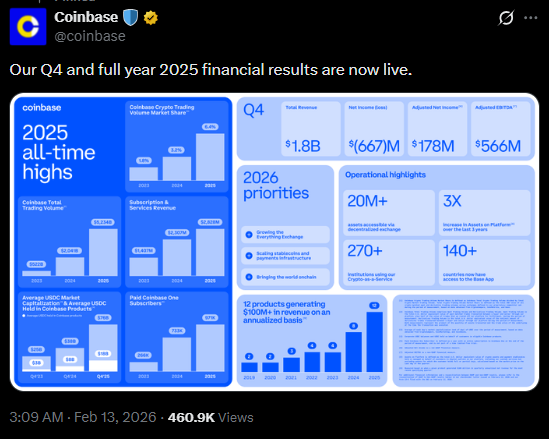
Coinbase, one of the world’s largest cryptocurrency exchanges, reported a significant net loss of $667 million in the fourth quarter of 2025. The financial results highlighted the ongoing challenges facing crypto exchanges amid declining trading volumes, weaker market sentiment, and broader macroeconomic uncertainty. Once seen as the flagship of the crypto economy, Coinbase’s latest earnings reveal how deeply market cycles can affect even the most established players in the industry.
- Financial Overview: Breaking Down the $667 Million Loss
- The Crypto Market Slump and Its Impact
- Coinbase’s Business Model and Revenue Dependence
- Retail Investors: A Critical Revenue Driver
- Institutional Investors: Growth Opportunity with Lower Margins
- Leadership Response and Strategic Direction
- Regulatory Environment and Compliance Costs
- Coinbase’s Stock Performance and Investor Reaction
- Expense Management and Operational Efficiency
- Subscription and Services Revenue Growth
- Global Expansion and Market Diversification
- Industry Competition and Market Position
- Long-Term Crypto Market Outlook
- Lessons from Market Cycles
- Strategic Investments for Future Growth
- Risk Factors and Challenges Ahead
- Signs of Recovery and Future Potential
- FAQ’s
- Why did Coinbase report a $667 million loss in Q4 2025?
- How does crypto market performance affect Coinbase’s revenue?
- Is Coinbase still profitable despite the Q4 2025 loss?
- What is Coinbase doing to recover from the loss?
- Does this loss mean Coinbase is in financial trouble?
- How important are retail investors to Coinbase’s business?
- What is Coinbase’s future outlook after this loss?
- Conclusion
The reported loss reflects multiple factors, including reduced transaction revenues, falling retail participation, increased operational expenses, and strategic investments in long-term growth. While the crypto market remains volatile and unpredictable, Coinbase’s performance provides important insights into the current state of the digital asset ecosystem and what lies ahead.
This quarter marks a reminder that cryptocurrency exchanges operate within a highly cyclical environment, where bull markets bring explosive growth, while downturns expose structural weaknesses and revenue vulnerabilities.
Financial Overview: Breaking Down the $667 Million Loss
Coinbase’s $667 million loss represents a substantial decline compared to previous profitable periods. The loss includes both operational challenges and strategic financial adjustments.
Key components of the loss include:
Declining transaction revenue
Transaction revenue, historically Coinbase’s largest income source, declined sharply during the quarter. Retail trading activity dropped significantly as investors became cautious amid uncertain market conditions.
Lower trading volumes
Trading volumes across major cryptocurrencies fell during the quarter. Reduced activity directly impacted Coinbase’s fee-based revenue model.
Operational and infrastructure expenses
Coinbase continued investing heavily in technology infrastructure, security, compliance, and international expansion, increasing overall expenses.
Asset impairment and valuation adjustments
Market fluctuations affected Coinbase’s crypto holdings and investment portfolio, contributing to the reported loss.
Regulatory and compliance costs
Compliance requirements continue to grow globally, forcing exchanges to spend more on legal, regulatory, and operational compliance systems.
These combined factors resulted in the largest quarterly loss Coinbase experienced in recent periods.
The Crypto Market Slump and Its Impact
The fourth quarter of 2025 was marked by weaker overall crypto market performance. After periods of strong growth earlier in the cycle, the market entered a consolidation and correction phase.
Several factors contributed to reduced activity:
Investor uncertainty
Global economic uncertainty, inflation concerns, and interest rate fluctuations made investors more cautious.
Reduced retail participation
Retail investors, who are more active during bull markets, significantly reduced trading frequency during the quarter.
Institutional slowdown
Institutional investors also slowed their crypto exposure, waiting for clearer regulatory frameworks and market direction.
Price volatility and consolidation
Instead of sustained upward momentum, crypto assets experienced sideways movement, reducing trading incentives.
Since Coinbase generates revenue primarily from transaction fees, any slowdown in trading activity directly impacts earnings.
Coinbase’s Business Model and Revenue Dependence
Coinbase’s business model relies heavily on trading fees collected from users. When users buy, sell, or trade cryptocurrencies, Coinbase earns a percentage of each transaction.
Major revenue streams include:
- Retail transaction fees
- Institutional trading services
- Subscription and services revenue
- Custody services
- Blockchain infrastructure tools
However, transaction fees remain the dominant revenue source.
During market downturns, trading volume drops significantly, causing revenue to decline rapidly. This dependency makes exchanges like Coinbase highly sensitive to market cycles.
To reduce this vulnerability, Coinbase has been working to diversify its revenue streams through subscriptions, blockchain infrastructure, and institutional services.
Retail Investors: A Critical Revenue Driver
Retail investors play a major role in Coinbase’s profitability. Historically, retail users generate higher fees compared to institutional traders.
During bull markets, retail trading surges due to:
- Fear of missing out (FOMO)
- Media attention
- Social media hype
- Rapid price increases
However, during downturns, retail activity declines sharply.
In Q4 2025, retail trading volume dropped significantly. Many investors adopted a wait-and-see approach, reducing Coinbase’s most profitable revenue segment.
Retail investor behavior remains one of the strongest indicators of Coinbase’s financial performance.
Institutional Investors: Growth Opportunity with Lower Margins
Institutional investors represent a growing segment for Coinbase. These include:
- Hedge funds
- Asset managers
- Investment firms
- Financial institutions
Institutional clients typically trade larger volumes but pay lower fees compared to retail users.
Coinbase has invested heavily in institutional services, including custody solutions and trading infrastructure.
While institutional adoption continues to grow, it has not yet fully compensated for declining retail activity.
This shift highlights the importance of building sustainable, diversified revenue streams beyond retail trading.
Leadership Response and Strategic Direction
Coinbase leadership acknowledged the challenging quarter but emphasized long-term growth strategy. CEO Brian Armstrong has consistently stated that crypto operates in cycles and that downturns are part of industry evolution.
Coinbase’s long-term strategy focuses on:
Building infrastructure for the crypto economy
Coinbase aims to become the backbone of the digital financial system.
Expanding subscription-based services
Subscription revenue provides more predictable and stable income.
Increasing global presence
Coinbase continues expanding into international markets.
Supporting institutional adoption
Institutional services remain a major growth opportunity.
Investing in blockchain innovation
Coinbase supports blockchain development tools and infrastructure.
Leadership believes these investments will strengthen Coinbase’s position in the long term.
Regulatory Environment and Compliance Costs
The regulatory landscape remains one of the biggest challenges facing Coinbase and the broader crypto industry.
Regulatory agencies such as the U.S. Securities and Exchange Commission have increased scrutiny of crypto platforms.
Compliance requirements include:
- User verification procedures
- Anti-money laundering systems
- Transaction monitoring
- Legal reporting requirements
Meeting these standards increases operational costs significantly.
However, regulatory clarity may ultimately benefit Coinbase by increasing institutional confidence and market legitimacy.
Coinbase’s Stock Performance and Investor Reaction
Coinbase’s stock, listed on Nasdaq, reacted cautiously following the earnings announcement.
Investor reactions were mixed:
Negative sentiment due to losses
Some investors expressed concern over declining revenues and profitability.
Confidence in long-term growth
Others remained optimistic about Coinbase’s long-term potential.
Recognition of industry-wide slowdown
Investors understood that the loss reflected broader market conditions rather than company-specific failures.
Coinbase stock performance often correlates closely with cryptocurrency market trends.
Expense Management and Operational Efficiency
Coinbase has taken steps to manage expenses and improve efficiency.
Cost management strategies include:
- Workforce restructuring
- Operational efficiency improvements
- Technology optimization
- Strategic investment prioritization
These efforts aim to improve financial sustainability during market downturns.
Coinbase continues balancing cost control with long-term investment.
Subscription and Services Revenue Growth
One of Coinbase’s most important strategic goals is reducing dependence on trading fees.
Subscription and services revenue includes:
- Custody services
- Blockchain infrastructure
- Staking services
- Developer tools
These services provide recurring revenue, improving financial stability.
This segment continues growing even during trading slowdowns.
Subscription revenue represents the future of Coinbase’s financial model.
Global Expansion and Market Diversification
Coinbase is expanding internationally to reduce reliance on U.S. markets.
Expansion goals include:
- Entering new geographic markets
- Supporting local currencies
- Partnering with financial institutions
- Offering localized services
International markets offer strong growth potential, especially in regions with growing crypto adoption.
Global expansion strengthens Coinbase’s long-term outlook.
Industry Competition and Market Position
Coinbase faces strong competition from other crypto exchanges.
Competitors include:
- Global exchanges with lower fees
- Regional crypto platforms
- Decentralized exchanges
Competition pressures Coinbase to innovate and improve services.
However, Coinbase maintains strong advantages:
- Brand reputation
- Regulatory compliance
- Institutional trust
- Security standards
These factors help Coinbase maintain its leadership position.
Long-Term Crypto Market Outlook
Despite short-term challenges, the long-term outlook for crypto remains positive.
Key growth drivers include:
Institutional adoption
Financial institutions continue entering the crypto market.
Technological innovation
Blockchain technology continues evolving.
Global financial integration
Crypto plays an increasing role in global finance.
Regulatory clarity
Clear regulations improve investor confidence.
These trends support Coinbase’s long-term growth potential.
Lessons from Market Cycles
Coinbase’s loss highlights the cyclical nature of crypto markets.
Crypto cycles typically follow patterns:
- Bull market expansion
- Peak euphoria
- Market correction
- Consolidation
- Recovery
Companies that survive downturns often emerge stronger.
Coinbase’s continued investment suggests confidence in future growth.
Strategic Investments for Future Growth
Coinbase continues investing in future opportunities.
Strategic focus areas include:
- Blockchain infrastructure
- Layer 2 scaling solutions
- Institutional services
- Global expansion
- Subscription services
These investments aim to position Coinbase as a foundational crypto infrastructure provider.
Long-term strategy focuses on sustainability rather than short-term profits.
Risk Factors and Challenges Ahead
Coinbase faces several risks:
Market volatility
Crypto markets remain unpredictable.
Regulatory uncertainty
Changing regulations create operational challenges.
Competition pressure
Global competition continues increasing.
Revenue dependence on trading activity
Trading volume fluctuations impact revenue.
Managing these risks remains essential for long-term success.
Signs of Recovery and Future Potential
Despite losses, several positive indicators exist:
- Growing institutional adoption
- Expanding subscription revenue
- Continued global expansion
- Increasing blockchain innovation
These factors support long-term recovery potential.
Coinbase remains well-positioned to benefit from future crypto market growth.
Read More: MSTR Stock Reddit What Investors Are Saying Online
FAQ’s
Why did Coinbase report a $667 million loss in Q4 2025?
Coinbase reported a $667 million loss mainly due to declining crypto trading volumes, reduced retail investor activity, higher operational costs, and ongoing investments in infrastructure and global expansion.
How does crypto market performance affect Coinbase’s revenue?
Coinbase earns most of its revenue from trading fees. When crypto prices fall or trading activity slows, transaction volume decreases, reducing Coinbase’s earnings significantly.
Is Coinbase still profitable despite the Q4 2025 loss?
Coinbase has been profitable in previous bull market periods. However, crypto exchanges often experience losses during market downturns due to reduced trading activity and revenue.
What is Coinbase doing to recover from the loss?
Coinbase is focusing on expanding subscription services, growing institutional offerings, improving operational efficiency, and expanding globally to reduce dependence on trading fees.
Does this loss mean Coinbase is in financial trouble?
Not necessarily. Coinbase still has strong financial reserves, a large user base, and long-term growth potential. Losses during crypto downturns are common for exchanges.
How important are retail investors to Coinbase’s business?
Retail investors are extremely important because they generate higher transaction fees compared to institutional investors, making them a major revenue source for Coinbase.
What is Coinbase’s future outlook after this loss?
Coinbase’s long-term outlook remains positive due to growing crypto adoption, institutional interest, and its strategic investments in blockchain infrastructure and subscription services.
Conclusion
Coinbase’s $667 million loss in Q4 2025 reflects the difficult environment facing crypto exchanges during market slowdowns. Declining trading volumes, reduced retail participation, increased expenses, and regulatory challenges all contributed to the loss.
However, Coinbase’s long-term strategy focuses on building sustainable revenue streams, expanding globally, and investing in blockchain infrastructure.
The crypto industry remains cyclical, and downturns are part of its natural evolution. Coinbase’s strong brand, regulatory compliance, institutional trust, and continued innovation position it well for future growth.