


Key Insights
- Changpeng Zhao (CZ), founder of Binance, believes the cryptocurrency market is approaching a full-scale supercycle.
- Trump \attributes this potential breakout to a sharp increase in U.S. liquidity ahead of the upcoming midterm elections.
- Expanding fiscal stimulus, tax refunds, and proposed monetary easing could significantly boost risk assets.
- The Federal Reserve may be pressured into rate cuts or renewed quantitative easing as the M2 money supply reaches record highs.
- Technical indicators, investor sentiment, and regulatory shifts all point toward a renewed bull market in crypto.
CZ’s Macro Thesis: Why a Crypto Supercycle May Be Near
Changpeng Zhao, the founder and former CEO of Binance, has once again sparked debate across the cryptocurrency ecosystem by suggesting that the market may be on the brink of a new supercycle. In a recent interview, CZ argued that a confluence of macroeconomic, political, and liquidity-driven forces is aligning in a way that strongly favors digital assets, particularly Bitcoin and leading altcoins.
- Key Insights
- CZ’s Macro Thesis: Why a Crypto Supercycle May Be Near
- Liquidity as the Lifeblood of Financial Markets
- Trump’s Economic Strategy and the Midterm Election Factor
- The “Big Beautiful Bill” and Its Ripple Effects
- Tax Refunds as a Liquidity Injection
- The Proposed “Tariff Dividend” and Risk-On Sentiment
- Pressure on the Federal Reserve and Leadership Uncertainty
- Rate Cuts, Quantitative Easing, and Crypto Markets
- The M2 Money Supply Reaches Record Highs
- Bitcoin’s Technical Structure Signals Potential Upside
- Why Bitcoin Leads and Altcoins Follow
- Sentiment Indicators Point to a Market Turnaround
- Retirement Funds and Structural Demand for Crypto
- Institutional and Regulatory Tailwinds
- Risks and Counterarguments
- FAQ’s
- What does Changpeng Zhao mean by a “crypto supercycle”?
- How does U.S. liquidity impact cryptocurrency prices?
- Why are Trump’s economic policies considered bullish for crypto?
- What role does the Federal Reserve play in a potential crypto supercycle?
- What are the main risks to CZ’s crypto supercycle forecast?
- Conclusion
According to CZ, the cryptocurrency market has remained in a prolonged consolidation and partial bear phase despite occasional rallies. Bitcoin has struggled to sustain momentum following its 2025 highs, while most altcoins have declined more than 20% from their peak levels. However, Zhao believes this underperformance is not a sign of structural weakness but rather a calm before a potentially historic surge.
At the center of his argument is one key variable: liquidity.
Liquidity as the Lifeblood of Financial Markets
Liquidity—the availability of capital within the financial system—has long been one of the most critical drivers of asset prices. When liquidity expands, investors tend to take on more risk, funneling capital into equities, commodities, real estate, and increasingly, cryptocurrencies. When liquidity contracts, risk assets typically suffer.
CZ emphasized that crypto markets are especially sensitive to changes in global liquidity. Unlike traditional markets, cryptocurrencies trade continuously, are globally accessible, and attract a high concentration of speculative capital. As a result, even modest increases in liquidity can trigger outsized price movements.
In Zhao’s view, the United States is entering a phase of aggressive liquidity expansion driven by political incentives, fiscal policy decisions, and potential changes at the Federal Reserve.
Trump’s Economic Strategy and the Midterm Election Factor
A major pillar of CZ’s thesis is the political calculus surrounding the upcoming U.S. midterm elections. Donald Trump, who has returned to the center of U.S. economic policymaking, has made no secret of his desire to see strong financial markets and visible economic growth heading into the elections.
Historically, incumbent administrations often pursue expansionary policies ahead of elections to boost voter confidence. Trump, known for his market-focused messaging, appears particularly inclined toward policies that support asset prices, employment, and consumer spending.
CZ argues that this political reality dramatically increases the likelihood of further fiscal stimulus, tax relief, and monetary accommodation—all of which tend to benefit cryptocurrencies.
The “Big Beautiful Bill” and Its Ripple Effects
One of the most significant policy actions cited by CZ is the passage of the so-called “Big Beautiful Bill” in 2025. This sweeping legislation introduced a wide range of tax cuts for individuals and businesses, with the stated goal of stimulating economic growth and increasing disposable income.
While the bill was passed last year, many of its most impactful provisions are expected to be felt more strongly in the current fiscal cycle. These include reductions in individual income taxes, expanded deductions, and incentives for investment.
Analysts estimate that the legislation reduced individual income tax obligations by approximately $129 billion. That capital does not simply disappear; instead, it re-enters the economy through consumer spending, savings, and investment.
For crypto markets, this matters because retail participation has historically surged when disposable income rises. During previous stimulus cycles, a portion of excess cash found its way into Bitcoin, Ethereum, and speculative altcoins.
Tax Refunds as a Liquidity Injection
Another element highlighted by CZ is the anticipated surge in U.S. tax refunds. According to projections, refunds this year could increase by 15% to 20% compared to previous years, driven largely by changes introduced under the Big Beautiful Bill.
Trump has publicly stated that Americans may see some of the largest tax refunds in recent history. While refunds are often viewed as routine, they function as a temporary liquidity injection for millions of households.
Data from prior years shows that when refunds rise meaningfully, a portion of that capital flows into investment platforms, including stock trading apps and crypto exchanges. Younger investors, in particular, have shown a strong tendency to allocate discretionary funds toward digital assets.
CZ believes that even a small percentage of refund capital entering crypto markets could have a disproportionate impact, given crypto’s relatively smaller market size compared to equities.
The Proposed “Tariff Dividend” and Risk-On Sentiment
In addition to tax cuts and refunds, Trump has floated the idea of issuing a “tariff dividend” worth approximately $2,000 per taxpayer. This proposal would redistribute revenue collected from tariffs directly back to citizens.
While still under discussion, the concept echoes pandemic-era stimulus checks, which had a profound impact on financial markets. During that period, retail trading surged, meme stocks exploded in value, and cryptocurrencies experienced one of the most powerful bull markets in history.
CZ argues that a similar outcome is likely if tariff dividends are implemented. Direct cash transfers tend to boost risk appetite, particularly among retail investors. Crypto, as one of the most accessible and volatile asset classes, often becomes a prime destination for such capital.
Pressure on the Federal Reserve and Leadership Uncertainty
Another critical variable in CZ’s outlook is the future direction of the Federal Reserve. Trump has repeatedly criticized the Fed’s leadership and monetary policy stance, particularly under Chair Jerome Powell.
Reports suggest that Trump is considering replacing Powell with a more dovish figure who supports aggressive rate cuts and, if necessary, renewed quantitative easing. Names frequently mentioned include Rick Rieder, Kevin Hassett, Kevin Warsh, and Christopher Waller.
A shift in Fed leadership could dramatically alter monetary policy expectations. Even the perception of a more accommodative Fed can move markets, lowering bond yields and increasing the appeal of non-yielding assets like Bitcoin.
CZ notes that cryptocurrencies have historically performed well during periods when investors expect easier monetary conditions, regardless of whether policy changes have already occurred.
Rate Cuts, Quantitative Easing, and Crypto Markets
If a new Federal Reserve leadership team were to pursue rate cuts or asset purchases, the implications for crypto could be substantial. Lower interest rates reduce the opportunity cost of holding assets like Bitcoin, which does not generate yield but is often viewed as a hedge against monetary debasement.
Quantitative easing, meanwhile, directly increases the money supply and has historically coincided with major bull markets in digital assets. The mere anticipation of QE has, in past cycles, triggered significant rallies.
CZ believes that even incremental policy shifts could act as a catalyst, particularly given how compressed crypto valuations remain relative to prior peaks.
The M2 Money Supply Reaches Record Highs
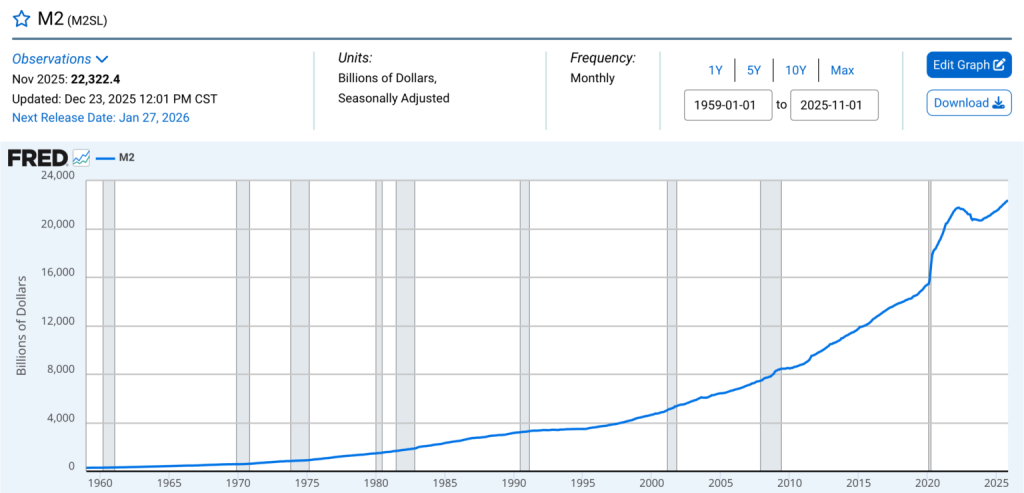
Supporting CZ’s thesis is the continued expansion of the M2 money supply, a broad measure of money circulating in the economy. Recent data shows that U.S. M2 has climbed to an all-time high of approximately $22.32 trillion.
Historically, rising M2 levels have been strongly correlated with higher prices for risk assets, including equities, real estate, and cryptocurrencies. When more money is available, it inevitably seeks returns, pushing investors toward higher-risk, higher-reward opportunities.
CZ emphasized that crypto markets tend to respond with a lag to changes in M2. This suggests that the full impact of recent liquidity expansion may not yet be reflected in current prices.
Bitcoin’s Technical Structure Signals Potential Upside
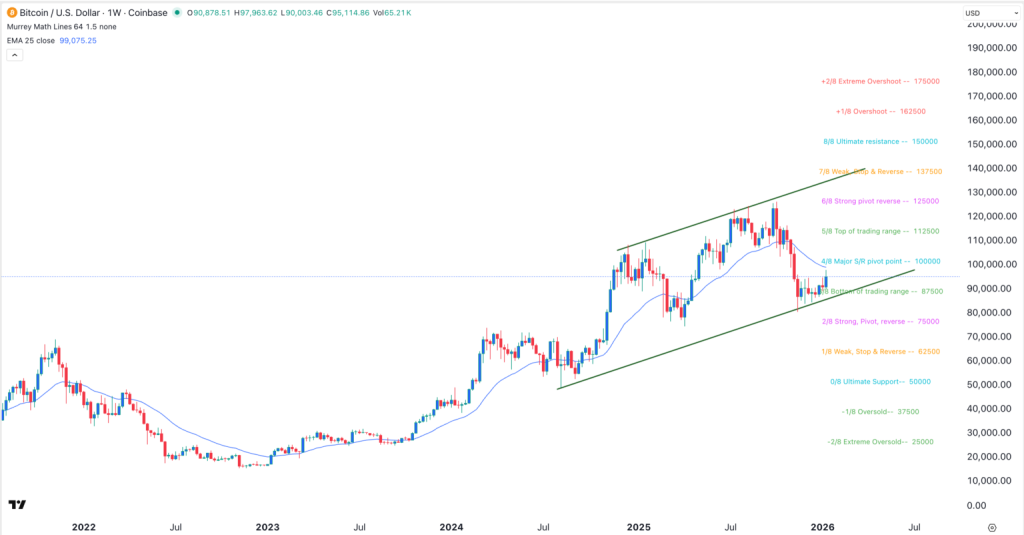
Beyond macroeconomic factors, CZ also pointed to technical indicators that support a bullish outlook. On both daily and weekly charts, Bitcoin has maintained a long-term ascending channel that began forming in 2024.
The recent pullback brought Bitcoin toward the lower boundary of this channel, a zone that has historically acted as strong support. This level also aligns with key Murrey Math Lines, a technical tool often used to identify major reversal points.
Technical analysts argue that such confluence increases the probability of a rebound. If Bitcoin resumes its upward trajectory, CZ believes a move toward the $125,000 level is achievable within the year.
Why Bitcoin Leads and Altcoins Follow
In previous market cycles, Bitcoin has typically led major bull runs, with altcoins following once confidence returns. CZ expects a similar pattern to play out if Bitcoin breaks decisively higher.
As Bitcoin rallies, capital often rotates into Ethereum, large-cap altcoins, and eventually smaller speculative tokens. This rotation effect is a defining characteristic of crypto supercycles and can result in exponential gains across the market.
CZ noted that many altcoins remain significantly below their historical highs, suggesting substantial upside if market sentiment shifts.
Sentiment Indicators Point to a Market Turnaround
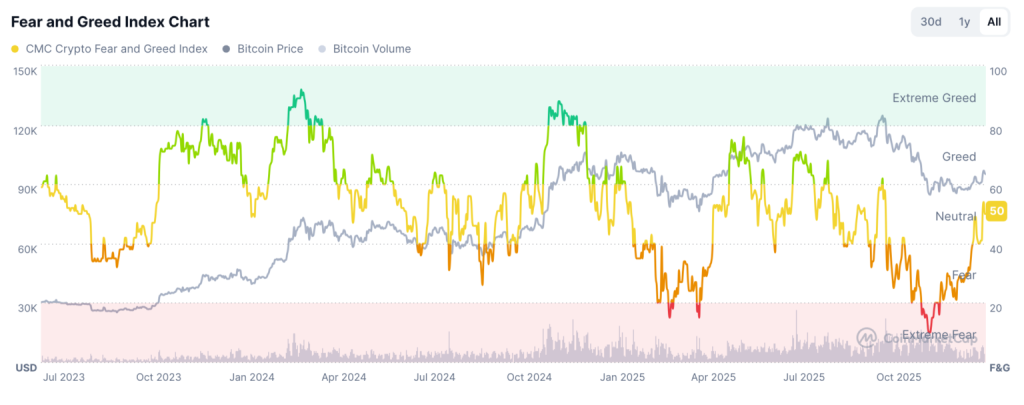
Investor psychology is another factor supporting CZ’s optimism. The Crypto Fear and Greed Index, which measures market sentiment, has rebounded from extreme fear levels near 10 last year to a neutral reading around 50.
Historically, transitions from fear to neutrality often precede major rallies. As sentiment improves further and enters the “greed” zone, momentum-driven buying tends to accelerate.
CZ believes that sentiment remains far from euphoric, meaning the market still has room to run before overheating.
Retirement Funds and Structural Demand for Crypto
One of the most transformative proposals under discussion involves changes to how Americans can invest their retirement savings. Trump has suggested allowing 401(k) and similar retirement accounts to allocate funds toward cryptocurrencies and private credit.
If implemented, such reforms could unlock trillions of dollars in long-term capital. Even a small allocation—such as 1% to 5%—would represent an enormous inflow relative to crypto’s current market capitalization.
CZ described this as a potential “structural demand shock,” capable of reshaping crypto markets over the next decade.
Institutional and Regulatory Tailwinds
In addition to retail and retirement capital, institutional adoption continues to grow. Spot Bitcoin ETFs, custody solutions, and clearer regulatory frameworks have made it easier for traditional investors to gain exposure to digital assets.
CZ emphasized that unlike previous cycles, the next bull market may be driven not only by speculation but also by long-term institutional positioning
Risks and Counterarguments
Despite his bullish outlook, CZ acknowledged that risks remain. Geopolitical tensions, unexpected regulatory crackdowns, or a sharp economic downturn could disrupt the thesis.
However, he argued that the balance of probabilities favors higher prices, given the scale of liquidity expansion and political incentives at play.
Read More: Crypto News: UK Regulator Sets September 2026 Launch for Crypto Licensing Regime
FAQ’s
What does Changpeng Zhao mean by a “crypto supercycle”?
A crypto supercycle refers to a prolonged period of sustained growth in cryptocurrency markets, characterized by rising prices, increased adoption, and strong investor demand across Bitcoin and altcoins. According to Changpeng Zhao, such a cycle is driven not by hype alone, but by structural factors like liquidity expansion, favorable macroeconomic conditions, and growing institutional participation.
How does U.S. liquidity impact cryptocurrency prices?
Increased U.S. liquidity means more money circulating in the economy, which often pushes investors toward risk assets in search of higher returns. Cryptocurrencies are particularly sensitive to liquidity conditions, and historically, periods of rising money supply and easier financial conditions have coincided with strong crypto bull markets.
Why are Trump’s economic policies considered bullish for crypto?
Trump’s proposed tax cuts, larger tax refunds, potential tariff dividends, and pressure for easier monetary policy all increase disposable income and market liquidity. These measures tend to create a risk-on environment, where investors are more willing to allocate capital to volatile assets such as cryptocurrencies.
What role does the Federal Reserve play in a potential crypto supercycle?
The Federal Reserve influences crypto markets through interest rate policy and monetary easing. Rate cuts or quantitative easing lower borrowing costs and increase money supply, making non-yielding assets like Bitcoin more attractive. Expectations of a more accommodative Fed often lead to higher demand for cryptocurrencies.
What are the main risks to CZ’s crypto supercycle forecast?
Key risks include unexpected regulatory restrictions, geopolitical instability, a sharp economic slowdown, or tighter-than-expected monetary policy. While these factors could delay or weaken a bull market, CZ believes that the current liquidity trends and policy incentives outweigh the downside risks.
Conclusion
Changpeng Zhao’s outlook on a coming crypto supercycle is grounded in a rare convergence of macroeconomic, political, and market-driven factors. Rising U.S. liquidity, expansive fiscal policies, and the possibility of a more accommodative Federal Reserve are creating a favorable environment for risk assets, particularly cryptocurrencies. At the same time, improving technical indicators, strengthening investor sentiment, and potential structural inflows from retirement funds add further support to this bullish thesis. While risks remain, the broader conditions increasingly resemble those that have historically preceded major crypto market upswings.