


Key Insights
- Solana price has pulled back sharply in recent days, dropping to its lowest level since early January.
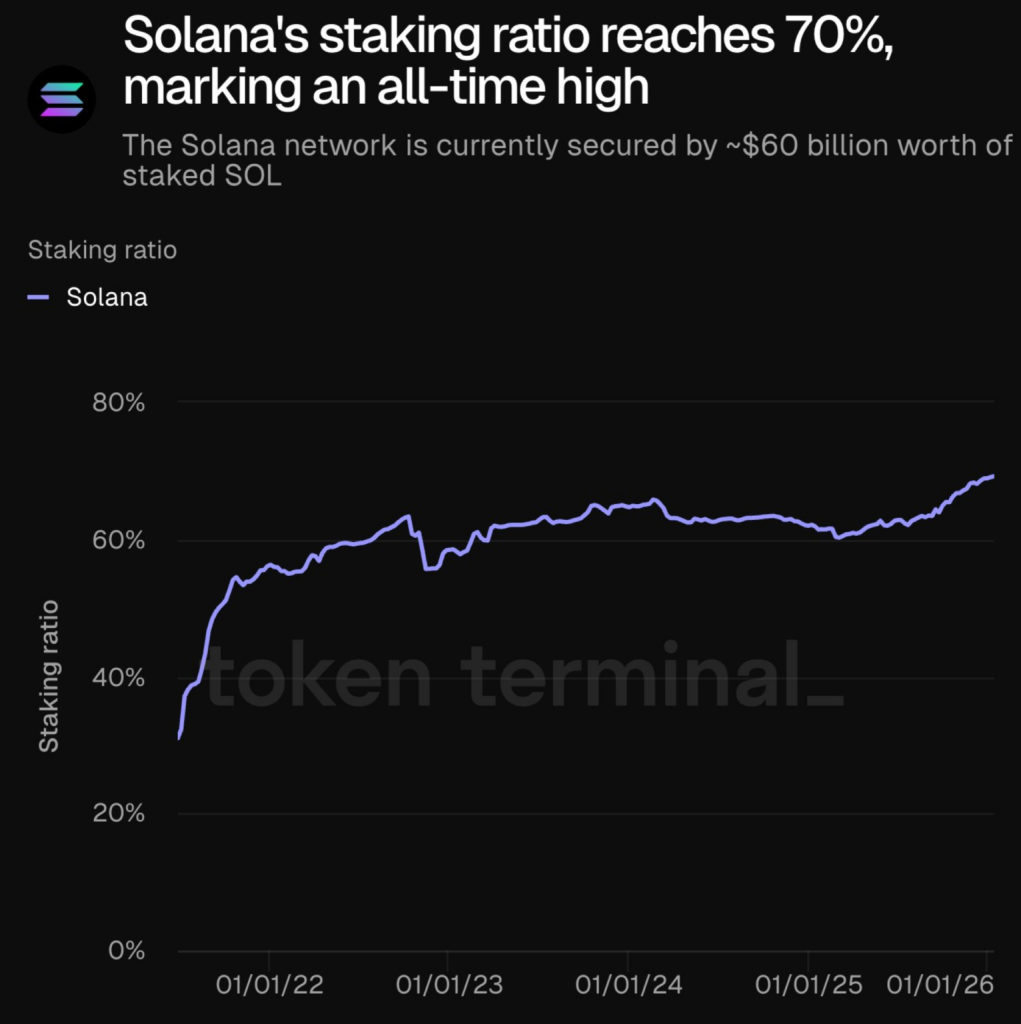
- The SOL staking ratio has surged to 70%, indicating rising long-term holding and reduced selling pressure.
- Technical analysis suggests a potential rebound as SOL appears to be forming a cup-and-handle bullish continuation pattern.
- Network fundamentals are strengthening, with transaction volume, active users, and fees rising ahead of the upcoming Alpenglow upgrade.
- ETF inflows and institutional interest continue to support long-term demand despite short-term price weakness.
Introduction: SOL’s Recent Pullback and What It Means
Solana (SOL) has been one of the most watched cryptocurrencies in recent months, but its price action has become more volatile as the market rotates between speculative memecoins and major layer-1 networks.
- Key Insights
- Introduction: SOL’s Recent Pullback and What It Means
- Solana Staking Ratio Hits 70%: Why It Matters
- Solana’s Staking Yield: A Competitive Advantage
- ETF Inflows and Institutional Demand: A Major Support Factor
- Continued Demand for Solana ETFs
- What ETF Inflows Mean for SOL
- Morgan Stanley and Future Institutional Demand
- On-Chain Activity Surges Ahead of the Alpenglow Upgrade
- Solana Network Activity Is Strong
- Solana Network Fees and Profitability
- Alpenglow Upgrade: A Catalyst for Growth
- Solana Price Technical Analysis: Cup-and-Handle Pattern Forms
- Potential Price Targets if Breakout Occurs
- What Could Prevent the Rebound?
- Failure to Hold $1.96 Support Zone
- Low Volume Breakout
- Broader Market Weakness
- Regulatory or Negative News
- Why the Current Setup Is Still Bullish
- High Staking Ratio Reduces Supply
- Strong On-Chain Activity
- ETF Demand Provides Institutional Support
- Upcoming Alpenglow Upgrade
- FAQ’s
- What does a 70% staking ratio mean for Solana?
- Why is the staking ratio important for SOL price?
- Is Solana’s staking yield attractive compared to other networks?
- What are the main catalysts for SOL price in 2026?
- How do Solana ETFs impact SOL price?
- What technical pattern suggests a rebound in SOL price?
- What are the main risks to SOL’s rebound?
- Conclusion
On January 20, SOL dropped to a low of $129, marking its lowest level since January 2. This represents a decline of over 13% from its January highs, and it has raised questions about whether the current pullback is a temporary correction or the start of a deeper downtrend.
However, while price has been falling, several key fundamental indicators have strengthened, suggesting that the broader narrative may still be bullish. The most important of these is the surging staking ratio, which has reached 70%—a level that signals rising long-term confidence and reduced selling pressure.
In this article, we will analyze the key drivers behind Solana’s current price action, examine on-chain data, evaluate technical patterns, and provide a reasoned outlook for the short and medium term.
Solana Staking Ratio Hits 70%: Why It Matters
What Is the Staking Ratio?
The staking ratio is the proportion of a blockchain’s total supply that is locked in staking contracts. For proof-of-stake networks like Solana, staking is the mechanism through which the network achieves consensus and rewards users for securing the network.
A high staking ratio usually indicates:
- Strong long-term conviction from holders
- Lower circulating supply available for trading
- Reduced sell pressure from holders who are locked into staking rewards
- Stronger network security due to more validators and staked tokens
Solana’s Staking Ratio Reaches 70%
Data shows that Solana’s staking ratio has surged to 70%, representing over $55 billion worth of SOL staked. This is a significant milestone for the network and reflects a growing trend among holders to lock their SOL and earn staking rewards rather than trade or sell.
This level is high relative to many other major blockchains. For comparison:
- Ethereum: ~30%
- BNB Chain: ~18%
- Tron: ~46%
- Hyperliquid: ~45%
- Cardano: ~57%
Solana’s staking ratio is now among the highest in the industry, indicating that a large portion of the supply is being removed from circulation.
Why Staking Ratio Matters for Price
A rising staking ratio often correlates with reduced supply pressure. When fewer tokens are available on exchanges, the market requires less buying pressure to support price increases. In other words, supply scarcity can amplify bullish momentum.
Moreover, stakers typically have a longer investment horizon. They are less likely to sell during short-term market dips because their tokens are locked or because they are earning yield.
Solana’s Staking Yield: A Competitive Advantage

Solana’s staking rewards are also attracting users because of high yields relative to other major networks.
The average staking yield on Solana is 6.1%, which is significantly higher than:
- Ethereum: 2.85%
- Tron: 3.85%
- Hyperliquid: <3%
- Cardano: <3%
This yield advantage is likely one of the key reasons for the rising staking ratio. Investors are increasingly treating SOL as a yield-generating asset, not just a speculative token.
In times of market uncertainty, yield-bearing assets tend to attract capital. This is particularly true in DeFi and staking ecosystems, where participants are incentivized to hold rather than sell.
ETF Inflows and Institutional Demand: A Major Support Factor
Continued Demand for Solana ETFs
Despite the recent price drop, Solana ETFs have continued to attract capital from U.S. investors.
Data compiled by SoSoValue indicates that:
- SOL ETFs suffered a $2 million outflow on Monday.
- However, total inflows for January exceeded $97 million.
- Since approval, SOL ETFs have collected over $863 million in cumulative inflows.
- These funds now hold over $1.21 billion in assets, with the Bitwise SOL ETF holding over $804 million.
Other major SOL ETF issuers include:
- Grayscale
- Fidelity
- VanEck
What ETF Inflows Mean for SOL
ETF inflows matter because they represent institutional or semi-institutional demand that is less likely to sell quickly. Unlike retail traders who may exit during volatility, institutional funds typically hold longer and may increase their allocations over time.
Moreover, ETF inflows can act as a baseline support level for price, particularly in periods of weakness. Even if retail demand slows, institutional inflows can provide stability.
Morgan Stanley and Future Institutional Demand
The potential approval of a Morgan Stanley Solana ETF would be a major development. Morgan Stanley is one of the largest banks in the United States, managing over $9.3 trillion in client assets.
If such a fund is approved, it could dramatically increase institutional exposure to SOL, which could:
- Increase liquidity
- Raise baseline demand
- Support long-term price appreciation
On-Chain Activity Surges Ahead of the Alpenglow Upgrade

Solana Network Activity Is Strong
On-chain metrics show that Solana remains one of the most active blockchains in the world.
Data from Nansen indicates:
- Solana handled nearly 1.9 trillion transactions in the last 30 days
- Active addresses increased by 21% in the same period
- Active addresses now exceed 73.9 million, which is higher than Arbitrum, Ethereum, and Polygon combined
These figures demonstrate that Solana is not only a major network, but also one of the most used and fastest-growing ecosystems.
Solana Network Fees and Profitability
Despite low network fees, Solana has generated significant revenue.
In the last 30 days, the network collected close to $19 million in fees. This highlights how volume and transaction throughput can generate strong revenue even with low per-transaction costs.
Alpenglow Upgrade: A Catalyst for Growth
Solana’s upcoming Alpenglow upgrade is expected to significantly improve network performance by changing the network’s architecture to enhance speed and security.
The upgrade is expected to:
- Increase throughput
- Reduce latency
- Improve network stability
- Enhance security and validator performance
Historically, major network upgrades often lead to renewed investor interest and increased demand for the native token. If Alpenglow delivers as expected, it could be a major catalyst for SOL.
Solana Price Technical Analysis: Cup-and-Handle Pattern Forms
Recent Price Action
Solana’s price bottomed at $116 on December 19, and then rallied strongly during the market-wide crypto rally in early January.
The token rose to resistance at $150, which coincides with the December 2022 high. This level has historically acted as strong resistance, making it a key point of interest.
However, the recent pullback has seen SOL drop back toward $129, creating a new consolidation phase.
Cup-and-Handle Pattern Explained
A cup-and-handle is a bullish continuation pattern that signals a possible continuation of an uptrend after a period of consolidation.
The pattern consists of:
- A “cup” shape formed by a rounded bottom
- A “handle” formed by a smaller consolidation or pullback
- A breakout above the handle resistance indicates continuation
In Solana’s case:
- The cup formed between December 19 and early January
- The handle is currently forming as the price pulls back from $150
- A breakout above the handle would confirm the pattern
Why the Cup-and-Handle Pattern Matters
Cup-and-handle patterns are common in bullish markets and often lead to strong upward moves. The pattern indicates:
- A period of accumulation (cup)
- A consolidation phase (handle)
- A breakout driven by renewed buying pressure
If SOL breaks above the handle resistance, it would suggest that the uptrend is likely to resume.
Potential Price Targets if Breakout Occurs
Immediate Target: $150
The first major target is $150, which represents the January high and the key resistance level.
A move above $150 would validate the cup-and-handle breakout and signal renewed bullish momentum.
Next Target: $170 (38.2% Fibonacci Retracement)
If SOL breaks above $150, the next target is $170, which aligns with the 38.2% Fibonacci retracement level.
Fibonacci retracement levels are widely used in technical analysis to identify potential reversal points. A move above 38.2% often indicates strong bullish momentum.
Key Target: $200
If the uptrend continues, the next major psychological and technical target is $200.
A move to $200 would represent a strong bullish breakout and would likely attract renewed investor attention.
What Could Prevent the Rebound?
Despite the strong fundamentals, several factors could delay or prevent a rebound:
Failure to Hold $1.96 Support Zone
If SOL fails to hold key support zones, the bullish structure could break down.
Low Volume Breakout
If SOL breaks out of the handle on low volume, the breakout may fail, leading to further consolidation.
Broader Market Weakness
If the overall crypto market turns bearish, SOL could remain range-bound or decline further.
Regulatory or Negative News
Any negative news related to Solana or the broader market could trigger sell pressure.
Why the Current Setup Is Still Bullish
Despite the pullback, Solana’s current setup remains bullish for several reasons:
High Staking Ratio Reduces Supply
A 70% staking ratio means a large portion of SOL supply is locked, reducing sell pressure and increasing scarcity.
Strong On-Chain Activity
Transaction volume, active addresses, and network fees are rising, indicating real demand and usage.
ETF Demand Provides Institutional Support
Solana ETFs continue to attract inflows, supporting price even during short-term volatility.
Upcoming Alpenglow Upgrade
The Alpenglow upgrade could drive renewed interest and adoption, which would likely support price.
Read More: XRP Approaches Key Breakout as Falling Wedge Targets $2.23
FAQ’s
What does a 70% staking ratio mean for Solana?
A 70% staking ratio indicates that a large portion of SOL is locked for staking, reducing circulating supply and selling pressure.
Why is the staking ratio important for SOL price?
Higher staking reduces token supply on exchanges, which can support price stability and potential upside as demand rises.
Is Solana’s staking yield attractive compared to other networks?
Yes. Solana’s average staking yield is around 6.1%, higher than Ethereum (2.85%) and Tron (3.85%), attracting long-term holders.
What are the main catalysts for SOL price in 2026?
Key catalysts include rising staking, ETF inflows, growing network activity, and the upcoming Alpenglow upgrade.
How do Solana ETFs impact SOL price?
ETF inflows represent institutional demand, which can provide stable buying pressure and reduce volatility during market dips.
What technical pattern suggests a rebound in SOL price?
SOL appears to be forming a cup-and-handle pattern, which is a bullish continuation signal if confirmed by a breakout.
What are the main risks to SOL’s rebound?
Risks include broader market weakness, failed breakout, low trading volume, or negative regulatory/news events affecting crypto markets.
Conclusion
Solana’s recent pullback has created a critical decision point for the token. On one hand, the price is showing signs of technical stabilization through the cup-and-handle pattern and support zones. On the other hand, the market is still uncertain, and a deeper correction cannot be ruled out.
However, the strong staking ratio, rising on-chain activity, and continued institutional demand create a bullish foundation that suggests the current pullback may be a temporary correction rather than the start of a new downtrend.