
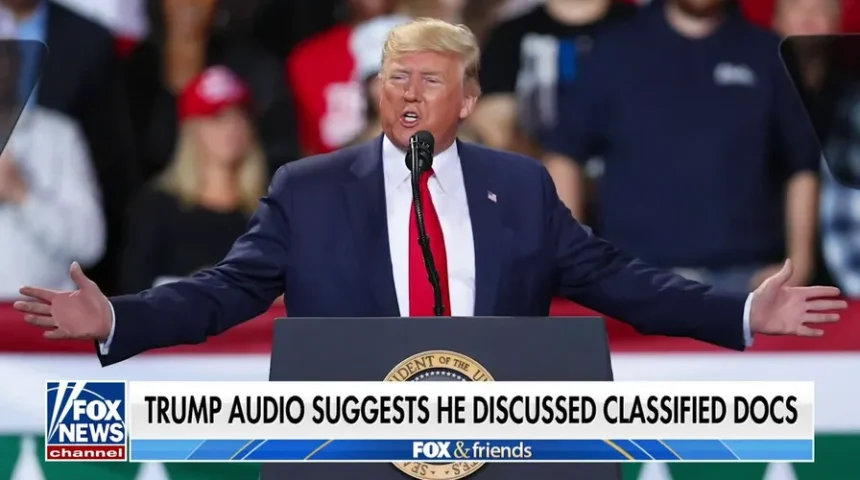
Former U.S. President Donald Trump has been drawn into a fresh wave of political controversy after reports emerged that audio recordings of private conversations had been leaked to journalists and political insiders. The alleged tapes, which reportedly capture Trump discussing a range of sensitive political topics, have reignited debates about his conduct both during his time in office and in the years following his departure from the White House. Critics argue that the contents, as described in early media coverage, raise troubling questions about judgment, intent, and the handling of politically delicate matters, while supporters insist the episode is being exaggerated for partisan gain.
According to multiple news organizations, the recordings began circulating quietly earlier this week among reporters, legal analysts, and political commentators before details of their existence became public. While no outlet has yet released the full audio files, several have cited sources familiar with portions of the material, describing conversations in which Trump allegedly speaks candidly about political strategy and other high-stakes issues. Because the tapes have not been independently authenticated, major uncertainties remain about when the recordings were made, who captured them, and whether they represent complete exchanges or only selected fragments.
Trump and members of his inner circle have forcefully pushed back against the reports, characterizing them as misleading and politically motivated. In statements to the press, allies said any excerpts being discussed were taken out of context or deliberately edited to create a damaging narrative. One spokesperson dismissed the coverage as “recycled accusations amplified for political purposes,” arguing that the timing of the leak — in the midst of an election cycle — was no coincidence. Trump himself has frequently framed similar controversies as part of a coordinated effort by opponents and hostile media organizations to weaken his standing with voters.
The renewed scrutiny arrives at a particularly sensitive juncture for the former president. Despite facing a series of legal battles and ongoing ethical criticisms, Trump remains the most influential figure within the Republican Party and has dominated polling in several primary contests. Surveys continue to show him enjoying strong loyalty from his core supporters, many of whom view repeated investigations and scandals as proof that he is being unfairly targeted. At the same time, his critics argue that the accumulation of controversies underscores deeper concerns about transparency, rule-of-law norms, and accountability for powerful political figures.
Political analysts suggest that the ultimate impact of the alleged recordings may hinge less on what is actually said in them and more on how the story is framed and amplified in public discourse. One Washington-based strategist noted that Trump has often weathered damaging revelations by aggressively challenging the credibility of the sources behind them and by portraying himself as the victim of establishment forces. “He has a well-tested playbook,” the strategist said. “The open question is whether this story breaks through to voters who are not already firmly in his camp, or whether it simply reinforces existing divisions.”
On Capitol Hill, reactions have largely followed predictable partisan lines. Several Democratic lawmakers have called for a thorough inquiry into the origin and authenticity of the recordings, with some urging federal authorities or congressional committees to determine whether any laws were broken in the process of making or leaking them. They argue that, if genuine, the tapes could shed light on matters of public interest that deserve closer scrutiny. Republicans, meanwhile, have mostly rallied behind Trump, accusing Democrats and certain media outlets of selective outrage and of pursuing politically damaging stories while ignoring controversies involving figures on their own side.
Legal scholars caution that leaked audio can carry serious ramifications depending on both its content and the circumstances under which it was obtained. If recordings were made without consent in jurisdictions that require it, those responsible for taping or distributing them could face legal exposure. Additionally, if the conversations involve classified or highly sensitive information, that could introduce further complications. For now, however, experts emphasize that without verified recordings and clear evidence about how they were produced, any legal consequences remain speculative.
The episode also underscores the increasingly complex interplay between politics, media leaks, and legal strategy in a highly polarized election year. In recent decades, secretly recorded conversations and whistleblower disclosures have periodically reshaped political narratives, sometimes dramatically. In Trump’s case, supporters maintain that a steady stream of scandals has failed to erode his popularity and instead has hardened loyalty among his base. Critics counter that each new controversy, taken together, contributes to a broader pattern that they believe voters should take seriously.
As of now, many fundamental questions remain unanswered. The full recordings have not been released to the public, leaving observers to rely on second-hand descriptions. It is still unclear who made the recordings, under what circumstances, how long they have existed, and why they surfaced at this particular moment. Until those details are clarified and the audio itself is authenticated, the story is likely to remain in a state of uncertainty.
In the meantime, the so-called “leaked audio” affair has become another flashpoint in America’s already volatile political environment — fueling cable-news debates, partisan clashes on social media, and speculation about its potential influence on the upcoming election. Whether the controversy fades quickly or grows into a more consequential episode will depend largely on what further evidence emerges and how voters ultimately interpret it in a landscape already crowded with competing narratives and political battles.