


Chainlink (LINK) is attracting attention as its reserve holdings increase and its cross-chain infrastructure expands. The project’s growing focus on institutional finance, blockchain interoperability and enterprise adoption has added new dimensions to its long-term price outlook. However, whether LINK can reach $100 depends on several factors beyond network development.
- Chainlink Price Outlook: What Would It Take for LINK to Reach $100?
- Chainlink Reserve Surpasses 6 Million LINK
- Chainlink CCIP Expansion Adds to Its Long-Term Potential
- Infosys Partnership Strengthens Chainlink’s Institutional Ambitions
- Standard Chartered’s $200 LINK Forecast and the $100 Target
- Key Risks That Could Affect the Chainlink Price Outlook
- What to Watch Next for LINK
- Conclusion: Can Chainlink Reach $100?
In September 2026, Chainlink’s Reserve surpassed 6 million LINK, while its partnership with Infosys brought further attention to its institutional ambitions. Meanwhile, analysts continue to discuss ambitious price targets, including $100 and $200.
These developments have renewed interest in the Chainlink price outlook. However, reserve accumulation, network adoption and market demand are different measures, and none guarantees a particular price.
Chainlink Price Outlook: What Would It Take for LINK to Reach $100?
LINK’s potential move toward $100 represents a substantial increase from its price near $14 in late September 2026. Reaching that level would require a sustained rise in demand, favorable market conditions and continued confidence in Chainlink’s long-term prospects.
At approximately $14, LINK would need to gain more than 600% to reach $100. Such a move is possible in volatile cryptocurrency markets, but it would require considerably more buying pressure than a short-term price rally.
The $100 target also has important implications for Chainlink’s market capitalization. With approximately 748 million LINK in circulation, a $100 token price would imply a circulating market capitalization of roughly $74.8 billion. Based on a maximum supply of 1 billion tokens, the fully diluted valuation would be approximately $100 billion.
These figures help put the price target into perspective. A higher valuation would require investors to support a substantially larger market capitalization, making sustained demand an important consideration.
Why the $13.69 Price Level Matters
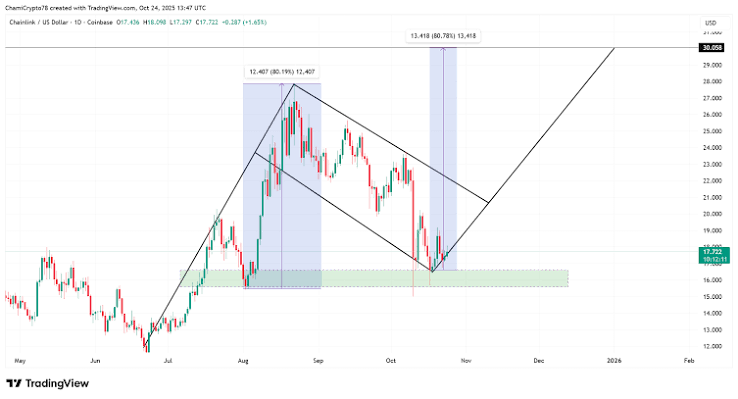
Technical analysts have identified $13.69 as an important level in LINK’s recent price action. A sustained move above this area could attract additional attention from traders watching for a continuation of the recovery.
However, briefly trading above a resistance level does not necessarily confirm a lasting breakout. Trading volume, broader cryptocurrency market conditions and subsequent price action can all influence whether a breakout holds.
If LINK maintains its upward momentum, traders may monitor the $20 level as a potential intermediate target. Conversely, a rejection near resistance could lead to renewed selling pressure, with lower price areas, including $10, attracting attention.
Technical levels should be treated as potential areas of market interest rather than guaranteed support or resistance. They can change as new price data becomes available.
Read more: XRP Price Prediction: Why $1.65 Is Becoming a Key Level
Chainlink Reserve Surpasses 6 Million LINK
Chainlink’s Reserve has become an important part of the project’s token economics. Introduced in 2025, the reserve is designed to accumulate LINK using revenue generated by Chainlink’s services.
Through Payment Abstraction, eligible payments made in other assets can be converted into LINK. This mechanism allows revenue from enterprise and on-chain services to contribute to the reserve without requiring every customer to purchase LINK directly.
In September 2026, the Chainlink Reserve added approximately 373,791 LINK, worth more than $4.3 million at the time of the reported transaction. The addition brought its total holdings to approximately 6.04 million LINK, up from around 3.06 million at the end of the first quarter.
The increase demonstrates continued reserve accumulation. It also highlights Chainlink’s approach to connecting service revenue with its native token.
How Reserve Growth Could Affect LINK
The Reserve’s accumulation is relevant to LINK’s long-term outlook because it creates a mechanism through which eligible service revenue can be converted into the token.
As Chainlink expands its services, additional revenue could contribute to future reserve growth. The scale and consistency of that growth will depend on actual revenue, payment activity and the adoption of Chainlink’s products.
Nevertheless, reserve accumulation should not be confused with an immediate increase in market demand. Tokens held in the reserve are not equivalent to new purchases made by independent investors on exchanges.
The reserve’s long-term significance will depend on its growth relative to the wider token supply, the revenue supporting it and how the accumulated LINK is managed.
For investors following the Chainlink price outlook, reserve growth is one useful metric, but it should be considered alongside market liquidity, circulating supply and actual network usage.
Chainlink CCIP Expansion Adds to Its Long-Term Potential
Chainlink’s Cross-Chain Interoperability Protocol (CCIP) is designed to help applications and institutions transfer information and value between different blockchain networks.
Blockchain networks often operate independently, creating challenges for applications that need to interact across multiple systems. CCIP aims to address these limitations by providing infrastructure for cross-chain communication.
The technology could support applications involving tokenized assets, decentralized finance and institutional blockchain systems. It also forms part of Chainlink’s broader strategy to provide infrastructure for financial institutions and blockchain developers.
According to figures cited in September 2026 reporting, CCIP secured approximately $82.39 billion in cross-chain tokens. This figure highlights the scale of assets associated with the protocol, although it should not be interpreted as Chainlink’s revenue or the market capitalization of LINK.
Why CCIP Adoption Matters
Greater use of CCIP could strengthen Chainlink’s position in blockchain interoperability. If financial institutions and decentralized applications increasingly rely on cross-chain infrastructure, demand for reliable messaging and data services could expand.
However, the relationship between protocol adoption and LINK’s market price is not automatic. Network activity, revenue generation and token demand are separate factors. Their relationship depends on how Chainlink’s services are used and how the associated payment mechanisms operate.
Competition from other interoperability projects also remains relevant. Chainlink’s ability to maintain adoption will depend on reliability, security, integration costs and the needs of developers and institutions.
Consequently, CCIP’s expansion offers important information about Chainlink’s infrastructure strategy, but it does not independently establish a future price target.
Infosys Partnership Strengthens Chainlink’s Institutional Ambitions
Chainlink’s partnership with Infosys has brought additional attention to its efforts to connect blockchain infrastructure with traditional financial systems.
Infosys provides technology and financial infrastructure services, with its banking platform supporting more than 1.7 billion accounts, according to the figures reported for the partnership. The collaboration focuses on connecting enterprise systems with blockchain infrastructure.
The partnership involves Chainlink technologies, including CCIP and the Chainlink Runtime Environment, alongside services such as Data Feeds, Data Streams, Proof of Reserve and the Automated Compliance Engine.
These technologies address different requirements. Data services provide information to blockchain applications, Proof of Reserve can help verify asset backing, and CCIP enables communication across blockchain networks. The Runtime Environment is designed to coordinate complex workflows involving different systems.
What the Partnership Could Mean for LINK
Institutional adoption is an important part of Chainlink’s long-term strategy. Financial institutions exploring tokenization and blockchain-based services may need infrastructure that connects existing systems with blockchain networks.
A partnership involving Infosys could help make Chainlink’s technology accessible to enterprise use cases. Potential applications include tokenized financial assets, cross-chain transactions and automated processes that connect traditional financial infrastructure with blockchain networks.
However, a partnership does not mean that every institution using an Infosys platform has adopted Chainlink. Nor does it establish a specific transaction volume, revenue figure or timeline for wider deployment.
The commercial impact will depend on whether pilot projects progress into operational services and whether those services generate sustained demand for Chainlink’s infrastructure.
LINK Address Activity Draws Market Attention
On-chain activity has also contributed to interest in LINK. Data attributed to Santiment showed that 1,344 new LINK addresses were created on September 22, approximately 19% above the reported monthly average.
An increase in new addresses can indicate growing participation or renewed interest in a cryptocurrency. However, wallet creation alone cannot establish whether the new addresses belong to individual investors, institutions or automated systems.
It also does not reveal how much LINK was purchased or whether the activity will continue.
Address growth is therefore best considered alongside trading volume, active addresses, transaction activity and other indicators of actual network use.
Standard Chartered’s $200 LINK Forecast and the $100 Target
Long-term forecasts have added another dimension to discussions about LINK’s potential. Standard Chartered has previously projected that LINK could reach $200 by the end of 2030.
The forecast has attracted attention because it places LINK well above the $100 milestone frequently discussed by traders. However, a long-term price projection is an analyst estimate, not a confirmed outcome.
The projections reported alongside this outlook include intermediate targets of approximately $13 for 2026, $41 for 2027, $82 for 2028 and $133 for 2029, before the projected $200 level in 2030.
Such forecasts generally depend on assumptions about adoption, market conditions and the future role of blockchain infrastructure. Changes in those assumptions can significantly affect the estimated value.
For LINK to approach $100, investors would need to support a much higher valuation than its late-September 2026 level. Sustained demand, wider use of Chainlink’s infrastructure and favorable conditions across the cryptocurrency market could all influence that process.
However, even substantial progress in enterprise adoption would not eliminate market risks. Cryptocurrency prices can experience sharp declines regardless of developments in the underlying technology.
Investors should therefore distinguish analyst projections from observable developments, such as reserve growth, confirmed integrations and actual network activity.
Key Risks That Could Affect the Chainlink Price Outlook
Although Chainlink has expanded its infrastructure and institutional partnerships, several risks could affect LINK’s future performance.
Slower institutional adoption: Financial institutions can take considerable time to move from testing blockchain applications to full commercial deployment. Delays or abandoned projects could limit the expected benefits of partnerships.
Cryptocurrency market volatility: LINK remains exposed to broader market conditions. Bitcoin’s price movements, changes in investor sentiment and shifts in liquidity can influence LINK even when Chainlink-specific developments remain positive.
Competition in blockchain infrastructure: Chainlink operates in a competitive environment. Other oracle providers and interoperability solutions may attract developers and institutional customers, potentially affecting Chainlink’s adoption.
Uncertain token economics: Growth in service usage does not necessarily translate into proportional demand for LINK. The effect on token value depends on payment mechanisms, revenue conversion and the broader supply and demand balance.
Uncertain long-term forecasts: Price targets such as $100 and $200 depend on assumptions that may not materialize. Changes in regulation, technology, institutional interest or market conditions could make existing forecasts less relevant.
These risks make it important to evaluate Chainlink’s measurable progress separately from expectations about its future token price.
What to Watch Next for LINK
Several indicators could help investors assess whether Chainlink’s development is translating into measurable progress.
- Reserve accumulation: Monitor the amount of LINK added to the reserve and whether growth continues over time.
- CCIP adoption: Look for confirmed integrations, sustained usage and evidence of commercial activity rather than relying solely on headline figures.
- Institutional deployments: Track whether partnerships lead to operational products and recurring activity.
- Trading volume: Examine whether price movements are supported by sustained market participation.
- Token economics: Consider circulating supply, reserve holdings and the relationship between service revenue and demand for LINK.
These indicators provide different perspectives on Chainlink’s development. Taken together, they can help distinguish short-term market enthusiasm from longer-term progress.
Conclusion: Can Chainlink Reach $100?
Chainlink’s growing Reserve, CCIP expansion and partnership with Infosys have strengthened interest in its long-term outlook. Reserve holdings exceeding 6 million LINK and the reported increase in new addresses are notable developments, while institutional integrations could create additional opportunities for the network.
Nevertheless, a $100 LINK price remains a speculative target. Reaching it would require a substantial increase in valuation, sustained market demand and favorable conditions across the cryptocurrency sector.
The $200 forecast attributed to Standard Chartered represents a longer-term projection rather than a guaranteed destination. Similarly, reserve growth and institutional partnerships should be evaluated based on their measurable impact instead of assumed price appreciation.
For anyone following LINK, the most useful approach is to monitor actual adoption, token economics and market conditions while recognizing the uncertainty associated with cryptocurrency price forecasts.
Disclaimer: This article is for informational and educational purposes only. It does not constitute financial or investment advice. Cryptocurrency markets are highly volatile, and readers should conduct their own research before making investment decisions.