

Key Insights
- XRP price has pulled back to a key support level, signaling consolidation.
- Total assets in XRP ETFs have crossed the $1.5 billion milestone, showing strong institutional interest.
- Ripple will activate permissioned DEX on the XRP Ledger, which could boost adoption and network utility.
- XRP’s price rally has lost momentum, but underlying fundamentals remain strong.
XRP’s Rally Stalls, But ETF Demand Keeps Rising
XRP’s price has lost momentum over the past few weeks, erasing much of its early-year gains. The broader crypto market slowdown has weighed heavily on momentum, and XRP has not been immune. This pullback, however, has not dampened the interest of investors in XRP ETFs.
- Key Insights
- XRP’s Rally Stalls, But ETF Demand Keeps Rising
- XRP ETF Adoption Still Below Major Crypto Standards
- Why Institutional Demand for XRP Is Growing
- Ripple’s Regulatory and Licensing Progress
- Banking Charter and Institutional Expansion
- Stablecoin Growth: RLUSD
- Permissioned Domains Upgrade: A Major Catalyst
- XRP Price Technical Analysis: Triple Bottom and Trendline Support
- Triple Bottom Pattern
- Inverted Head-and-Shoulders Breakout
- Retest and Break-and-Retest Pattern
- Indicators Supporting Bullish Outlook
- Potential Price Targets
- Risks and Downside Scenarios
- FAQ’s
- Why is XRP’s price pulling back despite strong ETF inflows?
- How much have XRP ETFs accumulated so far?
- What does the $1.5 billion milestone mean for XRP?
- Why are institutions investing in XRP ETFs?
- What is Ripple’s Permissioned Domains upgrade?
- What technical pattern suggests XRP may rebound?
- What is the next key price target for XRP?
- What would invalidate the bullish XRP outlook?
- How does Ripple’s licensing progress affect XRP?
- Are XRP ETFs still underrepresented compared to Bitcoin and Ethereum?
- Conclusion
In fact, ETF inflows continue to rise, which suggests that institutions and retail investors are still confident in XRP’s long-term potential. According to data from SoSoValue, XRP ETFs continued to accumulate assets even as price momentum faded.
On Thursday, inflows increased by $17 million, bringing total net inflows to $1.27 billion since their approval late last year. This demonstrates that while the price may be consolidating, the underlying demand remains strong.
XRP ETF Flow Details
- Grayscale’s GXRP ETF added $3.49 million in inflows, raising its assets to $291 million.
- Bitwise’s XRP ETF added $3.47 million, also reaching $291 million in assets.
- In total, XRP ETFs have recorded over $107 million in inflows this year.
- Total assets under management across XRP ETFs crossed $1.5 billion, a new milestone.
These figures matter because they show that XRP is attracting serious capital even when market sentiment is uncertain. While Bitcoin and Ethereum ETFs dominate the crypto ETF landscape, XRP’s inflows show that investors are diversifying into alternative digital assets.
XRP ETF Adoption Still Below Major Crypto Standards
Despite this growth, XRP ETFs still represent only 1.21% of XRP’s market capitalization. In comparison:
- Bitcoin ETFs account for 6.58% of Bitcoin’s market cap
- Ethereum ETFs account for 5.15% of Ethereum’s market cap
This disparity suggests there is still significant room for growth in XRP ETF adoption. If inflows continue, the ETF ecosystem could eventually capture a larger share of XRP’s market value, which could support higher prices over time.
Why Institutional Demand for XRP Is Growing
The continued inflows into XRP ETFs are not happening by accident. The demand is driven by strong fundamentals and a broader narrative around Ripple’s expanding global footprint.
Ripple’s Regulatory and Licensing Progress
Ripple Labs has been aggressively expanding its regulatory compliance and licensing efforts globally. Recently, the company secured a new license in Luxembourg, following a similar approval in the United Kingdom. These approvals increase Ripple’s ability to operate and partner with financial institutions across Europe.
Overall, Ripple now holds over 75 licenses, which enables it to make deals with banks, payment providers, and money transfer companies. This regulatory expansion is important because it reduces operational risks and increases confidence among institutional investors.
Banking Charter and Institutional Expansion
Ripple has also received a banking charter from the U.S. Office of the Comptroller of the Currency (OCC). This approval positions Ripple to provide banking services and potentially offer custody solutions to other firms.
With a banking charter, Ripple can expand its services to include:
- Custody for institutional clients
- Payment settlement services
- Cross-border transaction solutions
These capabilities could attract new enterprise customers, increasing network utility and demand for XRP.
Stablecoin Growth: RLUSD
Ripple is also becoming a major player in the stablecoin market. Its stablecoin, RLUSD, has gained over $1.4 billion in assets and processed 370,000 transactions worth $3.3 billion. Stablecoin adoption supports network activity and demonstrates that Ripple’s ecosystem is expanding beyond just XRP.
These developments collectively strengthen the long-term case for XRP. They also help explain why ETF investors are continuing to accumulate XRP even when the price is consolidating.
Permissioned Domains Upgrade: A Major Catalyst
A significant potential catalyst for XRP is the upcoming activation of the Permissioned Domains amendment on the XRP Ledger. This upgrade is expected to occur later this month.
What Are Permissioned Domains?
Permissioned Domains introduce institutional-grade controls on a public blockchain. The feature is designed to provide the security and compliance needed by financial institutions without sacrificing the scalability and openness of a public ledger.
This upgrade will enable institutions to:
- Operate permissioned flows
- Manage controlled lending and borrowing
- Enable institutional trading and settlement
- Use the XRP Ledger for scalable and resilient infrastructure
The Permissioned Domains upgrade is important because it bridges the gap between public blockchain innovation and the regulatory requirements of institutional finance. It can potentially attract new enterprise users to the XRP Ledger, increasing network usage and demand for XRP.
XRP Price Technical Analysis: Triple Bottom and Trendline Support
From a technical perspective, XRP has shown signs of strength despite the recent pullback.
Triple Bottom Pattern
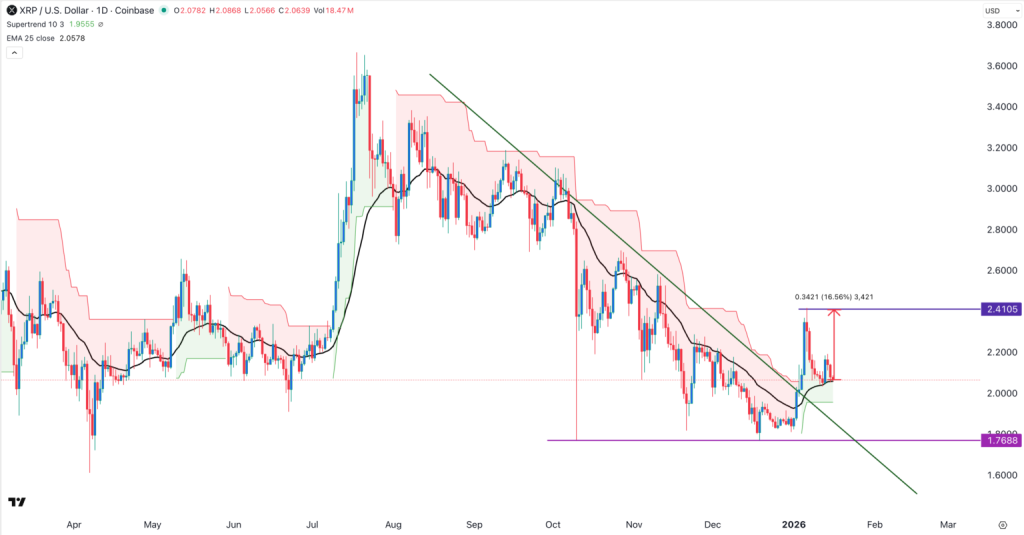
On the daily chart, XRP formed a triple bottom at $1.7688, marking lows in October, November, and December. A triple bottom is a bullish reversal pattern that indicates sellers are unable to push the price below a critical support level.
This pattern suggests that demand is strong at that level and that a breakout could lead to a significant upward move.
Inverted Head-and-Shoulders Breakout
XRP also broke above a descending trendline that connects the highest swings since September last year. This trendline was the neckline of an inverted head-and-shoulders pattern. This breakout was a bullish signal, suggesting a potential reversal in the long-term downtrend.
Retest and Break-and-Retest Pattern
Currently, XRP is attempting to retest this trendline, which is a common continuation signal in technical analysis. If the price successfully holds above the trendline, it would confirm a break-and-retest and suggest further upward momentum.
Indicators Supporting Bullish Outlook
- Supertrend indicator remains green
- XRP is trading above the 25-day EMA
As long as these conditions remain in place, the bullish case remains valid.
Potential Price Targets
If XRP continues to hold support and gains momentum, the next target is the year-to-date high of $2.41, which is roughly 16% above the current price.
A move above $2.41 would likely open the door for further upside toward the psychological $3 level, a major target for bulls.
Risks and Downside Scenarios
While the bullish case is compelling, the market still faces risks. The main downside scenario would be if XRP fails to hold its key support levels.
Bearish Scenario
If XRP falls below the $1.7688 support level and breaks the triple bottom, it could signal renewed bearish momentum. In that case, the price could revisit lower support levels and the bullish thesis would weaken.
Additionally, if ETF inflows slow or reverse, it could lead to increased selling pressure. The market is also sensitive to broader crypto sentiment and macroeconomic conditions, which could impact XRP’s price.
Read More: Bitcoin ETF Exodus: $395M Withdrawn in Just One Day
FAQ’s
Why is XRP’s price pulling back despite strong ETF inflows?
XRP’s price pullback reflects broader market weakness and profit-taking, while ETF inflows indicate long-term institutional confidence and accumulation.
How much have XRP ETFs accumulated so far?
XRP ETFs have crossed $1.5 billion in total assets, with net inflows exceeding $1.27 billion since their approval.
What does the $1.5 billion milestone mean for XRP?
It shows increasing institutional adoption and suggests that ETFs are becoming a significant channel for capital inflows into XRP.
Why are institutions investing in XRP ETFs?
Institutional interest is driven by Ripple’s regulatory progress, expanding licenses, and growing stablecoin activity, which strengthen XRP’s long-term fundamentals.
What is Ripple’s Permissioned Domains upgrade?
Permissioned Domains is an XRP Ledger upgrade that introduces institutional-grade controls, enabling permissioned trading and lending flows on a public blockchain.
What technical pattern suggests XRP may rebound?
XRP has formed a triple-bottom pattern around $1.7688, indicating strong support and potential for a bullish reversal.
What is the next key price target for XRP?
If XRP holds support and gains momentum, the next major target is $2.41, with potential upside to the $3 psychological level.
What would invalidate the bullish XRP outlook?
A break below the triple-bottom support at $1.7688 would weaken the bullish structure and could trigger further downside.
How does Ripple’s licensing progress affect XRP?
More licenses expand Ripple’s ability to partner with banks and financial institutions, increasing real-world use cases and supporting long-term demand for XRP.
Are XRP ETFs still underrepresented compared to Bitcoin and Ethereum?
Yes. XRP ETF assets represent only 1.21% of XRP’s market cap, while Bitcoin and Ethereum ETFs account for 6.58% and 5.15%, respectively—suggesting room for growth.
Conclusion
XRP’s recent pullback does not necessarily signal the end of the rally. Instead, it may be a period of consolidation, as the market digests strong ETF inflows and waits for new catalysts.
Institutional interest remains strong, with XRP ETFs crossing the $1.5 billion milestone. Ripple’s regulatory progress, stablecoin growth, and the upcoming Permissioned Domains upgrade add to the long-term fundamental case.
Technically, XRP is holding critical support levels and showing bullish continuation signals, such as the triple bottom and break-and-retest pattern. As long as it stays above the 25-day EMA and maintains the Supertrend in green, the outlook remains positive.
The next key target is $2.41, and a break above that level could pave the way toward $3.