


Key Insights
Pump.fun has launched Pump Fund, a new $3 million investment initiative designed to fund 12 early-stage projects with $250,000 each at a fixed $10 million valuation.
The program is structured as a 30-day “build in public” hackathon, requiring teams to launch live tokens and demonstrate real-time market traction.
Project selection will be based entirely on on-chain activity, community engagement, and user demand, rather than traditional venture capital screening.
Pump.fun says it has facilitated more than 14 million token launches and generated over $1 billion in cumulative revenue since inception.
The move comes as memecoin trading activity on the platform has declined significantly from its 2025 peak amid broader market cooling.
- Key Insights
- From Memecoin Mania to Market Experimentation
- The Birth of Pump Fund
- A Deliberate Rejection of Traditional Venture Capital
- How the Hackathon Works
- Community as the Primary Arbiter of Value
- Open to Crypto and Non-Crypto Projects
- Mentorship Without Control
- Pump.fun by the Numbers
- The Context: Memecoin Trading Slows
- From Speculation to Rotation
- Why Pump Fund Now?
- Transparency and Governance Concerns
- Tokens as Social Proof
- Lessons From Past Token Experiments
- Pump.fun’s Challenging Reputation
- Regulatory Implications
- Strategic Risks and Opportunities
- What Success Would Look Like
- FAQ’s
- Conclusion
From Memecoin Mania to Market Experimentation
Pump.fun, the Solana-based memecoin launchpad that became synonymous with last year’s speculative frenzy, is charting a new strategic direction. As trading volumes cool and the memecoin sector enters a more selective phase, the platform has introduced Pump Fund, an investment arm aimed at backing early-stage projects through open market participation rather than closed-door venture capital processes.
The initiative marks a notable shift in how Pump.fun positions itself within the crypto ecosystem. Once primarily known for enabling rapid-fire token launches and viral speculation, the company is now framing its platform as an alternative capital formation engine, one that places communities, real users, and live market signals at the center of funding decisions.
Pump.fun’s leadership describes the effort as an experiment in market-driven discovery—one that challenges conventional startup financing models in both crypto and traditional venture capital.
The Birth of Pump Fund
Pump Fund is a $3 million investment program that will deploy capital to 12 selected projects, each receiving $250,000 at a standardized $10 million valuation. Rather than negotiating bespoke terms with founders behind closed doors, Pump.fun has opted for a uniform structure designed to reduce friction and eliminate subjective gatekeeping.
The investment program will run as a 30-day hackathon, during which participating teams must:
- Launch a live token on Pump.fun
- Build publicly and communicate progress in real time
- Attract users through organic engagement
- Demonstrate sustained on-chain activity
At the end of the program, winning projects will be selected based on market traction rather than panel judgment.
A Deliberate Rejection of Traditional Venture Capital
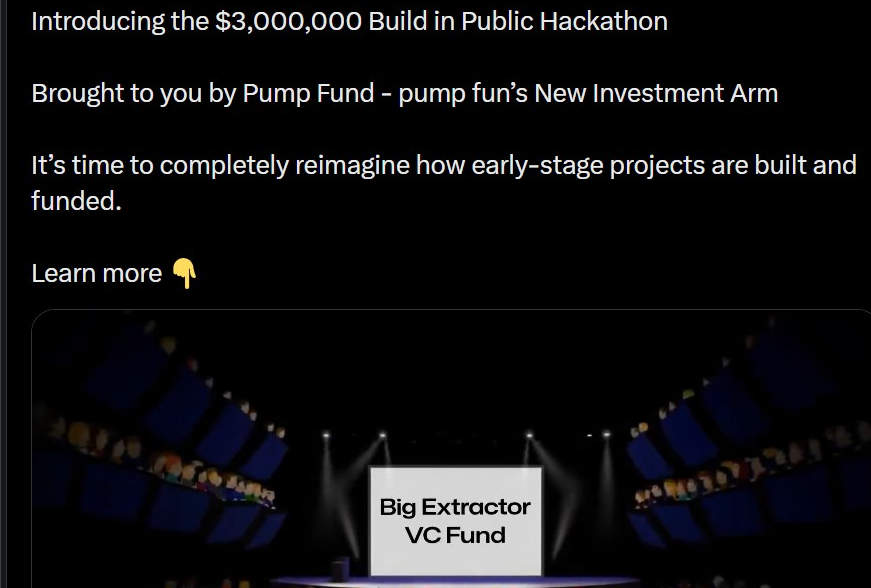
Pump.fun has positioned Pump Fund as a direct alternative to the traditional venture capital (VC) model, which it argues has become increasingly opaque, relationship-driven, and disconnected from real user demand.
In conventional VC pipelines, founders often secure funding through networks, reputation, and private pitch meetings. By contrast, Pump.fun’s model places founders directly in front of users and markets, forcing ideas to compete in the open.
According to the company, tokens themselves become the pitch, while price discovery, trading volume, holder retention, and community participation serve as signals of viability.
This framing aligns with a broader ideological shift within parts of the crypto community that favors permissionless access, transparency, and market-based validation over institutional gatekeeping.
How the Hackathon Works
Build in Public, Compete in the Open
The Pump Fund hackathon—branded internally as “Build in Public”—requires founders to operate under constant market scrutiny. Teams are expected to:
- Publish frequent development updates
- Engage directly with users across social platforms
- Demonstrate tangible progress during the 30-day window
- Maintain transparent token supply and distribution
The hackathon concludes on February 18, with results announced immediately following the end of the program window.
Unlike traditional demo days or pitch competitions, there is no single presentation moment. Instead, evaluation is continuous and dynamic, reflecting how real users interact with the project over time.
Fixed Valuation, Fixed Capital
One of the most unusual aspects of Pump Fund is its fixed investment structure. Every selected project receives the same amount of capital at the same valuation, regardless of sector, team size, or perceived ambition.
Pump.fun argues that this standardization reduces negotiation friction, minimizes power imbalances, and allows founders to focus on execution rather than fundraising theatrics.
Success, under this model, is not measured by who can tell the best story—but by who can retain users and sustain activity.
Community as the Primary Arbiter of Value
At the heart of Pump Fund is the belief that communities—not venture partners—are best positioned to evaluate early-stage projects.
Pump.fun’s model shifts the burden of validation away from professional investors and toward:
- Token holders
- Traders
- Builders
- End users
Demand is expressed through on-chain behavior rather than term sheets.
To ensure alignment, participating teams are required to retain at least 10% of their token supply throughout the program, signaling long-term commitment and discouraging quick exits.
Open to Crypto and Non-Crypto Projects
Unlike many blockchain incubators, Pump Fund is not limited to crypto-native startups. Pump.fun has stated that it welcomes teams building:
- Consumer applications
- Infrastructure tools
- Creator platforms
- Gaming or social products
- Non-crypto services experimenting with tokenized engagement
The only requirement is that teams are willing to issue a token and allow the market to evaluate demand in real time.
This openness reflects Pump.fun’s broader ambition to position tokens as general-purpose coordination and fundraising tools, not just speculative assets.
Mentorship Without Control
Pump.fun has said that selected teams will receive direct mentorship from its founders, focusing on product iteration, community communication, and growth strategy.
However, the company has emphasized that it will not exert editorial or operational control over projects. Instead, mentorship is framed as guidance rather than oversight.
This hands-off approach reinforces Pump.fun’s thesis that markets—not managers—should determine outcomes.
Pump.fun by the Numbers
Pump.fun’s credibility in launching Pump Fund rests partly on its scale.
According to the company:
- Over 14 million tokens have been launched via Pump.fun
- The platform has generated more than $1 billion in revenue
- It became one of the most active launchpads on Solana during the memecoin boom
These figures position Pump.fun as one of the largest token issuance platforms in crypto history, albeit one associated with extreme volatility and speculation.
The Context: Memecoin Trading Slows
The launch of Pump Fund comes amid a noticeable cooling in memecoin trading activity, particularly on Solana.
Industry data shows that Pump.fun reached a peak monthly trading volume of approximately $11.75 billion in January 2025. By December, that figure had dropped sharply to around $2.43 billion, representing a decline of nearly 80%.
While still substantial by historical standards, the slowdown reflects a broader shift in market sentiment.
From Speculation to Rotation
Recent market data suggests that memecoin trading has entered a phase characterized by capital rotation rather than expansion.
In several recent sessions:
- Trading volume across meme assets spiked briefly
- Overall sector market capitalization declined
- Price gains failed to sustain
This pattern indicates that traders are cycling funds between assets rather than introducing fresh capital into the ecosystem.
For platforms like Pump.fun, this environment presents both a challenge and an opportunity: speculative momentum has cooled, but attention and liquidity remain available for projects that can demonstrate genuine utility or engagement.
Why Pump Fund Now?
From a strategic perspective, Pump Fund appears designed to:
- Diversify Pump.fun’s identity beyond memecoins
- Extend user engagement beyond short-term speculation
- Capture value from longer-lived projects
- Position the platform as a capital formation layer
By encouraging builders to create products rather than one-off tokens, Pump.fun may be attempting to stabilize activity and reduce dependency on viral hype cycles.
Transparency and Governance Concerns
Despite the innovation, Pump Fund has raised questions among analysts and industry observers—particularly around governance, manipulation, and fairness.
Measuring “Organic Traction”
One major concern is how Pump.fun will distinguish genuine user engagement from artificial activity.
Musheer Ahmed, founder and managing director of Finstep Asia, emphasized that without clear safeguards, hackathon-style programs risk being gamed by:
- Automated bots
- Wash trading
- Coordinated pump groups
Ahmed argued that transparent rules around distribution and engagement metrics are essential to maintain credibility.
Preventing Manipulation
Given Pump.fun’s open nature, critics have noted that sophisticated actors could manufacture short-term traction to influence selection outcomes.
Preventing such behavior would require:
- Robust on-chain analytics
- Behavioral pattern analysis
- Clear exclusion criteria
So far, Pump.fun has not published detailed methodology for filtering manipulated activity.
Tokens as Social Proof
Pratik Kala, head of research at Apollo Crypto, described Pump Fund as an experiment in social proof–based funding.
In his view, the model mirrors markets that surface demand signals quickly, allowing capital to flow toward attention.
However, Kala cautioned that token-based funding structures vary widely in how they translate participation into long-term value for holders.
He pointed to earlier crypto experiments where tokens successfully bootstrapped interest but failed to deliver sustainable returns or governance rights.
Lessons From Past Token Experiments
Crypto history is littered with examples of token launches that generated early excitement but collapsed due to:
- Poor accountability
- Misaligned incentives
- Lack of product-market fit
- Absence of long-term governance
Without clear post-hackathon frameworks, Pump Fund projects may face similar risks once initial momentum fades.
Pump.fun’s Challenging Reputation
The launch of Pump Fund follows a difficult period for Pump.fun’s public image.
In 2025, the platform paused its livestreaming feature after concerns emerged over inappropriate content and moderation failures. The episode drew regulatory and community scrutiny, forcing Pump.fun to reevaluate its content policies.
Additionally, the company has been named in a class action complaint alleging that its parent entity operated an illegal securities exchange by facilitating large-scale unregistered token issuance while collecting substantial fees.
While these allegations remain unresolved, they underscore the regulatory uncertainty surrounding token launch platforms.
Regulatory Implications
Pump Fund’s structure may attract additional regulatory attention, particularly around:
- Whether funded tokens constitute securities
- How investor protections are enforced
- The role of platforms in token distribution
As regulators globally continue to clarify crypto rules, market-driven funding models like Pump Fund may test the boundaries of existing frameworks.
Strategic Risks and Opportunities
Opportunities
- Reinventing Pump.fun as a builder-focused platform
- Capturing value beyond speculative trading
- Attracting higher-quality projects
- Extending ecosystem longevity
Risks
- Manipulation of traction metrics
- Reputational damage from failed projects
- Regulatory enforcement
- Community skepticism
The success of Pump Fund will likely depend on execution rather than ideology.
What Success Would Look Like
For Pump.fun, a successful Pump Fund cycle would produce:
- Projects that retain users beyond the hackathon
- Tokens with sustainable activity rather than flash pumps
- Builders who continue developing post-funding
- A replicable funding model
Failure, by contrast, would reinforce criticisms that open-market funding prioritizes attention over substance.
Read More: Makina Finance Suffers $5M Exploit, MEV Bot Secures $4.1M
FAQ’s
What is Pump Fund and why did Pump.fun launch it?
Pump Fund is a $3 million investment program created by Pump.fun to fund early-stage projects through a market-driven hackathon. It was launched as memecoin trading activity slowed, with the goal of shifting focus toward long-term building and real user demand.
How does the Pump Fund hackathon work?
The program runs for 30 days and requires participating teams to launch live tokens on Pump.fun. Projects are evaluated based on real-time market traction, on-chain activity, and community engagement rather than traditional venture capital judging.
How much funding do selected projects receive?
Pump Fund will invest $250,000 into each of 12 selected projects at a fixed valuation of $10 million. The standardized structure removes negotiation and emphasizes execution and user adoption.
Who can participate in the Pump Fund program?
The hackathon is open to both crypto-native and non-crypto projects, as long as teams are willing to issue a token, build publicly, and engage with users throughout the program.
What risks or concerns have analysts raised about Pump Fund?
Analysts have raised concerns about how Pump.fun will measure genuine user traction and prevent manipulation, such as wash trading or bot-driven activity, during the hackathon. Regulatory and governance questions have also been highlighted.
Conclusion
Pump.fun’s launch of Pump Fund represents a bold attempt to rethink early-stage funding in crypto. By tying capital allocation directly to market participation, the platform is testing whether open demand signals can outperform traditional venture capital selection.
The timing is significant. As memecoin trading cools and speculative cycles shorten, platforms that rely solely on hype face diminishing returns. Pump Fund may be Pump.fun’s effort to evolve—or a high-risk experiment that exposes the limits of market-driven validation.
Whether the initiative becomes a blueprint for decentralized funding or a cautionary tale will depend on how effectively Pump.fun balances openness with integrity, transparency with growth, and innovation with accountability.