


Bitcoin has once again entered a phase of sharp volatility, reminding markets that even after a strong rally, the flagship cryptocurrency remains sensitive to macroeconomic shocks and technical barriers. After failing to break decisively above the $100,000 mark, BTC has retraced sharply within the span of a week. On Sunday, January 18, the market experienced another downward leg, with Bitcoin slipping approximately 2.6% as global risk sentiment deteriorated.
- Key Takeaways
- Bitcoin’s Recent Technical Breakdown: A Failure to Sustain Above $100,000
- Bloomberg’s Bear Case: Why $10,000 is Being Discussed
- ETF Outflows and Institutional Sentiment
- The Bitcoin-to-Gold Relationship: A Five-Year “Curse”?
- Gold Hits Record High as Trade War Escalates
- Liquidations and Market Volatility
- Geopolitical Risks and Market Psychology
- The Broader Market Cycle: Where Is Bitcoin in the Trend?
- What Could Change the Outcome?
- FAQ’s
- Conclusion
The catalyst behind this sell-off was not confined to crypto-specific news. The broader macroeconomic environment intensified when the European Union escalated its tariff response to the United States, marking a major escalation in the US-EU trade conflict. This sudden shift pushed investors toward traditional safe-haven assets, with Gold futures surging to a new record high of $4,660 per ounce.
Amid this backdrop, Bloomberg Intelligence analyst Mike McGlone delivered a stark warning: Bitcoin’s repeated failure to hold above $100,000 and its ongoing weakness could trigger a deeper downtrend, potentially driving BTC toward $10,000 in 2026. This forecast has reignited debate over whether Bitcoin is in a late-cycle market environment, where risk assets may face a dramatic “end-game” retracement.
This analysis examines the technical, macro, and institutional factors driving the current Bitcoin correction, explores the implications of the Bloomberg warning, and assesses the broader market context—including the relationship between Bitcoin and gold.
Key Takeaways
- Bitcoin’s pullback intensified after failing to sustain momentum above $100,000, triggering a week-long retracement.
- Bloomberg analyst Mike McGlone warns of a possible decline to $10,000 in 2026, citing late-cycle dynamics and weakening institutional support.
- Gold futures hit an all-time high of $4,660 per ounce amid escalating US-EU trade tensions.
- Spot Bitcoin ETFs experienced systematic outflows, reflecting dampened institutional appetite.
- Crypto markets faced heavy liquidations, with nearly $867 million wiped out within 24 hours, signaling high leverage and risk-off sentiment.
Bitcoin’s Recent Technical Breakdown: A Failure to Sustain Above $100,000
Bitcoin’s current correction can be traced back to its repeated inability to secure a sustained breakout above $100,000. While the asset has demonstrated a capacity to rally sharply in the past, it has often struggled to maintain momentum at psychologically and technically significant levels.
The $100,000 zone has historically acted as both a magnet for buyers and a ceiling for sellers. When BTC approaches this threshold, it often triggers a wave of profit-taking and margin selling, which can quickly reverse bullish momentum.
Why the $100,000 Level Matters
- Psychological significance: Round numbers act as strong emotional barriers in financial markets.
- Technical resistance: Multiple previous attempts to breach this level have resulted in rejections, reinforcing its strength.
- Leverage risk: A large portion of leveraged long positions are typically placed near major breakout levels. When BTC fails to break out, these positions become vulnerable to liquidation.
Bitcoin’s inability to sustain above $100,000 has therefore become a major bearish signal for some analysts, suggesting that market participants are not yet ready to accept a new phase of bullish dominance.
Bloomberg’s Bear Case: Why $10,000 is Being Discussed
Mike McGlone’s warning is rooted in the concept of a late-cycle market environment, where assets that previously performed strongly begin to show signs of structural weakness. In such environments, the market’s collective psychology shifts from risk-seeking to risk-avoidant, and price action often becomes dominated by downside volatility.
McGlone argued that:
- Bitcoin’s failure to sustain momentum in 2025 increases the risk of a deeper decline in 2026.
- Spot ETF outflows indicate a cooling of institutional demand, weakening the market’s support structure.
- Prolonged weakness below major resistance levels can signal a broader market revision, possibly toward much lower price levels.
What “Late-Cycle Downturn” Means for Bitcoin
A late-cycle downturn refers to a phase where an asset class or market experiences a final peak before a sustained decline. For Bitcoin, this could mean:
- A period of increased volatility and sharp drawdowns.
- A shift in investor sentiment from bullish to cautious.
- A “flight to safety” where capital rotates into traditional safe-haven assets.
McGlone’s forecast of $10,000 implies a major correction that would wipe out a significant portion of gains from the current cycle. While this scenario may seem extreme to many investors, it is grounded in the idea that markets can undergo deep resets when speculative bubbles or excessive optimism reach their peak.
ETF Outflows and Institutional Sentiment
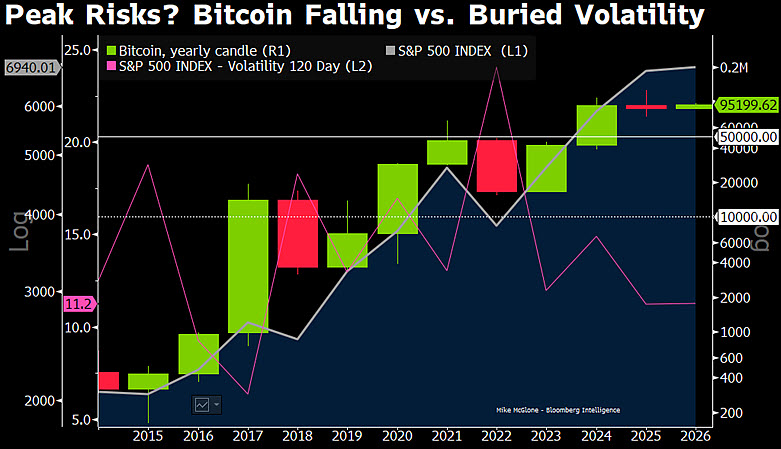
A key component of McGlone’s bearish thesis is the weakening of institutional support, particularly through spot Bitcoin ETFs.
Why ETF Outflows Matter
Institutional demand is often considered a stabilizing force in financial markets. When institutions buy, they typically do so with longer time horizons and higher capital thresholds, reducing volatility.
However, when ETF flows reverse:
- Liquidity decreases.
- Price becomes more sensitive to retail sentiment.
- Leveraged positions become more vulnerable to liquidation.
Recent data showed systematic outflows from spot Bitcoin ETFs, indicating that some institutional investors may be rotating out of BTC or reducing exposure due to macro uncertainty.
The Bitcoin-to-Gold Relationship: A Five-Year “Curse”?
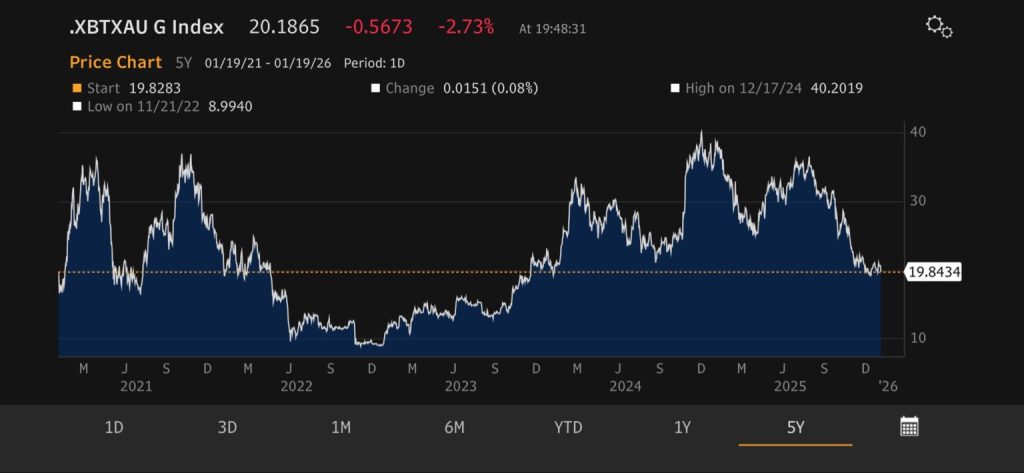
Mike McGlone also highlighted Bitcoin’s relative performance compared to gold over the past five years, suggesting that the Bitcoin-to-gold ratio is stuck in a prolonged stagnation phase.
The Bitcoin-to-Gold Ratio Explained
The ratio measures Bitcoin’s price relative to gold. A rising ratio suggests Bitcoin is outperforming gold, while a falling ratio indicates gold is outperforming BTC.
McGlone noted that:
- The Bitcoin-to-gold ratio remains near 20x, roughly unchanged from five years ago.
- This indicates that Bitcoin has not meaningfully outperformed gold over the long term.
- His base case is that the ratio may revert toward 10x, rather than returning to the high levels seen in earlier cycles.
What This Means for Bitcoin
If gold continues to outperform Bitcoin, it could suggest that investors are favoring traditional safe-haven assets during periods of geopolitical uncertainty. This would align with the current risk-off environment triggered by the escalating US-EU trade conflict.
Gold Hits Record High as Trade War Escalates
On Sunday, January 18, Gold futures surged to a new record of $4,660 per ounce, reflecting a broader shift toward safe-haven assets. This surge came amid an escalating trade war between the United States and the European Union.
What Triggered the Rally?
The rally was triggered by President Donald Trump’s announcement of new 10% tariffs on the EU, prompting an immediate retaliation from Brussels. Reports indicated that the EU is preparing up to $100 billion in tariffs and restrictions targeting U.S. companies.
The market’s reaction was swift:
- Risk assets declined sharply.
- Gold rallied as investors sought refuge from geopolitical uncertainty.
- Bitcoin fell alongside equities and other high-risk assets.
Why Gold Matters for Bitcoin
Gold’s rally has implications for Bitcoin because both assets are often viewed as alternative stores of value. However, in times of acute risk-off sentiment, gold has historically proven to be the more reliable safe-haven asset. This can lead to a rotation of capital away from riskier assets like Bitcoin.
Liquidations and Market Volatility
The last 24 hours have seen intense liquidation activity in the crypto market. Total liquidations reached approximately $867 million, with long positions accounting for around $784 million.
What This Tells Us
- The market is highly leveraged, with many traders betting on continued upward momentum.
- When the market reverses, leverage is quickly unwound, creating a cascading effect.
- This kind of volatility is common near major resistance levels like $100,000.
Major assets such as Bitcoin, Ethereum, and Solana were affected, highlighting that the sell-off was broad-based rather than isolated to BTC alone.
Geopolitical Risks and Market Psychology
The escalating trade war is not merely an economic story; it has major implications for market psychology.
Why Geopolitical Risk Impacts Crypto
Cryptocurrencies are often viewed as high-risk assets. When geopolitical uncertainty rises, investors tend to reduce exposure to risk and seek safe-haven assets like gold and cash.
The EU-US trade conflict is especially significant because:
- It can trigger inflationary pressure.
- It can slow global growth.
- It can create systemic risk across global markets.
This environment is unfavorable for risk assets, including Bitcoin.
The Broader Market Cycle: Where Is Bitcoin in the Trend?
The current environment raises a critical question: Is Bitcoin still in a bullish cycle or approaching the end of a major trend?
Signs of a Late-Cycle Market
McGlone’s thesis suggests that the market may be entering a late-cycle phase. Signs that support this view include:
- Repeated failure at key resistance levels.
- Rising safe-haven demand for gold.
- Weak ETF inflows and institutional hesitation.
- Elevated speculative hype without strong risk-adjusted returns.
Signs of Continued Bullish Momentum
Conversely, there are factors that could argue against a deep crash:
- Bitcoin’s long-term adoption continues to grow.
- Institutional interest remains significant despite temporary outflows.
- Technical support levels remain strong.
- Macro conditions could shift in favor of risk assets.
What Could Change the Outcome?
A major question remains: what could prevent a deep decline and instead support a continued bullish trend?
Potential Bullish Catalysts
- Strong macro data or improved risk sentiment.
- Renewed ETF inflows, especially from institutional investors.
- Bitcoin breaking and holding above $100,000 with strong volume.
- Regulatory clarity that supports institutional adoption.
- De-risking of global trade tensions or a resolution to the EU-US tariff conflict.
Potential Bearish Catalysts
- Further escalation of trade wars and geopolitical instability.
- Widening risk-off sentiment across global markets.
- Increased ETF outflows and institutional withdrawal.
- Failure to break above $100,000, leading to deeper technical weakness.
- Major macroeconomic shocks that push investors toward cash and gold.
Read More: Solana Price Turns Bullish as Addresses and DEX Volume Surge
FAQ’s
Why did Bitcoin fall sharply after failing to break $100,000?
Bitcoin’s repeated rejection at the $100,000 resistance triggered profit-taking and liquidations, intensifying selling pressure and driving the price downward.
What did Bloomberg analyst Mike McGlone predict for Bitcoin?
Mike McGlone warned that Bitcoin’s continued weakness could signal a late-cycle downturn, potentially leading to a deep correction toward $10,000 in 2026.
How are US-EU trade tensions impacting Bitcoin?
Escalating trade war tensions have increased risk-off sentiment, pushing investors toward safe-haven assets like gold and causing selling pressure in risk assets including Bitcoin.
Why is Gold rising while Bitcoin falls?
Gold is seen as a safer asset during geopolitical and economic uncertainty. As trade tensions escalate, investors shift capital from riskier assets to gold, driving its price higher.
What would invalidate the bearish outlook for Bitcoin?
A sustained breakout and close above $100,000 with strong volume and renewed ETF inflows could invalidate the bearish scenario and support a bullish continuation.
Conclusion
Bitcoin is at a critical crossroads. The repeated failure to break above $100,000, combined with macroeconomic stress and risk-off sentiment, has triggered a sharp correction. Bloomberg analyst Mike McGlone’s warning of a potential move to $10,000 in 2026 has intensified the debate over whether Bitcoin is entering a late-cycle downturn.
At the same time, the surge in gold to record highs highlights that investors are increasingly seeking traditional safe havens amid geopolitical tensions. The current environment favors cautious positioning and strong risk management, especially for traders using leverage.
Ultimately, the next major move for Bitcoin will likely depend on whether it can reclaim and sustain the $100,000 level, while broader macro conditions either stabilize or deteriorate further.