

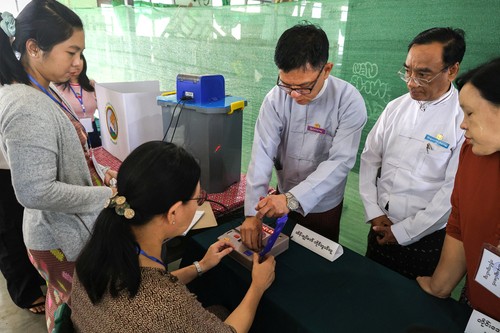
YANGON, Myanmar Voters went to the polls on Sunday for the first phase of Myanmar’s general election, the country’s first in five years. The vote is being conducted under the supervision of the military government while much of the nation remains embroiled in a civil war.
Final results will only be known after two additional rounds of voting scheduled later in January. It is widely anticipated that Senior Gen. Min Aung Hlaing, who has ruled Myanmar since the army takeover in 2021, will assume the presidency.
While the military government has framed the election as a step toward democracy, its legitimacy is heavily questioned. The absence of formerly popular opposition parties and reports of voter intimidation by soldiers cast doubt on the fairness of the process.
Candidates and Voting Process
More than 4,800 candidates from 57 parties are contesting seats in national and regional legislatures. However, only six parties are believed to have the potential to gain significant influence in parliament. The military-backed Union Solidarity and Development Party (USDP) is the strongest contender nationwide.
The election is being conducted in three phases, with Sunday’s voting covering 102 of Myanmar’s 330 townships. Subsequent rounds are scheduled for January 11 and January 25, though 65 townships are excluded due to ongoing armed conflicts. Final results are expected by February, though it remains unclear if authorities will release aggregate figures from the first round. Local polling stations did announce counts publicly.
Criticism of the Election
Critics argue that the election is designed to provide a veneer of legitimacy to the military government. The army seized power in February 2021, removing the elected government of Aung San Suu Kyi, and blocked her National League for Democracy (NLD) party from serving a second term despite their landslide victory in the 2020 election.
Many analysts say the results will lack credibility due to the exclusion of major parties and continued government repression. The expected victory of the USDP reinforces the perception that the transition to civilian rule is largely symbolic.
Tom Andrews, the U.N.-appointed human rights expert for Myanmar, criticized the vote on X, stating:
“An election organized by a junta that continues to bomb civilians, jail political leaders, and criminalize all forms of dissent is not an election — it is a theater of the absurd performed at gunpoint.”
Some neighboring countries, including China, India, and Thailand, may interpret the vote as a sign of progress toward stability, while Western nations continue to maintain sanctions against Myanmar’s ruling generals due to anti-democratic actions and ongoing human rights abuses.
Voter Turnout and Pressure
Preliminary counts from a Yangon polling station indicated 524 of 1,431 registered voters cast ballots—just under 37%. Of these, 311 voted for the pro-military USDP, suggesting that calls for a voter boycott by opposition groups may have influenced participation.
Some voters expressed mixed feelings about casting ballots amid the ongoing conflict. Khin Marlar, 51, who fled her village in Mandalay, told The Associated Press:
“I am voting with the feeling that I will go back to my village when it is peaceful.”
Others cited coercion from local authorities. A resident of Mon state, identified only as Khin, said:
“I have to go and vote even though I don’t want to, because soldiers showed up with guns to our village to pressure us yesterday.”
Opposition and Political Repression
Aung San Suu Kyi, Myanmar’s 80-year-old former leader, and her NLD party are not participating. Suu Kyi is serving a 27-year prison term on charges widely viewed as politically motivated, and the NLD was dissolved in 2023 after refusing to register under new military rules.
Several other parties also declined to run, citing unfair conditions, and opposition groups called for a voter boycott. According to Amael Vier, an analyst for the Asian Network for Free Elections, 73% of voters in 2020 had supported parties that no longer exist, further highlighting the lack of genuine political choice.
Humanitarian Impact and Civil War
Since the 2021 military takeover, Myanmar has seen widespread unrest and violence. Armed resistance erupted after the army violently suppressed nonviolent protests, leading to a civil war that has displaced more than 3.6 million people, according to the U.N. Over 7,600 civilians have been killed, and more than 22,000 people are currently detained for political offenses.
The new Election Protection Law imposes harsh penalties for public criticism of the polls, further restricting political expression. Despite calls from armed resistance groups to disrupt the election, there were no major reports of interference at polling stations.
Min Aung Hlaing’s Position
Both the military and its opponents expect power to remain with Min Aung Hlaing. Speaking to journalists after voting, he said:
“I am the commander in chief. I am a civil servant. I cannot say that I want to serve as a president. I am not the leader of a political party. There is a process for electing a president from parliament only when it is convened. I think it is appropriate to speak about it only then.”
Conclusion
Myanmar’s first general election in five years, conducted under military supervision, has raised serious questions about legitimacy, voter freedom, and the future of democracy in the country. While the military government presents the election as a step toward civilian rule, critics argue that it merely reinforces military control.
The conflict, widespread displacement, political imprisonment, and reports of voter coercion illustrate the complex and precarious situation in Myanmar. Observers both locally and internationally will be watching closely as the remaining phases of voting take place, and the nation faces a critical test in balancing governance, stability, and democratic principles.