

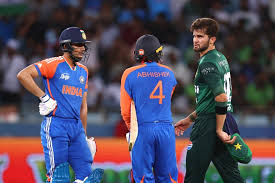
At last, the wait is over. After weeks of uncertainty that briefly threatened the fixture itself, India vs Pakistan is set to take centre stage. The recent turmoil served as a reminder of how much of the cricketing ecosystem depends on this contest. In many ways, the result feels secondary — what matters most is that the match takes place.
A rivalry that still defines the sport
Indian captain Suryakumar Yadav recently suggested the rivalry is no longer what it once was, pointing to India’s broader competitive benchmarks. On pure cricketing terms, India may now measure themselves against other global heavyweights. Yet when it comes to crowd pull, television audiences and emotional investment, no fixture compares to this one.
For Pakistan, the significance has never diminished. Despite winning just three encounters in the past decade, two of those victories — “180 runs” and “152-0” — have become shorthand for iconic triumphs. The defeats may outnumber the wins, but belief persists.
Bigger than the tournament
From a tournament perspective, this clash carries limited jeopardy. Both teams are 2-0 against lower-ranked opposition, and a loss is unlikely to derail qualification hopes. This is a match that exists beyond standings — fuelled by history, pride and expectation.
On the field, India hold a clear edge. They swept Pakistan 3-0 in the recent Asia Cup, winning with bat, ball and tactical nous. Their top order remains explosive, the middle order powerful, the spin attack varied and world-class, and the pace department anchored by Jasprit Bumrah.

Pakistan, however, are not without hope. They have come agonisingly close to defeating India at recent T20 World Cups, letting opportunities slip in Melbourne (2022) and New York (2024). The challenge now is turning promise into conviction when key moments arise.
In the spotlight
Few Indian players relish this contest more than Hardik Pandya. His bowling numbers against Pakistan surpass his overall T20I record, and he has consistently dismissed key batters in recent meetings. While his batting returns have been mixed, his all-round impact makes him a pivotal figure.
For Pakistan, Sahibzada Farhan has enjoyed notable success against India, including two half-centuries at the Asia Cup. Remarkably, he has handled Bumrah better than most, striking him at a high rate without losing his wicket. If Pakistan are to break through, they may again need a flying start from the top.
Team news
India are expected to welcome back Abhishek Sharma, likely replacing Sanju Samson, and could consider an extra spin option — either Washington Sundar or Kuldeep Yadav — depending on conditions.
Pakistan are unlikely to make sweeping changes after a convincing win over USA, though Fakhar Zaman remains a possible inclusion.
Conditions and context
The match will be played on the same surface used for Australia vs Zimbabwe, with some grass visible and rain still a possibility. Weather interruptions remain a concern, though anticipation continues to build.
The occasion
India-Pakistan matches are often discussed for reasons beyond cricket. But for a few hours, the focus shifts squarely to the field. As Suryakumar acknowledged, players know this is no ordinary fixture — regardless of what clichés suggest.
For Pakistan captain Salman Agha, familiarity with Colombo offers no guarantees. Execution will decide the outcome.
And that is what makes this clash compelling: not just the history, not just the hype — but the chance, once again, for cricket to take centre stage.
Read More: India vs Pakistan clash a major boost for Sri Lanka’s T20 World Cup hopes
Conclusion
When India and Pakistan meet, context and consequences often stretch far beyond the scoreboard. Yet at its heart, this is still a cricket match — one shaped by skill, nerve and moments that define careers. With pride, history and expectation woven into every delivery, the stage is set for another chapter in a rivalry that continues to captivate the sport. For a few hours, the noise fades and the game itself takes over — exactly as it should.